
 Search Articles


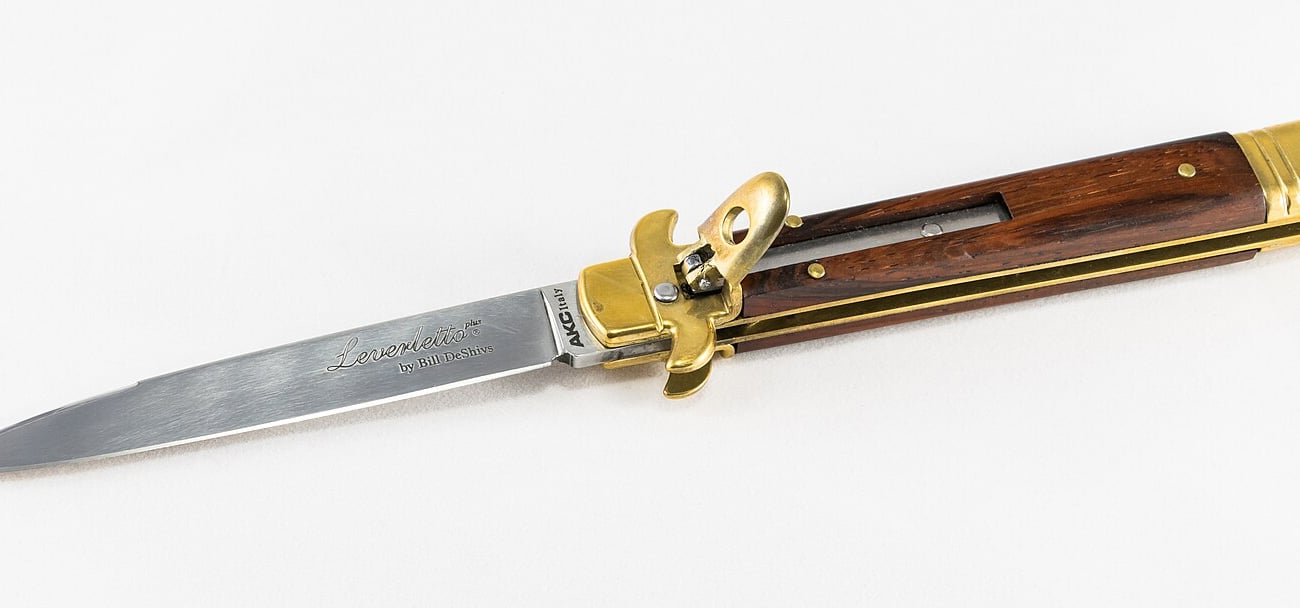
MINNEAPOLIS (CN) — Minnesota’s long-standing ban on switchblades faced a grueling test in federal court Friday, as a prominent knife advocacy group argued the ban slices right through Second Amendment protections.
Knife Rights, a group currently engaged in nationwide legal campaigns against similar restrictions, contends switchblades — typically understood as an automatically opening knife — qualify as “arms” and are therefore constitutionally protected.
The state, however, leaned on a narrow definition, arguing for a weapon to be considered a protected “arm,” it must be in “common use for self-defense.” Under this logic, Minnesota claims switchblades are uniquely situated for offensive maneuvers rather than defense, placing them outside the scope of the Second Amendment.
The state further contends switchblades to be an uncommon, poor choice of defensive weapons because of potential mechanical failure and user error, questioning why members of the public would seek to possess them for those purposes.
Chief U.S. District Judge Patrick Schiltz found Minnesota’s distinction largely nonsensical, pushing back on the notion that something can only be considered an arm if it is commonly used in a one-sided defensive confrontation.
“I’m posing a weapon that is great in offense and wouldn’t work in defense well at all… is that an arm or not an arm for Second Amendment purposes?” the George W. Bush appointee asked. “It’s about militias, you think it meant only that militias could protect against attack but not actually go on the offensive?”
Pushing further, Schiltz referenced the vast number of rifles, specifically AK-47s, in circulation, identifying only a tiny percentage of them have ever been fired in confrontation — even less in strictly defensive circumstances.
“Being able to stick an AK-47 out of your kitchen window, wouldn’t that make it great for self-defense?” Schiltz asked, noting how an “offensive” weapon can easily be used in defense. “I’ve seen assault rifles, they look to me like they’d be pretty useful if you wanted to defend your house against invaders.”
Arguing for summary judgment, Minnesota Assistant Attorney General Michael Goodwin fell back on the “unusually dangerous” argument, claiming a switchblades’ automatic function elevates risk, but Schiltz didn’t budge.
“All weapons are dangerous, a weapon is not useful if it’s not dangerous,” he said. “A switchblade might be unusually dangerous compared to a fixed blade, but it’s not unusually dangerous compared to a handgun.”
Minnesota enacted its switchblade ban in 1959 alongside restrictions in nearly every state in the country as panic spread surrounding the weapon’s use among juvenile delinquents.
The state argues its ban is consistent with the nation’s historical tradition of firearm regulation — claiming legislatures have long regulated specific types of weapons uniquely situated for criminality or fighting.
“It’s uniquely associated with criminals,” Goodwin said, likening switchblades to machine guns. “I don’t think anyone would describe a switchblade as a quintessential self-defense weapon.”
Schiltz all but laughed off that argument.
“I’ve been a judge for 20 years, I’ve had a million handgun cases, handguns are what criminals use,” he said. “There’s nothing that’s more associated with criminals than handguns, but we all agree that handguns are used for self-defense.”
The judge admitted there was likely a time when switchblade regulation made sense, but told the state it cannot ignore the vast majority of states who have dropped, or been forced to drop, switchblade regulation over the years.
“If these items, which are well known, were particularly unusually dangerous, it would be surprising to see only three states continue to ban them,” he said.
As of this year, New Mexico, Washington and Washington D.C. join Minnesota in strictly prohibiting switchblades, and a handful of other states include certain carry restrictions.
In 2024, the same year Knife Rights filed the Minnesota suit, the Massachusetts Supreme Court ruled the state’s 70-year ban on carrying switchblades to be unconstitutional — joining Vermont and Delaware as the most recent states to overturn switchblade bans — finding them not to be uniquely dangerous compared to other arms.
Likewise, Knife Rights claims no evidence shows switchblades are used in crime at higher rates than any other knife.
In contrast to debates with the state, Schiltz’s debate with Knife Rights, which is also asking for summary judgment, was kept short, consisting largely of clarifying questions and brief legal arguments.
The ongoing dispute mostly concerns the Supreme Court’s landmark decision in New York State Rifle & Pistol Association Inc. v. Bruen, which requires arms regulations to align with the text of the Second Amendment and historical traditions.
Knife Rights claims Bruenmade clear the Second Amendment protects the right to “acquire, possess and carry arms for self-defense and all other lawful purposes," including knives.
“Automatically opening knives are unquestionably less dangerous than handguns, as handguns and all other kinds of firearms exact lethal force at a distance,” Knife Rights said in its initial complaint. “However, handguns are not considered “dangerous” enough to justify any kind of prohibition under this formulation.”
Minnesota’s switchblade ban followed congressional enactment of the Federal Switchblade Act — also being challenged by Knife Rights — which restricted the interstate sale of switchblade knives.
Subscribe to our free newsletters
Our weekly newsletter Closing Arguments offers the latest about ongoing trials, major litigation and rulings in courthouses around the U.S. and the world, while the monthly Under the Lights dishes the legal dirt from Hollywood, sports, Big Tech and the arts.
Additional Reads



 Arizona sues to block ICE facility near chemical warehouse April 24, 2026