
 Search Articles


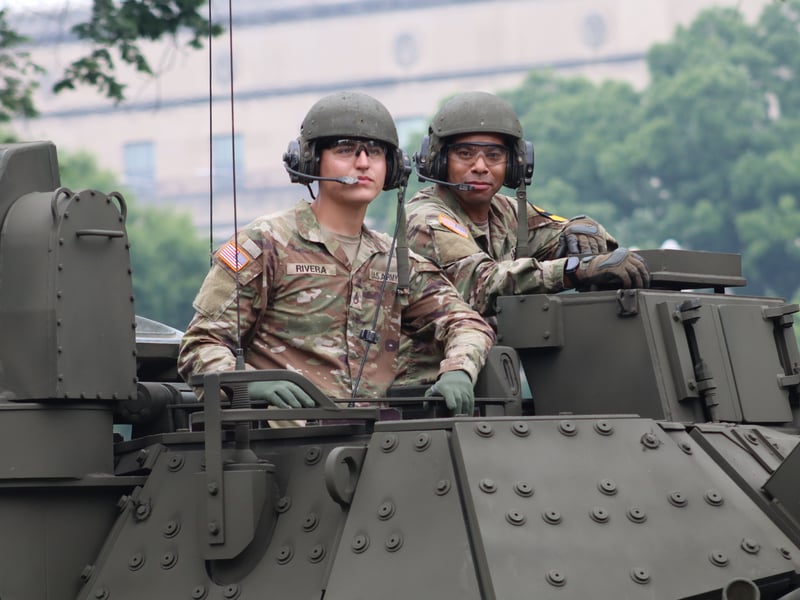
RICHMOND, Va. (CN) — The military asked a Fourth Circuit panel Tuesday to reinstate its policy barring prospective service members who are HIV-positive, asymptomatic and undetectable from enlisting.
The military, arguing in front of three Republican-appointed judges, claimed the financial and logistical burdens posed by HIV-positive service members provide a rational basis for their exclusion from the armed forces.
The plaintiffs include a trans woman who was honorably discharged from the Army for being HIV-positive, a gay man who was in the Georgia National Guard but cannot join the Army, and a cisgender woman who cannot enlist in the Army because she has HIV, along with the advocacy organization Minority Veterans of America.
The cohort successfully argued to a lower court that the policy violates the equal protection clause of the Fifth Amendment and the Administrative Procedure Act.
“Misconceptions and irrational fear,” attorney Scott Schoettes of Lambda Legal Defense & Education Fund, representing the plaintiffs, told the panel. “They’ve surrounded HIV and the people living with it since the very beginning of the epidemic.”
The military claims it disqualifies candidates who have high blood pressure, diabetes, asthma, limited motion in a joint, vision and hearing defects, peanut allergies or communicable diseases like hepatitis. The military claims that the lower court’s logic would require the qualification of numerous treatable chronic illnesses.
“The medical needs of individuals with HIV limit their deployability and the tasks they can perform in military service, and they impose additional costs on the military above those incurred by healthy individuals,” the military wrote in its brief. “Thus, at a minimum, there is a rational basis for the military to treat such individuals differently.”
It further claims it has a rational basis for disqualifying HIV-positive candidates because in high-stress environments, medical treatment is unreliable.
“The higher-cost justification is not a legitimate interest because it runs contrary to broader federal policy applicable to all agencies, including DoD,” the appellees wrote in their brief. “It is also arbitrary, as appellants apply it only to HIV, not any other condition, and it nonsensically fails to account for the fact that appellants provide HIV-related care to the dependents of service members, without inquiry into their HIV status or any impact on the recruit’s eligibility.”
The military also argues that, as an infectious disease, HIV poses a threat to other service members. According to the Centers for Disease Control and Prevention, those who regularly take antiretroviral medications can reduce their viral load to the point that it is undetectable in blood tests and unable to spread through sexual transmission.
“Denying accession to civilians living with HIV is contrary to ending HIV-related stigma and discrimination,” a group of nonprofits, including the Center for HIV Law and Policy and the American Civil Liberties Union, wrote in their brief supporting the appellees.
The Fourth Circuit held in a pair of cases filed in 2018 that the military’s policies prohibiting the commissioning and retention of asymptomatic HIV-positive service members with undetectable viral loads were irrational, arbitrary and capricious. The cases created an extensive factual record regarding the history and science of HIV and required the military to assess retaining HIV-positive service members on a case-by-case basis.
“Why is the military still acting like it’s 1981?” Schoettes asked.
U.S. Circuit Court Judge Julius Richardson, a Donald Trump appointee, asked how the military could avoid the circuit’s prior rulings. The military argued that retention is different from accession.
“It’s different from the judgment that the military makes with respect to retention for individuals who develop conditions after they’ve joined the military and after the military has invested significant time in training those individuals, putting them into specialized roles in some instances, and providing those individuals with extensive resources,” Hinshelwood said. “The military is already providing those individuals with medical care and has full visibility into their condition and ability to continue to serve.”
The human immunodeficiency virus, which causes acquired immunodeficiency syndrome, or AIDS, became treatable in the U.S. in 1996 when antiretroviral therapy became widely available. Today, the majority of HIV-positive individuals are on a one-tablet regimen that has minimal side effects. The United Kingdom, France and Australia allow those with undetectable loads to join their military ranks. Those with undetectable loads are prohibited from donating blood, a significant problem according to the military.
“If you have circumstances where someone is being deployed to a front-line position, that’s going to be difficult to resupply, that’s going to be in a small unit, potentially, where their inability to donate blood to other fellow soldiers would be important,” Hinshelwood said.
Richardson asked Schoettes if his argument applied to all chronic conditions, such as diabetes or asthma.
“The logic here seems to tie the government’s hand in a variety of ways for admission to the military,” Richardson said. “What I don’t understand is this effort to sort of pick out this one disease and suggest that it is somehow different than high blood pressure.”
Schoettes clarified that his clients are’’t seeking to remove criteria from the military’s decision-making process; instead, he argued that those with undetectable loads do meet the eligibility requirements. Schoettes said that someone who enters the military with high blood pressure is likely to have adverse health effects down the line, while someone who takes their daily HIV medication will remain in the same condition.
The military argued for the exclusion at a time when the government had repeatedly failed to reach recruitment goals over the last 30 years.
“These people are healthy, and obviously they have to meet the military’s other criteria, as far as strength and fitness and the other kind of things. So why would you exclude them?” Senior counsel for Lambda Legal, Gregory Nevins, said in an interview. “Especially, why would you exclude them now, when you’re having these challenges?”
U.S. Circuit Court Judge Paul Niemeyer, a George H. W. Bush appointee, and U.S. Circuit Court Judge Allison Rushing, a Trump appointee, completed the panel. The military did not respond to a request for comment.
Subscribe to our free newsletters
Our weekly newsletter Closing Arguments offers the latest about ongoing trials, major litigation and rulings in courthouses around the U.S. and the world, while the monthly Under the Lights dishes the legal dirt from Hollywood, sports, Big Tech and the arts.