
 Search Articles


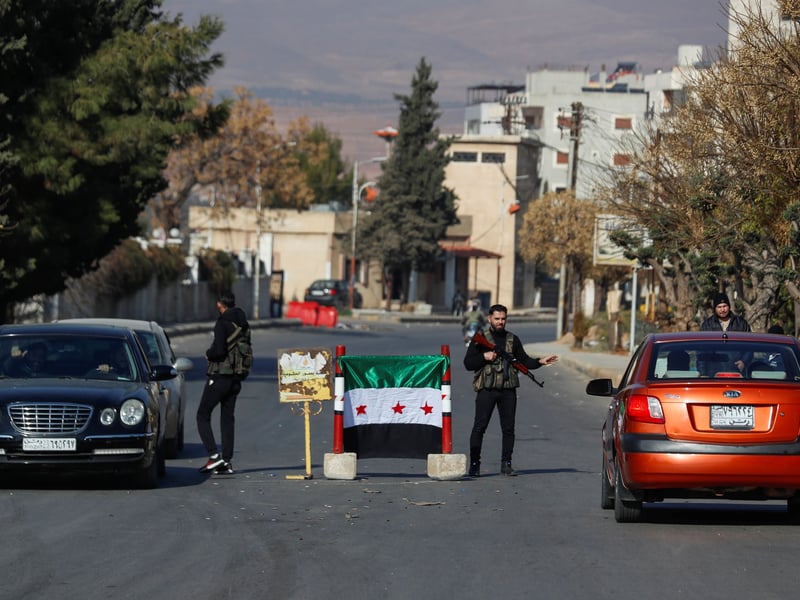
(CN) — The Middle East was rocked by the fall of Damascus to Islamist militant forces backed by Turkey, a NATO ally, over the weekend, with U.S. President Joe Biden leading the West in hailing the flight of Syrian President Bashar Assad as a victory against Russia and Iran.
The ramifications of the dramatic collapse of Assad’s brutal regime were extensive, as competing powers struggled to exert control over Syria, a country with about half of its 23 million people internally displaced or living as refugees in Turkey, Europe, the United States and elsewhere since the outbreak of a bloody civil war in 2011 during the Arab Spring. Many of those who fled Syria are expected to return, but the future of the country remains far from clear. Reports said returning Syrians lined up at checkpoints in Lebanon and Turkey.
By Monday, Syrians were seen looting and burning the presidential palaces of the Assad family, freeing prisoners from dungeon-like Syrian jails, looting the central bank and celebrating in the streets of Damascus and elsewhere, including in Western capitals such as London.
But the threat of more chaos and war hung over not only the country but the entire Middle East. Israel sent its troops deeper into parts of Syria it has occupied since 1967 and it said it bombed suspected stockpiles of chemical weapons in Syria; American warplanes shelled numerous Islamic State targets in central parts of the country; Kurdish fighters expanded their operations in parts they hold but were also targeted by Turkish-backed Syrian rebels; and militant groups aligned with Iran sought to establish themselves inside the country. There were also reports of violence against Assad loyalists.
“As much as you can be happy with the Syrians who are rejoicing that Assad has gone, of course the question of what will happen now is not clear at all,” said Raffaella A. Del Sarto, a Middle East expert at the European University Institute in Florence, Italy, speaking by telephone. “One of the major risks is that — as already immediately happened after the 2011 uprisings in Syria — very soon all kinds of regional and international actors start or continue intervening and funding their different militias.”
Over less than a fortnight, a lightning-fast offensive by Islamist fighters from the rebel Syrian stronghold of Idlib, and supported by Turkey, was met with little resistance from Assad’s army and Russian warplanes, allowing them to rapidly take possession of a series of cities on their way to the capital.
Assad’s authoritarian regime dissolved under crippling U.S. sanctions, deep corruption and exhaustion inside the country and the poorly paid military. The Assad family ruled Syria, a long-suffering multifaith country in the heart of the Middle East, with an iron fist for the past five decades.
In a news conference on Sunday, President Joe Biden welcomed the end of Assad’s regime and took partial credit for its demise. But he warned of challenges ahead. The European Union’s top diplomat also hailed the change.
“At long last, the Assad regime has fallen,” Biden said in televised remarks from the Roosevelt Room in the White House. “This regime brutalized and tortured and killed literally hundreds of thousands of innocent Syrians. The fall of the regime is a fundamental act of justice. It’s a moment of historic opportunity for the long-suffering people of Syria to build a better future for their proud county. It’s also a moment of risk and uncertainty.”
Kaja Kallas, the former Estonian prime minister and new EU top diplomat, called the end of Assad “a positive and long-awaited development” that highlighted “the weakness of Assad’s backers, Russia and Iran.”
The Kremlin confirmed Monday that it gave asylum to Assad and his family. For its part, Russia called a U.N. Security Council meeting on Monday in New York City and its media reported that Syrian rebels promised to allow Moscow to retain its military and air bases in Syria.
The sudden shift in power was seen as chiefly benefitting Turkey, which had long viewed Assad as an enemy. Turkey was expected to seek to extend its influence into Syria and use the new situation to bolster its attacks on rebel Kurds there and in Iraq. Kurdish groups, known as the Syrian Democratic Forces, hold onto territories, including lucrative oil fields, in Syria’s north and they are backed by the U.S., which maintains about 900 soldiers in Syria.
The developments mostly helped Ankara in its efforts to stem the power of Iran and its proxies in the Middle East. Turkey, the Middle East’s strongest Sunni nation, is a rival of Iran, the leader of the Shia world, and its proxies in Lebanon, the Palestinian territories and Yemen.
Assad’s removal was seen as dealing a major blow to the so-called “Axis of Resistance,” an alliance of Shia forces led by Iran. Under Assad, Syria played a central role by helping funnel weapons to Hezbollah fighters in Lebanon in its conflict with Israel.
For those opposed to Assad and his allies, the fast-evolving events in Syria were seen as a much-needed win in the larger geopolitical battle taking place around the world in the face of Russian advances in Ukraine, Moscow’s growing influence in Africa and the condemnation of Israel for its gruesome campaign against Palestinians in Gaza and the West Bank and attacks in Lebanon. Western experts and diplomats depicted the Syria collapse as a major humiliation for Russia that would complicate its ability to maintain its operations in the Middle East, the wider Mediterranean region and Africa.
But there are huge doubts about the intentions of the Islamist fighters who seized Syria and what will happen to the country. The militants are led by a former Al Qaeda militant, Abu Mohammed al-Golani, who has tried to portray himself as a reformed moderate in recent years and who went on a charm offensive in recent days that saw him interviewed on CNN and by other Western outlets. He leads Hayat Tahrir al-Sham, or HTS, a jihadist group still designated as a terrorist organization by the United States, the EU and other countries. There was a possibility the HTS may be taken off the terrorist list in a bid to help it stabilize Syria.
On Monday, the HTS began forming a transitional government by appointing Mohammed al-Bashir as Syria’s interim prime minister. Al-Bashir was serving as the prime minister of the rebel government in Idlib province.
Turkish President Recep Tayyip Erdoğan was seen as the chief beneficiary after he helped arm and train the opposition forces. Turkey shares a 560-mile border with Syria.
“Turkey has now emerged as the most influential foreign actor in the country,” said Wolfango Piccoli, an analyst with Teneo, a New York-based political risk firm, in a briefing note.
“While Ankara’s precise role in the surprising turn of events remains a topic of speculation, the rebel offensive could not have gone ahead without Turkey’s consent and support,” Piccoli noted.
But Erdoğan’s move came with risks because it was seen in Moscow as a betrayal of earlier talks on Syria and because Syria may implode into a deeper war, leaving Turkey exposed to new problems.
Piccoli said Turkey would want to ensure a “dangerous vacuum of power” does not emerge in Syria.
“Turkey stands to benefit only if the Assad regime is replaced by a functioning government able to face the daunting task of delivering stability to a diverse country with competing factions that will need billions of dollars in aid and investments to rebuild,” Piccoli said.
“If Assad’s downfall leads to more violence, Turkey could face a new wave of refugees heading towards its border if chaos ensues.”
Erdoğan will likely use the fall of Assad to drive Syrian refugees out of Turkey, which has housed more than 3 million Syrians in the wake of the civil war. In Turkey, the presence of these refugees has become politically toxic for Erdoğan.
Syria was one of the key hubs of the Ottoman Empire before it fell under French administration following World War I and gained its independence in 1946. With its central position on the Mediterranean Sea, it became one of the most diverse regions in the Middle East with an array of different peoples and religions. The vast majority of Syrians are Sunni, or about 74%, but there are numerous other religious groups. Assad was part of the minority Alawite creed, which make up about 15% of the population. Other minorities include Ismaili, Shia, Christians, Druze, Kurds, Levantines, Imamis, Nusairis, Assyrians, Turkomans and Armenians.
“Historically, culturally, politically, Syria is a very important state in the Middle East,” Del Sarto said.
Over the past 50 years, the Assad regime was very tough and brutal against its opponents, but she said minority groups supported the regime.
“The Christians and the Druze and other ethnic or religious minorities felt sort of protected by the Alawites because they were all minorities,” she said. “Minorities thought it was better to have Assad than a fundamentalist regime.”
Bashar Assad took the reins of power in 2000 following the death of his father, Hafez Assad. But Bashar Assad became a reviled leader known as “the Butcher of Damascus” for killing and imprisoning thousands of political opponents and minority populations.
The eruption of civil war in 2011 led to the deaths of more than 500,000 and displaced half the country’s population.
Courthouse News reporter Cain Burdeau is based in the European Union.
 Follow @cainburdeau
Subscribe to our free newsletters
Our weekly newsletter Closing Arguments offers the latest about ongoing trials, major litigation and rulings in courthouses around the U.S. and the world, while the monthly Under the Lights dishes the legal dirt from Hollywood, sports, Big Tech and the arts.