
 Search Articles


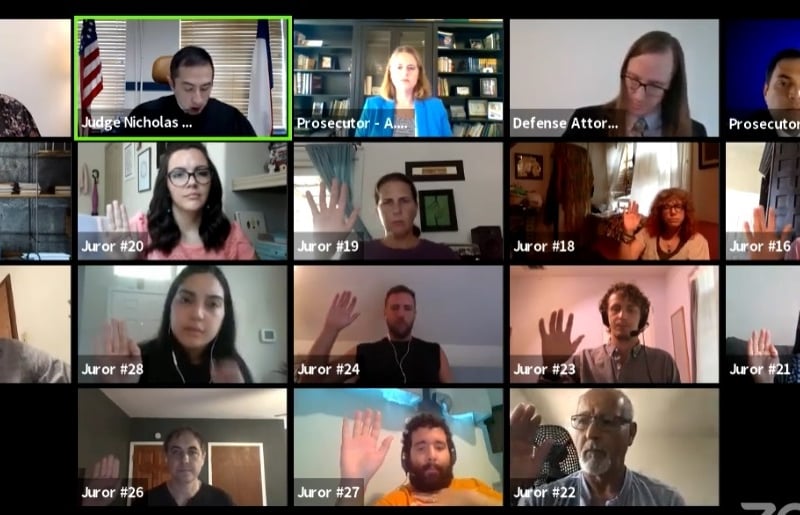
(CN) — A Sixth Circuit on Wednesday ruled 2-1 that a Michigan attorney lacks standing to bring a First Amendment claim regarding the recording of livestreamed court proceedings.
Nicholas Somberg claimed in a July 2020 lawsuit filed against Jessica R. Cooper, the Prosecuting Attorney of Oakland County, Michigan that he had a First Amendment right to record and photograph publicly livestreamed court proceedings regarding matters of public concern after being held in contempt for doing so.
The appeals court disagreed and found that Somberg couldn’t show causation and redressability.
“Somberg wants an injunction barring the prosecutor from seeking a contempt sanction if he records another proceeding,” U.S. Circuit Judge Amul Thapar, a Donald Trump appointee, wrote for the majority. “But regardless of what the prosecutor might do, courts have the authority to hold Somberg in contempt sua sponte by issuing a show cause order.”
Thapar added that the prosecutor is a party to the court, which is a material distinction.
“Contempt is ‘peculiar within our system,’” Thapar wrote. “It has both statutory as well as judge-made components and draws heavily from an ancient practice rooted in English common law. In the early Republic, courts had power to punish contempt summarily. While courts’ power to punish contempt has retreated from days past, contempt remains ‘sui generis’ in that it is primarily the purview of courts, not parties.”
Somberg wants to continue to record online judicial proceedings and he fears the prosecuting attorney will once again find him in contempt after Somberg used his cellphone to take a picture of a court proceeding on Zoom and posted the picture to Facebook.
He did so without the judge’s permission, prompting the contempt motion — though the motion was eventually dismissed without addressing the merits of the claim — being filed against him by the Oakland County Prosecutor.
He claimed in his lawsuit that once a judge allows a livestream of a court’s hearings, they cannot prohibit audio and visual recordings of those proceedings.
U.S. District Judge Gershwin A. Drain, a Barack Obama appointee, dismissed the lawsuit in September 2023, ruling Somberg lacked standing. The decision prompted the appeal to the Sixth Circuit.
U.S. Circuit Judge Alice Batchelder, a George H.W. Bush appointee, concurred with Thapar, but U.S. Circuit Judge Andre Mathis, a Joe Biden appointee, dissented, ruling that Somberg had standing.
“Multiple factors weigh in Somberg’s favor,” Mathis wrote. “First, McDonald’s office attempted to have Somberg held in contempt … even initiating a formal enforcement process ‘itself is chilling.’”
Mathis then noted that McDonald has not disavowed attempting to enforce a violation of the Electronics Rule against Somberg.
He added, “a violation of the Electronics Rule is easier to enforce because anyone can initiate contempt proceedings ‘for a contempt committed outside the immediate view and presence of the court, on a proper showing on ex parte motion supported by affidavits.’”
But even though Mathis believes Somberg has standing, the judge found that he would affirm the federal court’s ruling because Somberg’s case fails on the merits.
“The Electronics Rule need only be reasonable considering the purposes of the courtroom,” Mathis wrote. “The rule protects the legitimate government interest of ensuring criminal defendants receive fair trials by lessening courtroom distractions, preventing juror and witness intimidation, and guarding against online influence. Banning recordings via portable electronic devices is, at a minimum, a reasonable method for protecting this interest.”
Somberg’s attorney Philip Ellison, from Outside Legal Counsel PLC, said the case isn’t over.
“I’m disappointed in the panel’s split decision,” Ellison said in an emailed statement. “We will be asking the full circuit to re-review this confusing outcome.”
Brooke Tucker, an attorney who represented McDonald during oral argument, did not immediately respond to a request for comment.
 Follow @joeharris_stl
Subscribe to our free newsletters
Our weekly newsletter Closing Arguments offers the latest about ongoing trials, major litigation and rulings in courthouses around the U.S. and the world, while the monthly Under the Lights dishes the legal dirt from Hollywood, sports, Big Tech and the arts.