
 Search Articles


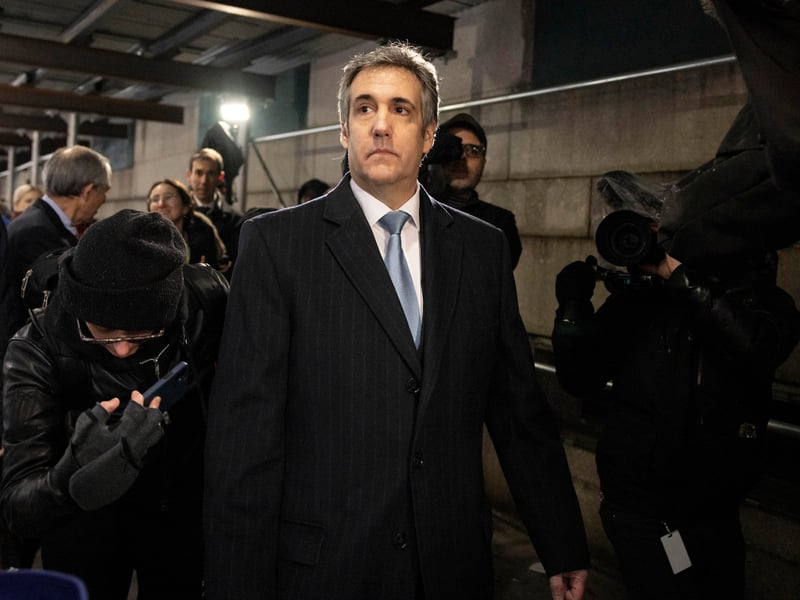
MANHATTAN (CN) — Michael Cohen asked the Second Circuit Thursday to bring back his claim that Donald Trump used his presidential powers to jail his ex-attorney to stop him from promoting his tell-all book.
Cohen, often referred to as Trump’s former “fixer,” was transferred to home confinement after serving one-third of his three-year sentence. He pleaded guilty to campaign finance violations, tax evasion and lying to Congress.
While in prison, the Trump ally-turned-critic began writing a book detailing his experiences with Trump over the past decade, including episodes in which Trump made antisemitic and racist comments.
As he was getting processed for home confinement, he was hit with a gag order that prevented him from speaking to the media or posting on social media. “The purpose is to avoid glamorizing or bringing publicity to your status as a sentenced inmate serving a custodial term in the community,” the order said, according to Cohen’s brief.
Jon-Michael Dougherty, an attorney for Cohen, pointed to U.S. Supreme Court case Bivens v. Six Unknown Named Agents of the Federal Bureau of Narcotics, which awarded damages after agents of the federal bureau forced their way into Bivens’ home without a warrant and arrested him on narcotics charges.
But the Supreme Court has hardly applied Bivens to subsequent cases except for in “the most unusual circumstances.”
“We are that most unusual circumstance, that reservoir, that thin sliver of Bivens the Court has left open,” Dougherty said Thursday. “What could be more unusual than an allegation that the federal executive used the prisons to silence a critic and what could be more unusual than a federal judge agreeing that that’s what happened?”
After Cohen filed his complaint, U.S. District Judge Lewis J. Liman, a Donald Trump appointee, dismissed the complaint but said the ruling is a “profound violence” against Cohen’s constitutional rights.
“Cohen’s complaint alleges an egregious violation of constitutional rights by the executive branch — nothing short of the use of executive power to lock up the President’s political enemies for speaking critically of him,” Liman said in his opinion.
Dougherty added that a Bivens remedy for damages is necessary to deter similar behavior in the future.
“A Bivens remedy for damages provides the necessary level of deterrence to ensure that presidents cannot use the prisons as a threat against their critics,” Dougherty said.
Alyssa O’Gallagher, an attorney representing former U.S. Attorney General William Barr and the other named federal defendants, said Cohen could have raised his grievances with the Federal Bureau of Prisons.
“You’re not seriously suggesting that, in the context of the facts and this case, that was a viable remedy. Are you,” U.S. District Judge Barrington D. Parker Jr., a George W. Bush, appointee, responded.
Judge Parker was joined by U.S. District Judge Myrna Perez and U.S. District Judge Sarah A. L. Merriam, both Biden appointees.
After Cohen was sent back to custody in 2020, he filed a petition for a writ of habeas corpus and was issued a preliminary injunction and an order to be released from custody, after a federal court found the government’s actions were “retaliatory” in response to Cohen’s promotion of his tell-all book.
O’Gallagher responded that injunctive relief generally does have a deterrent effect.
“It provides notice to all of those who may be in a similar situation that those actions were found to be unlawful,” O’Gallagher said Thursday.
O’Gallagher added that it’s Congress’ duty, no the court’s, to decide if a remedy is adequate in this instance.
“The implication of a damages remedy is fundamentally a legislative endeavor,” O’Gallagher said. “It requires the weighing of policy considerations, the effects that implying such remedy would have on the individual defendants on the government, on the operation of the government.”
Alina Habba, Trump’s attorney, agreed with O’Gallagher that injunctive relief would deter similar retaliatory behavior in the future.
“Generally speaking, when a judge puts an order in saying that behavior was unwarranted in their opinion, I think that’s a deterrent,” Habba said. “At least to me, I respect the robe enough to be deterred by something like that.”
Habba argued that Cohen’s complaint “does not have facts” and is based on Cohen’s interpretation of what happened when he was about to be released.
“He has absolutely no facts. It’s a Michael Cohen assumption,” Habba said.
 Follow @NikaSchoonover
Subscribe to our free newsletters
Our weekly newsletter Closing Arguments offers the latest about ongoing trials, major litigation and rulings in courthouses around the U.S. and the world, while the monthly Under the Lights dishes the legal dirt from Hollywood, sports, Big Tech and the arts.