
 Search Articles


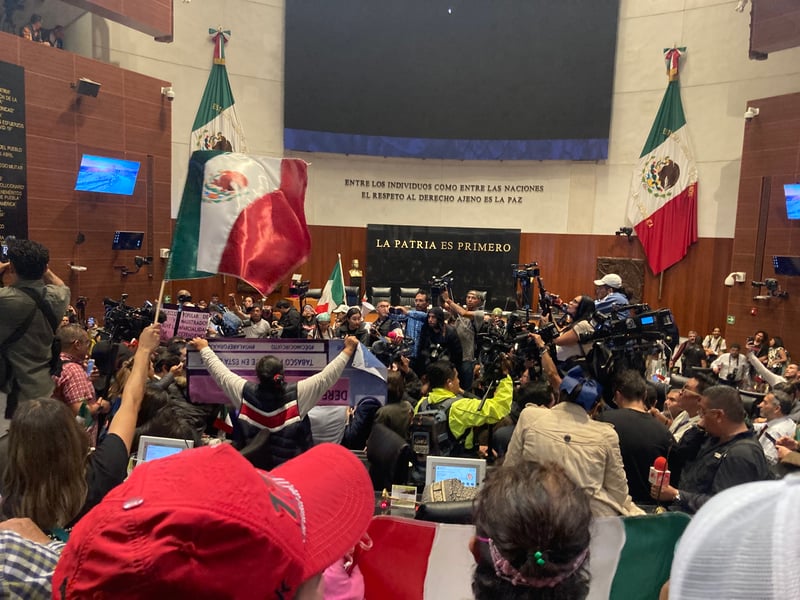
MEXICO CITY (CN) — On June 1, Mexican voters will choose nearly 3,000 judicial positions including nine Supreme Court justices, in the first round of popular elections since Mexico’s controversial judicial reform passed in September.
The reform was former President Andrés Manuel López Obrador’s final chess move against a judicial branch he viewed as corrupt before fellow Morena party member, President Claudia Sheinbaum, took office in October.
López Obrador’s constitutional reform — which passed with an 86-41 Senate vote, sparked massive protest and led to multiple Supreme Court justices resigning — sets the stage for Mexico to be the only country that will elect its entire judicial branch through popular vote in an unprecedented election set to take place in two different rounds — one in 2025 and another in 2027.
“This is a deliberate politicization of the judiciary which grew out of the frustration of the former president, Andrés Manuel López Obrador, because of his repeated confrontations with the judiciary,” said David Shirk, a political science and international relations professor at the University of San Diego.
López Obrador’s clashes with the judiciary branch were a constant during his six year presidential term but picked up steam during his proposed energy reforms and his first attempts at overhauling the judiciary.
In April 2023, the Supreme Court deemed López Obrador’s transfer of the National Guard — the security force he created in 2019 — from civilian to military control unconstitutional.
The next month, the Supreme Court struck down López Obrador’s decree to establish his Maya Train project as an issue of national security to bypass permit and public information requirements. The court also invalidated part of López Obrador’s bid to undermine and defund the National Electoral Institute — a public agency he claimed defended fraudulent elections — in May 2023.
In January 2024, Mexico’s Supreme Court ruled against López Obrador’s prioritization of the state-owned electrical power utility, PEMEX, over private companies. The Senate eventually passed his military reform in September in one of the former president’s final moves along with the judicial reform.
The reform also reduced the number of Supreme Court seats from 11 to nine, and limited Supreme Court justice tenures from 15 to 12 years.
The process of becoming one of the 881 elected judges started in October when the aspirants were reviewed by an evaluation committee comprising all three branches of government and also were chosen through a lottery process. In February, the Senate sent the final list of thousands of candidates to the National Electoral Institute for placement on the ballot.
“This is not a serious election. Nobody is supervising the election,” Ulises Beltrán, a policy studies professor at the Center for Economic Research and Teaching, said. “There is no guarantee whatsoever — as has been the case for every Mexican election before — of the way the voting process is done. The election outcome is whatever they want it to be. The very fundamental key of a democratic government is going to disappear after this.”
Those elected will take office in September and will be reviewed by a newly created Judicial Discipline Tribunal, which will replace the Federal Judicial Council. Five members of the new tribunal are up for election on June 1.
The tribunal is one of the most controversial aspects of the reform, as it will have the power to review judicial decisions and sanction or suspend judges if deemed unsatisfactory.
These decisions cannot be challenged and, according to Mexicanos Contra la Corrupción y la Impunidad, can easily be used as an instrument to pressure judges and magistrates, putting judicial independence and impartiality at risk.
“I think that what we are seeing in many different political systems around the world is there has been democratic backsliding and an effort by elected executives to broaden their powers,” Shirk said.
He added that what is happening in Mexico right now is especially important in the context of Mexico’s young democratic experiment, referring to the country’s 2000 transition to a democracy from de facto Institutional Revolutionary Party rule since 1929.
“What happens with this reform and with this election will really shape what happens over the course of the 21st century in Mexico in very meaningful ways,” Shirk said.
Shirk said the Mexican system doesn’t have sufficient oversight to deal with the thousands of judges up for election and paves the way for corruption. He compares the election process to building a car while driving it.
The civil society group Defensorxs lists several candidates as high-risk, who didn’t pass through reliable filters to appear on the ballot, like attorney Fernando Escamilla Villarreal, up for District Judge in Nuevo León. He has no judicial experience and defended multiple Zetas drug cartel members.
Another high-risk candidate, according to the organization, is Madian Sinai Menchaca Sierra, who is up for Third District Judge of Jalisco. Menchaca Sierra has no judicial experience and is the daughter of Bishop Nicolás Menchaca, defender of Naasón Joaquín García, a former leader of the Luz Del Mundo church imprisoned for sex crimes against minors, human trafficking and possession and distribution of child pornography.
Defensorxs filed formal complaints to the National Electoral Institute about 11 potential judges and magistrates tied to organized crime, with 60 more complaints on the way.
Shirk said this number isn’t even the tip of the iceberg.
“At best we’re going to see a lot of inexperienced incompetent judges rising to the bench. At worst we’ll see malevolent actors who are absolutely under undue influence,” Shirk said.
Paulina Creuheras, a lawyer and subdirector of political risk consultation firm Integralia, said the election’s design was doomed to start. With such a short implementation time and the sheer number of candidates, she said the Senate responsible for the final list of candidates didn’t have enough time to properly evaluate the candidates.
Creuheras said that the lack of election oversight and accessible information will paralyze the public.
“There’s one group that it doesn’t attract attention to. They don’t sympathize and they don’t even want to bother with it in the first place. And then there’s the other group of people who are convinced that this whole exercise is wrong, that it’s a farce, that it’s just an attempt by Morena and its allies to limit or gain more power through limiting the judiciary. And they’re under this idea that it’s better not to vote so as not to get involved in the game,” she said.
Creuheras mentioned the specific complications of the June 1 ballots. She said there are at least six different ballots at the federal level and for each ballot, voters will have to choose a separate number of candidates.
For example, the voter must choose five women and four men from the Supreme Court ballot’s 63 candidates because Sheinbaum promised to guarantee gender parity during her presidential term. The candidates are arranged alphabetically, as judges can’t run under party affiliation.
“So you’re going to put numbers eight, 30, 15 and five. A lot of work. Imagine. And also, tell me how we’re going to be able to investigate them with the little time we have,” Creuheras said.
“Do you think anyone will have the time to review the profiles of 63 candidates, and that’s just for the Supreme Court only,” she said. “I mean, beyond the fact that most people don’t completely know how the judiciary functions, even lawyers don’t fully understand because it’s very difficult to understand.”
Creuheras did mention some positives to the new system, though. There are still several judges, mostly on collegiate and circuit courts, who are already on the ballot because they are currently practicing judges. She said that these are the ones that may demonstrate best for the government.
“It’s a very dim light on the path of the general outlook, which is catastrophic. But we’ll see what happens, I suppose,” she said.
Subscribe to our free newsletters
Our weekly newsletter Closing Arguments offers the latest about ongoing trials, major litigation and rulings in courthouses around the U.S. and the world, while the monthly Under the Lights dishes the legal dirt from Hollywood, sports, Big Tech and the arts.