
 Search Articles


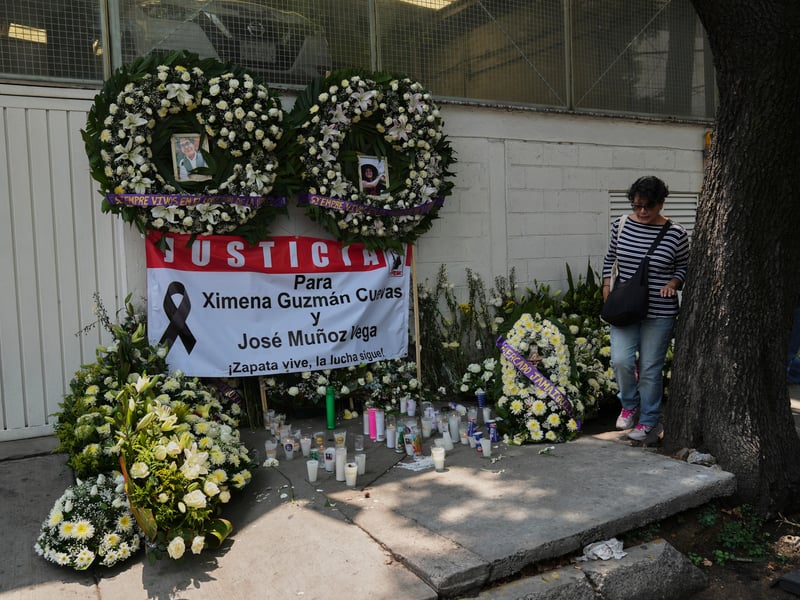
MEXICO CITY (CN) — After an unknown shooter killed two Mexico City mayor aideswhile their car was parked on a busy avenue in southern Mexico City last Tuesday, local and federal authorities, including President Claudia Sheinbaum, immediately pledged to investigate and hold the perpetrators accountable.
Sheinbaum and other authorities intensified raids, and a criminal cell reportedly dedicated to drug dealing was dismantled on Thursday night in the city.
The killings of Ximena Guzmán, personal secretary to Mexico City’s mayor, Clara Brugada, and Brugada’s security advisor, José Muñoz, pose a significant challenge to a party that arrived in power after decades of right-wing ruling under the “war on drugs,” which led to a wave of violence across the country.
Mexico City, once considered a land of turmoil, saw a decrease in crime rates over the last years, becoming attractive for locals and foreigners alike.
But the crimes against Brugada’s aides shed light on a more worrying fact: some homegrown cartels, like Unión Tepito and its split, Fuerza Anti Unión — who has aligned with the Jalisco New Generation Cartel — are becoming a threat to politicians and citizens alike, reviving the ghosts of the ’90s and early 2000s during the country’s early transition to democracy.
Sandra Ley, a political science professor at Tecnológico de Monterrey, said that this 2000s transition to democracy from de facto Institutional Revolutionary Party rule realigned criminal alliances and protection from old-guard political structures.
“Authoritarian leaders need specialists in violence as we call them, or just in general, armed forces to survive. They needed their loyalty. And part of how they make up their loyalty is allowing them to have different sources of income and one of those sources of income can be criminal activities, regulated criminal activity,” said Ley.
Ley, who studies political violence in Mexico, said that when political parties change, organized crime must build new territorial control. It happens region by region, she said, not on a massive scale.
“When transitions to democracy happen, then you have to take into account that transition means changes within the state. Those protection networks from the past are likely to change in the democratic future because new parties are going to come in, organized crime is going to have to negotiate with other actors," she said.
The soaring amount of violence in Mexico since the transition to democracy has only increased, especially during the 2018 and 2024 presidential elections, when the Morena party came to power. Countrywide, the violence reached unprecedented levels but Mexico City largely remained a safe zone.
The recent shooting, however, is a wake-up call for Mexico City politicians and residents.
“We don’t talk enough about organized crime in Mexico City. The structure of organized crime is different from what we see in Sinaloa or Chihuahua. It is happening through more desegregated structures with street gangs that are able to capture entire neighborhoods, but they are not necessarily carrying their big rifles and showing off like in other places because there are higher stakes,” Ley said.
This isn’t the first time a high-profile attack has happened in Mexico City. In June 2020, then-Mexico City Police Chief, Omar García Harfuch — now Mexico’s secretary of security and citizen protection — survived an attack also in broad daylight. Two of his security guards and a passerby were killed.
Harfuch quickly blamed the Jalisco New Generation Cartel then, prompting raids and 12 arrests on the same day of the shooting.
The Mexican government’s reaction to this recent shooting has been decidedly different. The Morena party has not placed blame on any organized criminal group. Meanwhile, the prosecutor’s office has not made any of its theories public, and it’s unclear whether they have a lead.
Ley says that the current government has to be careful about the narrative and how the U.S. perceives these events since it believes the Mexican government has an alliance with organized crime.
“I think there’s a reason behind being careful about that narrative and how it can be used within the bilateral relationship, and the fact that you have an election coming up and you’re trying to say … ‘It’s all good,’” said Ley.
Morena, immersed in talks with the U.S. government on tariffs and the United States-Mexico-Canada Agreement, will face another test of strength on Sunday with the judicial elections, the result of former President Andrés Manuel López Obrador’s top bill passed last September.
The elections are, politically, a way of disputing the power of the judiciary — a “democratization” of the courts. But many oppose the elections, suggesting they’re a way for Morena to monopolize power.
While the candidates are not explicitly linked to political parties, turnout for Sunday’s election is a litmus test of how supportive citizens are of Morena’s reforms — and it could also impact the perception of governability for crucial matters, like security.
The government’s security challenge
Pablo Vázquez, head of Mexico City’s security department, said last week that between October 2024 and May 2025, the agency arrested more than 3,000 people for committing crimes — 355 of whom belonged to criminal groups dismantled following the arrests. The scope of the crackdown increases the doubts about which group, specifically, is behind the crimes.
The growth of crime groups in the city has generated confusion among authorities and citizens, who feel paralyzed in the face of the seemingly exponentially fast changes in their daily lives.
A resident from the Santa María la Ribera neighborhood, who requested his name to be kept anonymous for safety reasons, said the neighborhood has seen an exponential increase in violent crimes in the last few months. He said at least once a week, he hears gunshots or news about the settling of scores near where he lives.
Santa María la Ribera’s northern avenue, Avenida Ricardo Flores Magón, is disputed territory between Unión Tepito and Fuerza Anti Unión, but the Venezuela gang Tren de Aragua has also moved into the territory.
On May 12, two Venezuelans were killed in a Santa María la Ribera bar reportedly linked to gang disputes. Their attackers fled on a motorcycle.
During the early morning hours of May 22, the National Guard, Mexico City Investigative Police and the Marines launched a sweep of the area cracking down on known criminals, but some say it’s not enough.
“You walk around this area and don’t see police or patrols, and that’s worrying,” said a Santa María resident who also requested anonymity for safety reasons. “One would expect that the administration, at a local and federal level, would do more.”
He said that the rhetoric of the government reminds him of President Felipe Calderón’s era, which, in the effort to counteract violence, resulted in more deaths, corruption and crime.
Morena, however, seems to show a more comprehensive policy towards violence.
Celeste Tossolini, a political scientist who also works in communications for Morena representatives in Congress, said that the current situation cannot be understood without looking to the past.
“Mexico has dealt with a violence crisis for decades, especially after Calderón declared the ‘war on drugs,’” she said. “That strategy was a failure, but also left a bloodbath and institutional decay at a federal level.”
Tossolini said that López Obrador’s administration began to repair the social vulnerabilities behind the structure of violence — aiming to fix poverty and inequality — and Sheinbaum’s administration is trying to take a step forward by strengthening security institutions.
“In the last seven months, the Sheinbaum administration arrested over 20,000 people for high-impact crimes,” she said. “It’s not like we’re living under peace, that would be offensive for the victims, but we’re working to stop what seemed to be an unstoppable spiral of violence.”
Subscribe to our free newsletters
Our weekly newsletter Closing Arguments offers the latest about ongoing trials, major litigation and rulings in courthouses around the U.S. and the world, while the monthly Under the Lights dishes the legal dirt from Hollywood, sports, Big Tech and the arts.