
 Search Articles


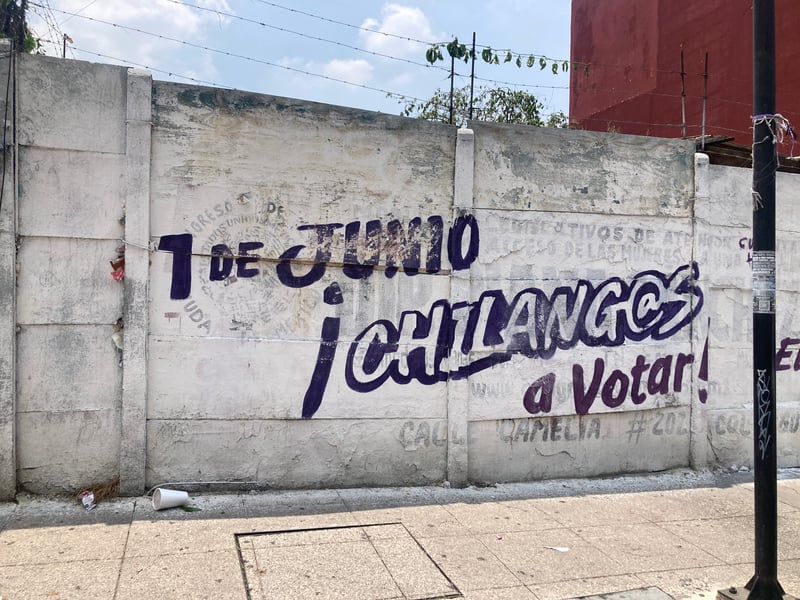
MEXICO CITY (CN) — Nearly all of the Supreme Court justices elected by popular vote in Mexico’s first-ever judicial elections have ties to former President Andrés Manuel López Obrador and the ruling Morena party.
Only 13% of the voting public voted in Sunday’s elections which resulted in the selection of nine Supreme Court justices who will be sworn in on Sept. 1 to begin their twelve-year terms.
Hugo Aguilar Ortíz will be the chief justice, capturing the most votes of any other Supreme Court candidate with a little over 5% of the vote.
Mexican President Claudia Sheinbaum celebrated his victory in her press conference Wednesday.
“I am very pleased that the next president of the Supreme Court of Justice of the Nation will be an indigenous Mixtec from Oaxaca, a very good lawyer, I have the privilege of knowing him,” Sheinbaum said.
“Today they are chosen by the people. Now it is up to them, from September, to set an example to Mexico and the world that there may be a different justice system,” she added.
The election was a result of a judicial reform introduced by López Obrador. It was his final chess move against a judicial branch he viewed as corrupt before Sheinbaum, a fellow Morena party member, took office in October.
López Obrador’s constitutional reform — which passed with an 86-41 Senate vote and sparked massive protest leading to multiple Supreme Court justices resigning — set the stage for Mexico to be the only country to elect its entire judicial branch through popular vote in an unprecedented election Sunday. The next round of elections is scheduled for 2027.
“This is the first time since Mexico’s transition to democracy that the Supreme Court has been totally captured by the majority political party. So, we’re expecting to have a very, very highly dependent court. And what we can expect from this court is that many of the rulings and decisions that it makes in the future are going to line up with the executive or legislative political preferences,” said Azul Aguiar, a political science professor at the Jesuit University of Guadalajara.
Aguiar is most worried about the potential devastation of human rights in Mexico.
She claims that judges will interpret the constitution differently, siding with López Obrador’s vision to no longer require judges to take into account international human rights treaties enshrined in Mexico’s constitution with the 2011 Mexican Constitutional Reform.
Aguiar noted that Mexico engages in several detention practices that fly in the face of international human rights conventions and specifically the Inter-American Court of Human Rights.
“One of these is preventive imprisonment— when you put people in jail without a sentence, without a ruling. And another is something called arraigo. And arraigo means that you can be detained without investigation if you are accused of being involved in organized crime,” said Aguiar.
Aguiar said in the past, judges were free to interpret the constitution based on international human rights treaties and now they may follow López Obrador’s guidance, leading to human rights violations that go against international rulings.
The new Supreme Court
The soon-to-be chief justice, Aguilar Ortíz has been the coordinator of indigenous rights for the National Institute of Indigenous Peoples since 2018. He consulted with López Obrador for the construction of the former president’s mega-projects, like the Tren Maya, the Interoceanic Corridor of the Isthmus of Tehuantepec and San Felipe International Airport. He has been criticized for prioritizing these projects over international human rights.
Lenia Batres Guadarrama, a current Supreme Court justice appointed by López Obrador in 2023, was elected with the second-highest amount of votes. She was the legal advisor to Mexico City’s Secretariat of Urban Development and Housing when Sheinbaum was mayor of Mexico City.
Yasmin Esquivel Mossa, a current Supreme Court justice who assumed office in 2019 under López Obrador, was also voted in by popular vote. The former president’s choice to select her for Supreme Court justice was controversial due to her marriage to José María Riobóo, López Obrador’s infrastructure advisor and head of construction conglomerate Grupo Riobóo which was implicated in controversial infrastructure projects.
Loretta Ortiz Ahlf, another current Supreme Court justice appointed by López Obrador will continue her tenure. According to her candidate profile, she believes “that being a judge is not limited to resolving conflicts, but implies contributing to the national project for a better Mexico.”
María Estela Ríos, a lawyer who was a legal advisor for López Obrador, will also fill a position as Supreme Court justice. Ríos was part of the team that drafted the controversial judicial reform that led to her election. She is currently the general director of Comparative Parliamentary Law and Legal Systematization at the Belisario Domínguez Institute of the Senate of the Republic.
Sara Irene Herrerías Guerra, another future Supreme Court justice, is currently a specialized human rights prosecutor of Mexico’s Attorney General’s Office, focusing on disappearance. She also worked as an equality director at the National Human Rights Commission.
Another future Supreme Court justice is Giovanni Azael Figueroa, from the western state of Nayarit. He holds a doctorate in constitutional law and has no experience as a judge. He is a proponent of the idea of an itinerant court that would bring public sessions to universities, public squares and marginalized communities. He is also a proponent of clarity in legal sentences free from overly technical legal jargon.
With 3% of the votes, Irving Espinosa Betanzo will become a Supreme Court justice. A lawyer with a background in public administration, and a current Mexico City Supreme Court magistrate since 2019, he worked in the Attorney General’s Office of Mexico City as a deputy legal attorney for inter-agency coordination and human rights.
Rounding out the court is Aristídes Rodrigo Guerrero, a doctor of law who was appointed by Morena party congress members as president of the Institute of Transparency, Access to Public Information, Protection of Personal Data and Accountability of Mexico City between December 2018 and December 2021. He has no judicial experience.
He ran on a platform that “the judicial function must be modernized through the use of artificial intelligence, improved training of legal operators and consistency in judicial criteria,” according to his candidate profile, and is also in favor of an itinerant court.
Subscribe to our free newsletters
Our weekly newsletter Closing Arguments offers the latest about ongoing trials, major litigation and rulings in courthouses around the U.S. and the world, while the monthly Under the Lights dishes the legal dirt from Hollywood, sports, Big Tech and the arts.