
 Search Articles


(CN) — Meta, the company that owns Facebook and Instagram, said Tuesday that it will roll out a software update to help teenage users have “safe, age-appropriate experiences” on its social media platforms.
Some content, including that which discusses “struggles with self-harm and eating disorders, or that includes restricted goods or nudity,” will be hidden from teenagers, according to a Meta press release.
But most of the changes will focus on steering users away from certain content, rather than banning outright. For example, some content will simply be hidden from sections in which algorithms suggest content, like searches and “for you”-type pages.
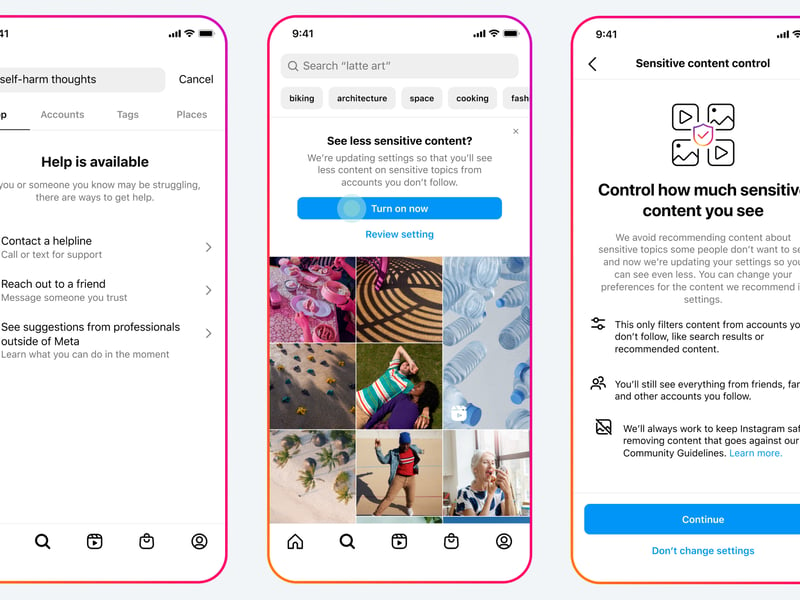
“Now, when people search for terms related to suicide, self-harm and eating disorders, we’ll start hiding these related results and will direct them to expert resources for help,” the press release says.
Searches for certain terms, like “self-harm thoughts” and “bulimic,” will direct users to a page reading, “Help is available,” with links to contact a helpline.
The update will also automatically place teenagers “into the most restrictive content control setting on Instagram and Facebook,” making it “it more difficult for people to come across potentially sensitive content or accounts in places like Search and Explore.” Those settings can be changed.
The update will be rolled out to the general public “over the coming weeks.”
Senator Richard Blumenthal expressed his doubt over Meta’s pledge for safer platforms. “Predictable & hollow,” he wrote in a tweet Tuesday.
James Steyer, founder of Common Sense Media, a nonprofit that advocates for protecting teenagers and children from new technologies, dismissed the Meta’s announcement as “merely a bandaid.”
“These so-called ‘protections’ are nothing but a short-term fix,” Steyer said in a written statement, “to distract from a huge underlying problem that social media apps like Instagram are not a safe place for children and teens.”
He noted that the software updates would still place “the onus on teens to navigate their own privacy.”
“Major new legislation that advocates for changing the design of platform and privacy practices is still needed to hold tech companies accountable,” Steyer added.
Meta, along with other social media giants like Snap and Tik Tok, has been on the receiving end of a rash lawsuits accusing the company marketing addictive products to teenagers and failing to shield them from harmful content. A lawsuit filed by 33 states, including California, argues that Meta “prioritizes engagement and profits to the detriment of young users’ well-being.” Nine other attorneys general brought similar suits of their own.
“Meta knows that what it is doing is bad for kids,” California Attorney General Rob Bonta said in a written statement in November.
Since early 2019, Meta has received more than 1.1 million reports of Instagram users under the age of 13, via an in-app reporting button. But the company disabled only a fraction of those accounts and, according to the lawsuit, “continued to collect children’s data without parental consent.”
In May of 2023, the Federal Trade Commission proposed a new regulation which would prevent Facebook from monetizing data from users who are under the age of 18. That November, Meta filed a motion to block the FTC’s new rule, calling it an “obvious power grab" that would amount to “an unconstitutional adjudication by fiat.”
A federal judge denied a request to enjoin the FTC from moving forward with the proposed rule change. Meta has appealing that ruling to DC Circuit Court.
 Follow @hillelaron
Subscribe to our free newsletters
Our weekly newsletter Closing Arguments offers the latest about ongoing trials, major litigation and rulings in courthouses around the U.S. and the world, while the monthly Under the Lights dishes the legal dirt from Hollywood, sports, Big Tech and the arts.