
 Search Articles


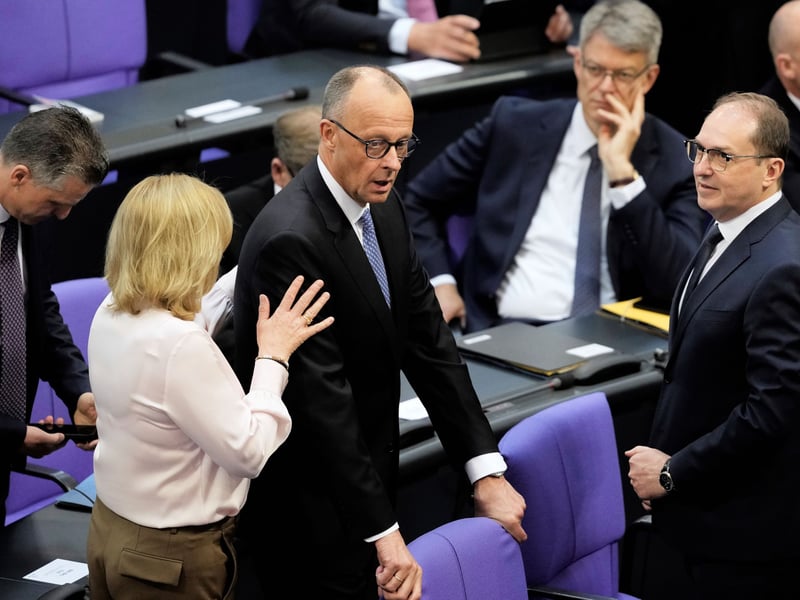
(CN) — Friedrich Merz, the leader of Germany’s center-right Christian Democrats, was sworn in as the new chancellor on Tuesday, marking the beginning of a new era in European politics.
But his new government — formed through a coalition with the center-left Social Democrats — got off to a very rough start after he became the first chancellor in post-war history to not get elected in the first round of voting in the Bundestag, Germany’s federal parliament.
In a first secret ballot on Tuesday, 310 members of the Bundestag voted in favor of Merz, leaving him six votes short of the needed majority. But in a second ballot held a couple hours later, he obtained 325 votes, allowing him to be formally sworn in.
But his defeat in the first round was seen as a shocking development for Germany’s normally staid politics and a stinging embarrassment for Merz. It signaled potential trouble ahead for Merz, who is a polarizing figure with many enemies on the left and even within his own ranks. Within the Christian Democratic party, he was a bitter foe of former Chancellor Angela Merkel, whom he blasted as too liberal.
Because the ballots were confidential, it was unknown who voted against Merz. There are 208 members of Merz’s party in parliament and 120 Social Democrats. There were 18 dissenting parliamentarians in the first vote and three holdouts in the second vote.
As of late Tuesday, the parliamentarians who disapproved of Merz had not come forward to explain the reasons for their votes.
“By letting Merz fail in the first round, MPs sent a warning shot to” both Merz and the new Social Democratic leadership, wrote Carsten Nickel, an analyst with Teneo, a political risk firm.
“The new German government is off to an unfortunate start,” commented Carsten Brzeski, an analyst for the ING Bank. “We’re reminded of a sprinter who stumbles immediately at the start of an Olympic final.”
Brzeski said the parliamentary defeat for Merz was a “painful reminder that it will be hard for the incoming government to fulfill the high expectations regarding investments and reforms.”
“It seems that not everyone in the coalition parties has fully understood the sense of urgency towards the necessity of a functioning government,” Brzeski wrote. “Friedrich Merz and his government now face the monumental challenge of restoring economic strength while keeping everyone in their own parties aligned.”
Merz, 69, takes over from Olaf Scholz, a Social Democrat who led a weak coalition government with the Greens and Free Democrats.
Merz won early elections in February, though his conservatives picked up only 28% of the vote, a result that forced him to enter into a coalition with the Social Democrats. During her 16 years as Germany’s leader, Merkel was compelled to enter into so-called “grand coalitions” with the Social Democrats three times.
Merz takes over the helm of Germany at a time of great turmoil both at home and within the European Union.
With its large economy and political clout, Germany has long been seen as the EU’s leading force, but the country is struggling economically and its political landscape has become fractious as its traditional powers — the Christian Democrats and Social Democrats — steadily lose voters.
In line with his strong conservative views, Merz has put a huge rearmament program and a tough stance on immigration at the core of his government’s plans.
Since winning the February election, he has vowed to spend massively on rebuilding Germany’s military and to do that he engineered the passage of historic legislation in March to reform Germany’s rigid spending cap. During the campaign, he repeatedly rejected the idea that Germany needed to loosen its tight fiscal rules.
On immigration, Merz has been pushed by Germany’s surging far-right Alternative for Germany to take a much tougher stance. He has pledged to tighten border controls and to make it easier to deport illegal immigrants.
Merz has been a member of the Christian Democratic Union since 1972 and he was first elected to the European Parliament in 1989. He worked as a corporate lawyer from 2009 to 2018 and sat on the boards of some of Germany’s biggest companies.
He is expected to travel to France and Poland on Wednesday to meet with French President Emmanuel Macron and Polish Prime Minister Donald Tusk.
Under the Merz government, Lars Klingbeil, a co-leader of the Social Democrats, will serve as finance minister and vice chancellor.
Courthouse News reporter Cain Burdeau is based in the European Union.
 Follow @cainburdeau
Subscribe to our free newsletters
Our weekly newsletter Closing Arguments offers the latest about ongoing trials, major litigation and rulings in courthouses around the U.S. and the world, while the monthly Under the Lights dishes the legal dirt from Hollywood, sports, Big Tech and the arts.