
 Search Articles


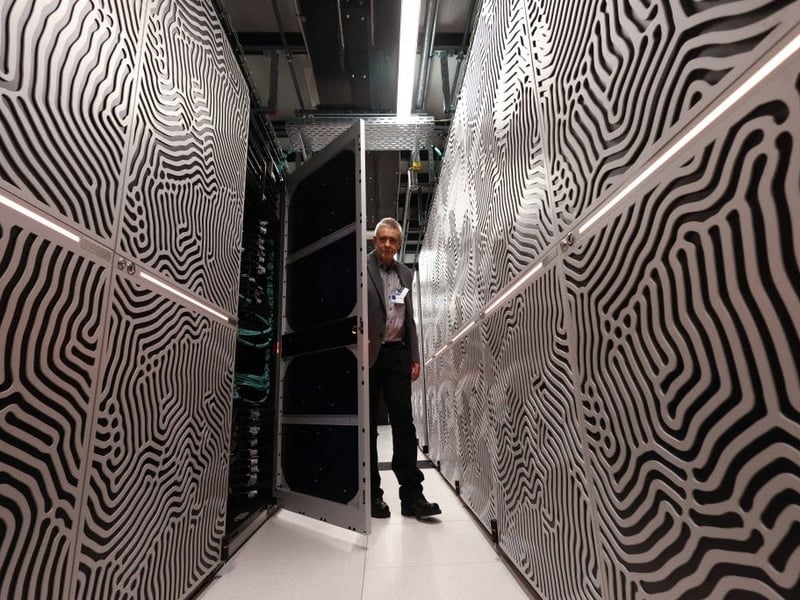
JULICH, Germany (AFP) — German Chancellor Friedrich Merz said on Friday that Europe can catch up in the global artificial intelligence race as he inaugurated the continent’s fastest supercomputer.
“The United States and China are in a neck-and-neck race to compete for future market share in an AI-supported global economy,” he said at the inauguration of the Jupiter computer, which will be able to perform at least 1 quintillion (or 1 billion billion) calculations per second.
“We in Germany, and we in Europe, have every opportunity to catch up and then keep pace.”
Jupiter, based in Julich, western Germany, is housed in a center about half the size of a football pitch and is packed with about 24,000 Nvidia chips, which are favored by the AI industry.
With the power of about 1 million smartphones, experts say it is the first supercomputer that can be considered internationally competitive in training AI models in Europe.
“In Germany and in Europe as a whole, we need sovereign computing capacities that are on a par with our international competitors,” Merz said. “This is a question of competitiveness as well as the security of our country.”
Researchers across numerous different fields will be able to access the 500-million-euro ($580 million) supercomputer, whose uses go far beyond AI.
They range from creating more detailed climate forecasts that can help predict extreme weather events to medical research and studies related to the energy transition.
—
By Agence France-Presse
Subscribe to our free newsletters
Our weekly newsletter Closing Arguments offers the latest about ongoing trials, major litigation and rulings in courthouses around the U.S. and the world, while the monthly Under the Lights dishes the legal dirt from Hollywood, sports, Big Tech and the arts.