
 Search Articles


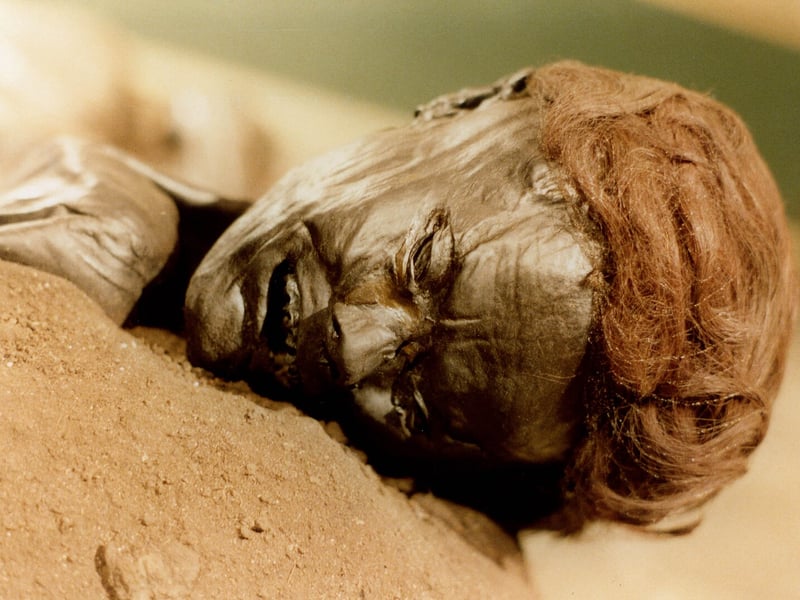
(CN) — Lynn Schoenbeck beams when she recalls her first peek at the Grauballe Man, a bog body who’s remained nearly intact since his throat-cutting execution more than 2000 years ago.
The German-born and Connecticut-raised archaeologist first saw him at a birthday party in his honor in 2018.
Although the Grauballe Man’s exact birthdate is unknown, her colleagues at the University of Edinburgh decided the ancient body deserved a celebration. They arranged an after-hours party at the Moesgaard Museum in Aarhus, Denmark’s second-largest city.
Schoenbeck remembers entering a dark room, drink in hand. There, she saw Grauballe Man cramped into an illuminated glass cage.
“We sang ‘Happy Birthday’ to him,” she said. “It was such a weird, strange experience,” and one that would shape the course of her career.
The Grauballe Man is the crown jewel of the Moesgaard Museum. Discovered in 1952 at Nebelgaard Bog west of Aarhus, the Moesgaard calls him “the world’s best-preserved bog body.”
He isn’t the only bog body, though, nor even the best-known one. That distinction likely goes to the Tollund Man, unearthed from nearby Bjældskovdal Bog in 1950.
Equipped with only a belt, hat and the leather strap that strangled him, the 2,400-year-old Tollund Man has a nearly completely intact face. He now resides nearby, at the Museum Silkeborg about a 40-minute drive outside Aarhus.
Bog bodies can be young or old, man or woman.
All share some similarities. They all died long ago, with most bog bodies dating from the late Bronze Age to the Iron Age. They come from northwestern Europe, from places like Scandinavia and the United Kingdom, where peat bogs offer ideal conditions for corpse preservation.
In the case of the Grauballe Man, he’s believed to have lived sometime between 400 and 200 B.C. and was around 35 years old when he died.
Although the circumstances of his death are unknown, his slit throat makes it clear he did not pass naturally. Many scholars believe he was sacrificed to the gods.

Regardless, the dark, cold void of the bog has done wonders for the Grauballe Man’s appearance, as he looks much better than the typical 2000-plus-year-old.
To simplify the chemistry a bit, the combination of cold temperatures and acidic, oxygen-poor soil means the Grauballe Man’s hair, skin, nails and teeth have stayed remarkably preserved through the millenia. His facial features are visible, with deep wrinkles and a pained expression. He could use a haircut.
The fact that Grauballe Man has been so well-preserved is by itself remarkable. But when Schoenbeck first saw him in 2018, she was particularly struck by the respectful way the Moesgaard Museum presented him. She decided to do her Ph.D. on the connection between this preserved man and Danish national identity.
“He is kept in his own little room. He [has] got this whole section just about him, describing why he is important,” Schoenbeck explained. “I think the point is to show that he was a person at one time, and not just a sort of thing to look at.”
There’s no evidence that the Grauballe Man had a partner. But he does have Pauline Asingh, lead exhibition developer at the Moesgaard, who has joked about being married to the bog body.
An award-winning archaeologist, Asingh literally wrote the book on the subject. It’s entitled “Grauballe Man: Portrait of a Bog Body.”
“We feel like we are giving him respect and dignity,” Asingh said of her boggy honorary husband in an interview with Courthouse News. “We have real feelings for him, the human he was, even though the soul has left him.”
When Grauballe Man was first discovered and shown to the public in the 1950s, men would take off their hats when visiting him. That sense of “emotional respect” has continued to this day, Asingh said.
“We have made an intimate exhibition, where you can spend time alone with him,” she said. “There is also room enough for an entire classroom, which can observe him as he lies inside the bog.”
It may surprise some to learn that in Denmark, that sense of respect entails displaying the Grauballe Man completely naked. Then again, Europe is much more relaxed about nudity than the United States.
“He has an incredibly beautiful body, and it would be weird to cover him up,” Asingh said, offering a Danish perspective on the matter. “We would rather take him for what he is, as the Lord has created him. That is how you should see him.”
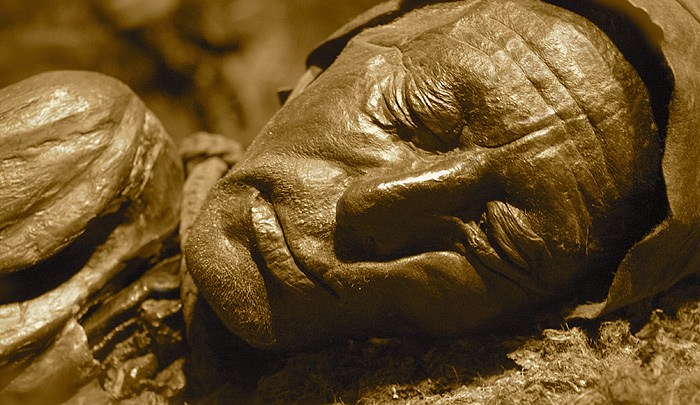
The cultural clashes don’t end there, though. In the United States, the showing of human remains has become increasingly controversial. That’s not least because the topic picks at historical wounds: While a formerly enslaved American might be put on show at a museum, most slaveholders got proper burials and therefore wouldn’t be.
In light of this, the Museum Silkeborg, home of the Tollund Man, in June asked the Danish public whether it should keep displaying bog bodies. A whopping 92% of participants said yes.
“It was a relief,” museum director Ole Nielsen said. “I sat at the edge of my seat, looking at the results, as our museum is planning to increase attention on bog bodies.” He agreed with the overwhelming majority of respondents. “It’s important to show these bog bodies, because they are part of our common ancient history,” he said. “These exhibitions are an attempt to get a deeper connection with them.”
For Nielsen, bog bodies like the Tollund Man are about more than history, Danish identity or morbid curiosity: They also force people to contemplate the impermanence of life.
“Here I am today, looking at a body that died 2,400 years ago,” he said. “Within 100 years, I will die too.”
For Schoenbeck, who credits Grauballe Man with inspiring her to pursue a Ph.D., what’s special about these bog bodies is the way they foster a sense of human connection.
“Empathy was my main feeling,” she recalled of the first time seeing him. “I felt connected to him in a way that I haven’t felt with other bodies, like mummies or anything else.”
 Follow @LasseSrensen13
Subscribe to our free newsletters
Our weekly newsletter Closing Arguments offers the latest about ongoing trials, major litigation and rulings in courthouses around the U.S. and the world, while the monthly Under the Lights dishes the legal dirt from Hollywood, sports, Big Tech and the arts.