
 Search Articles


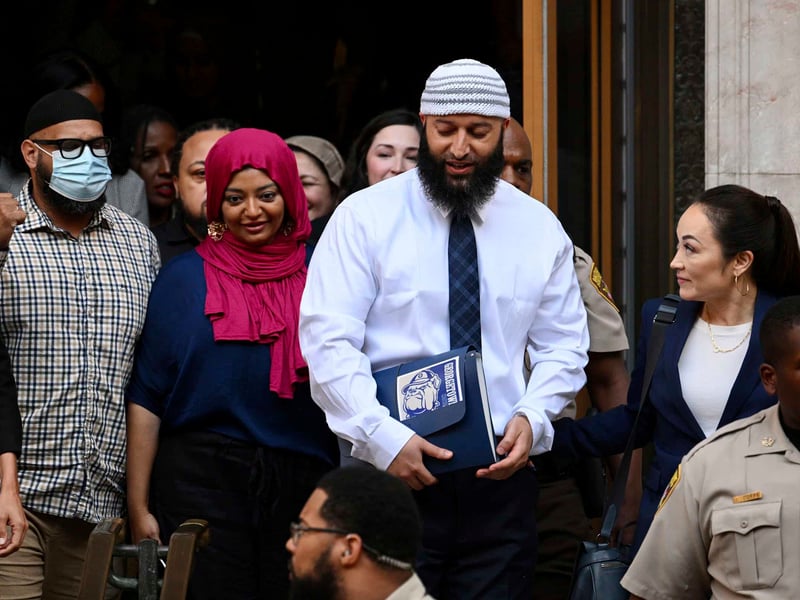
ANNAPOLIS, Md. — Citing the rights of victims in a 4-3 decision Friday, the Supreme Court of Maryland upheld the controversial murder conviction of Adnan Syed, the man at the center of the hit “Serial” podcast.
“The Maryland Constitution requires that crime victims and their representatives be treated by agents of the state with dignity, respect and sensitivity during all phases of the criminal justice process,” Justice Jonathan Biran wrote in his opinion.
Syed’s conviction for the 1999 murder of classmate and ex-girlfriend Hae Min Lee gained national notoriety after “Serial” detailed what producers described as mistakes and omissions leading to his imprisonment.
“Adnan’s case was a mess,” host Sarah Koenig said in a 2022 episode. “Adnan’s case contains just about every chronic problem our system can cough up."
The case has moved through the court and appeals process for the last 24 years.
Friday’s ruling centered on whether a lower court gave the victim’s family sufficient opportunity to participate in a 2022 hearing to vacate Syed’s conviction. That hearing ended with a dramatic call from the presiding judge to unshackle Syed.
But Maryland’s Appellate Court — and now, a majority in the Supreme Court — found that Lee family’s had insufficient opportunity to participate in those hearings. In its decision, the state Supreme Court held that victims and their representatives have the right to be heard at a hearing on a motion to vacate, including to weigh in on the motion’s merits.
Syed’s counsel, attorney Erica Suter of the University of Baltimore’s Innocence Project Clinic, met with Assistant State’s Attorney Becky Feldman in 2021 to discuss pursuing Syed’s release through the Maryland Juvenile Restoration Act. The conversation led Feldman to reopen the case’s files.
As Feldman reviewed those files, she — like many listeners of the “Serial” podcast — found some discrepancies in Syed’s conviction.
Prosecutors convicted Syed without any eyewitnesses or physical evidence tying him to the murder. Instead, the prosecution’s case rested primarily on the testimony of another classmate, Jay Wilds, who claimed he helped Syed dispose of Lee’s body, which was found in a shallow grave in a Baltimore park a month after her murder.
Wilds’ testimony was viewed as shaky at the time due to inconsistencies in his memory. Nonetheless, cell phone records corroborated his account.
When Feldman reviewed the files, she found a pair of notes seemingly written by a prosecutor who’d received calls about other possible suspects.
The notes, which the prosecution did not share with the defense during the 2000 trial, indicated that other suspects had motives to kill Hae Min Lee.
Along with other irregularities in the files, those notes caused Feldman to question Syed’s guilt. In Sept. 2022, she contacted Hae Min Lee’s brother Young Lee, alerting him that the state planned to pursue freeing Syed. In an email to Feldman that same month, Young Lee said his family opposed that course of action.
Two days later, the court held an off-the-record hearing in the court’s chambers. There, Feldman and Suter — but not Young Lee — provided the judge with the notes.
Representing Young Lee, attorney David Sanford of the firm Sanford Heisler Sharp argued in a phone interview with Courthouse News that the court had wrongly decided the validity of the new evidence behind closed doors.
“There is a conviction in place, and that has been in place for the better part of over 20 years,” Sanford said. “Suddenly, with one day’s notice, the family was told that all that was being essentially overturned and upset based on evidence that the state never presented in open court, never presented to the public, never presented to the press and significantly, never presented to the family.”
Three days after that private hearing, journalists and Syed supporters packed a courtroom to hear the outcome of that vacatur motion. Young Lee, who lives in California, said the court gave him insufficient time to plan a cross-country trip for the hearing.
The evening before the hearing, Lee hired attorney Steve Kelly of the firm Grant & Eisenhofer. Kelly, who has since recused himself from the case due to a conflict of interest, attempted to postpone the proceeding for a week but was denied.
While not there in person, Young Lee attended the hearing via Zoom and was allowed to make a statement. Nonetheless, he asserted that even if he and his family had been able attend the hearing, they could not have meaningfully participated because Feldman had not disclosed the factual basis supporting the motion and because the motion did not name any alternate suspects.
In Oct. 2022, the state entered a nolle prosequi or nol pros on Syed’s vacated charges, formally indicating that they were unwilling to prosecute Syed.
That filing effectively forgave Syed of his conviction. In the Supreme Court decision Friday, the three dissenting justices argued that at that point, the case became moot.
“This case exists as a procedural zombie,” Senior Justice Michele Hotten wrote in the dissenting opinion. “It has been reanimated, despite its expiration.”
But a narrow majority disagreed, finding the procedural history in the case did not excuse denying rights to victims and their families. As Justice Biran put it for the majority: “A prosecutor may not use the nol pros power to divest a victim of the right to appeal what the victim contends is an unlawful vacatur order.”
According to Kelly, a victim’s rights advocate whose sister was tragically murdered when he was 14, Friday’s ruling was a significant step for crime victims and their representatives.
“Victims are given, for the first time in a Supreme Court opinion, a clear, meaningful voice,” Kelly said in an interview with Courthouse News. “Victims’ rights have meaning, and they’re not just a matter of convenience.”
Kelly stressed that the Lees aren’t seeking revenge and would be fine with Syed’s release if it came with a proper explanation. Instead, Kelly argued national attention on the case encouraged the state and the court to release Syed without due diligence.
“What happened here is this thing was sort of rammed through,” Kelly said. “Everybody wanted their 15 minutes here.”
Attorneys representing the state did not respond to requests for comment by the time of publishing. The majority remanded the case back to the circuit court of Baltimore, with instructions for a new judge to hear the motion to vacate.
Subscribe to our free newsletters
Our weekly newsletter Closing Arguments offers the latest about ongoing trials, major litigation and rulings in courthouses around the U.S. and the world, while the monthly Under the Lights dishes the legal dirt from Hollywood, sports, Big Tech and the arts.