Search Articles


(CN) — New York voters in 2024 approved adding age as a protected civil rights category. What that means for the court system’s mandatory retirement age is now a question for the state’s top court.
Three septuagenarian judges brought their case before the seven-judge New York State Court of Appeals on Wednesday, arguing the Equal Rights Amendment to New York’s Constitution nullifies judiciary law provisions that require justices to retire at age 70, with provisions allowing them to be re-certified for two-year terms until they are 76 years old.
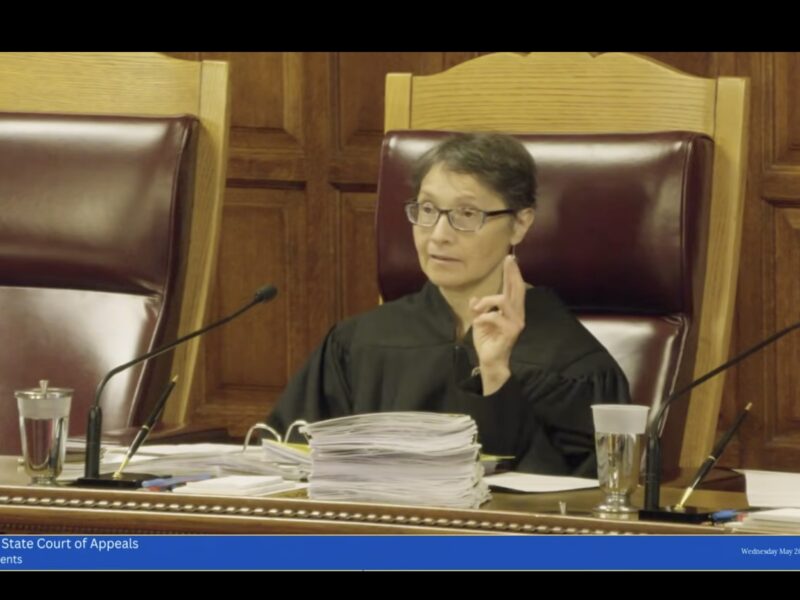
Judges sharply questioned plaintiff attorney John Leventhal of the firm Aidala, Bertuna & Kamins during oral arguments that lasted nearly an hour. They asked how the civil rights law can be understood as repealing the mandatory retirement age when it wasn’t explicitly presented to voters as doing so.
“Your argument is that, without having said it, putting it in a completely different section of the Constitution, the drafters and the voters understood that they were now eliminating a job criteria. It sounds astounding to make such an argument,” Associate Judge of the New York Court of Appeals Jenny Rivera said.
Leventhal, a retired judge himself, argued that the age limit for New York jurists is age discrimination, plain and simple, and said the Equal Rights Amendment’s inclusion of the words “pursuant to law” means “you can’t have any discrimination … whether it’s in the Constitution or not.”
“They also added civil rights,” Associate Judge of the Court of Appeals Anthony Cannataro responded, asking whether Leventhal reasoned that all New Yorkers have a constitutional right to be a judge.
Leventhal likened judgeship to the right to participate in jury duty, citing case precedent in People v. Kern.
Arguing on the state’s behalf, attorney Ester Murdukhayeva echoed lower court findings: “Being a judge, holding that office, is not a civil right,” she said.
Murdukhayeva faced a line of questions from Associate Judge of the Court of Appeals Shirley Troutman about why a judicial age cap doesn’t discriminate against elderly judges.
“What a civil right is, is what Kern said, it’s a right that appertains to a person by virtue of his citizenship in a state or community. Being a judge is something very different,” Murdukhayeva argued.
One of the suing judges, New York Supreme Court Justice Robert Miller, turned 76 in 2025, triggering mandatory retirement at the end of the year. New York Supreme Court Justice Orlando Marrazzo Jr., another plaintiff, turns 76 in August. The third plaintiff, New York Supreme Court Justice Richard Montelione, is 70 years old.
In November 2025, New York Supreme Court Justice Lyle Frank denied the plaintiffs’ bid for an injunction of the retirement law, noting that becoming a judge is not a civil right.
“Let me tell you, it took years,” he quipped at oral arguments.
The judges also failed to show that the Legislature didn’t expressly repeal the mandatory judge retirement age with the passage of the state’s Equal Rights Amendment.
Frank wasn’t sold on the law itself.
“There are serious public policy concerns with the current judicial mandatory retirement age scheme,” he wrote, but concluded he didn’t have the power to override the state mandate. The Appellate Division, First Department, affirmed Frank’s ruling.
In 2013, New York voters declined to extend the retirement age for judges to 80 years old.
The appeals panel reserved judgment following Wednesday’s hearing — but not before Leventhal got the last word.
After thanking the judges, he added, “I’m 77 years old and I’m still here.”
 Follow @NinaPullano
 Follow @ninapullano.bsky.social
Subscribe to our free newsletters
Our weekly newsletter Closing Arguments offers the latest about ongoing trials, major litigation and rulings in courthouses around the U.S. and the world, while the monthly Under the Lights dishes the legal dirt from Hollywood, sports, Big Tech and the arts.