
 Search Articles


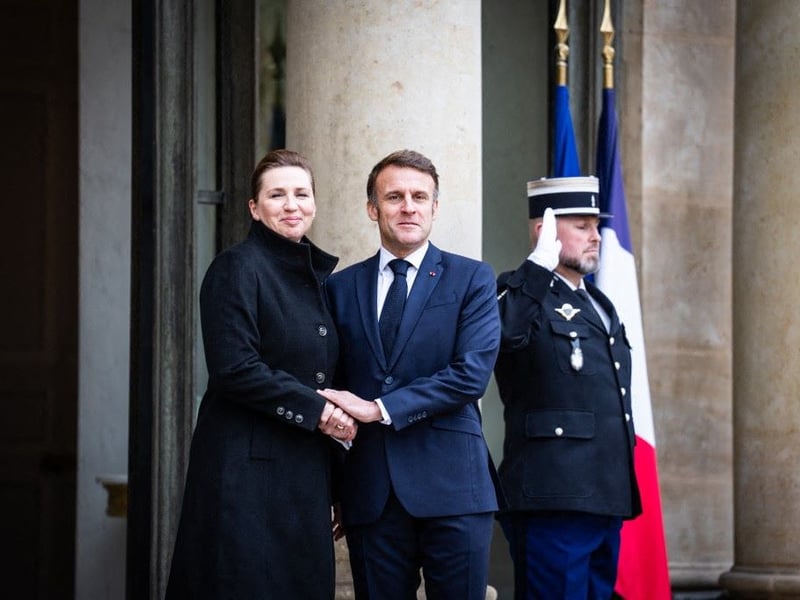
(CN) — Greenland’s capital, Nuuk, will buzz with police and politicians on Sunday as Emmanuel Macron becomes the first French president to make an official visit to the world’s largest island, highlighting its strategic importance.
Hosted by Greenland Prime Minister Jens-Frederik Nielsen and accompanied by his Danish counterpart, Mette Frederiksen, Macron is scheduled to discuss Arctic security, climate change and geopolitics.
“A first visit from a French president to Greenland marks a breakup with a previous passive attitude,” said Jørn Boisen, professor at the University of Copenhagen with a specialty in French studies. “Macron wants to show that France (including the EU) considers the Arctic a region of strategic, climatic and geopolitical significance.”
The visit comes after turbulent months when Greenland has found itself squeezed between U.S. President Donald Trump’s takeover threats, and a desire for eventual total independence from Copenhagen. The island is an autonomous Danish territory.
As Greenland repeated its mantra of wanting independence, rather than becoming American or continue being Danish citizens, leaders from the EU and Denmark were reluctant to take a stand against Trump’s takeover pressure.
France was among the first countries to counter Trump’s approach, offering to deploy troops to Greenland upon Denmark’s request.
Experts said that the France-Greenland visit signals a stance against U.S. ambitions to assert full control over the Arctic island. Denmark’s Parliament on Wednesday approved a bill to allow U.S. military bases on Danish soil. During Congressional hearings Thursday, U.S. Defense Secretary Pete Hegseth appeared to acknowledge the U.S. has a contingency plan to invade Greenland if deemed necessary.
With rising tensions between the U.S., Russia and China in the Arctic, the EU is striving to take full control of its own security.
“The visit signals that France and the EU back the Kingdom of Denmark and Greenland’s right to independence,” said Boisen. “Second, the visit is a rejection of either an American unipolar dominance in the Arctic, or a bipolar one with Russia.”
EU leaders are also eyeing Greenland’s natural resources, including metals vital to the green transition. Lately, local politicians have declared Greenland “open for business” to the U.S. and others.
In early June, the EU announced a 5.5-billion-euro ($6.3 billion) investment spread over 13 projects around the globe, aiming to secure critical natural resources, including mining Greenlandic graphite.
“Just until five years ago, it was not profitable to extract rare minerals in Greenland, because they were cheaper to buy on the world market,” said Jens Ladefoged Mortensen, professor of political science at the University of Copenhagen, with expertise in EU relations and international trade.
“To buy resources from China was previously not seen as a problem. Now, it has suddenly become a serious economic safety issue,” he said, highlighting that the Asian giant has tightened its grip over its export of rare minerals amid a trade war with the U.S.
Moscow’s invasion of Ukraine catalyzed a discussion about where the EU can secure natural resources to wean itself off Russian gas. As critical energy infrastructure is turning into security politics, Europe is starting to look beyond pricing.
Greenland’s “open for business” approach to all, including China, could turn risky, said Mortensen.
“It can create an American backlash — Trump has already threatened with a takeover of Greenland, but that can be interpreted as an attempt to attract American interest, and first and foremost, American investments,” he said.
The Royal Danish Defense College said that China’s growing military and its possible collaboration with Russia will probably create pressure on Denmark in the future, in a report titled “China as a Global Military Superpower — Military Strategic Perspectives for Danish Defense,” published Tuesday.
Greenlandic Minister of Foreign Affairs Vivian Motzfeldt previously told Danish media that Greenland is prepared to strengthen ties with China if other nations don’t invest.
Greenlanders are not keen on being exploited for their wealth of natural resources, Mortensen said. They look askance at a country like Norway as an example of how to get rich by selling valuable resources.
“Greenland’s wish for investments is about independence — and very willingly American investments. But if the U.S. does not, others will be welcome to make them,” he said.
 Follow @LasseSrensen13
Subscribe to our free newsletters
Our weekly newsletter Closing Arguments offers the latest about ongoing trials, major litigation and rulings in courthouses around the U.S. and the world, while the monthly Under the Lights dishes the legal dirt from Hollywood, sports, Big Tech and the arts.