
 Search Articles


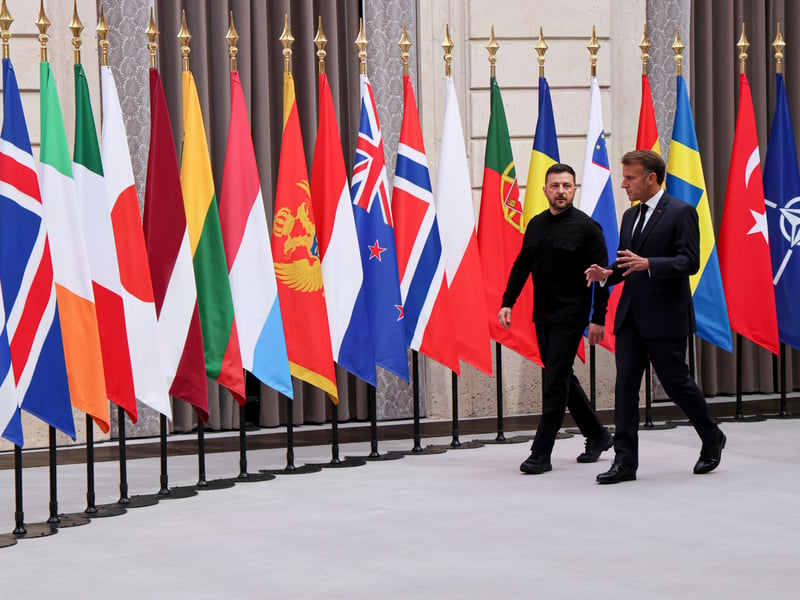
(CN) — Twenty-six countries have committed to deploy troops, naval vessels and aircraft on Ukrainian territory as a “reassurance force” following any future ceasefire, with the United States agreeing to provide support for the security guarantees, French President Emmanuel Macron announced Thursday.
The announcement came after European leaders gathered at France’s presidential palace exactly one week after Russian missiles nearly hit the EU’s diplomatic compound in Kyiv.
Macron said U.S. President Donald Trump confirmed during a phone call Thursday afternoon that “the U.S. has been clear on its will to be involved in the security guarantees” and agreed to finalize Washington’s support “in the coming days.”
“If Russia continues to refuse concrete peace discussions, then we will take additional sanctions in coordination with the U.S.,” Macron warned at a press conference, flanked by Ukrainian President Volodymyr Zelenskyy. Trump “expressed this as well during our call just now” and “confirmed he would join the coalition in taking action should Russia fail to act,” he added.
Trump sent special envoy Steve Witkoff to observe the meeting but did not attend himself.
The 35-nation “Coalition of the Willing” represents the most concrete commitment yet for Western military presence in Ukraine, with forces deploying “on land, in the sea or in the air” to “guarantee peace” and provide “strategic signaling” to deter future Russian aggression, according to Macron. The forces would not engage Russia directly but would deploy after a ceasefire to maintain any peace agreement.
Macron declared the security guarantees are now “ready” after months of planning by defense ministers working with the U.S. and NATO, representing what he called the coalition’s completed military and political engagement from all 35 members.
He stressed that “26 countries have confirmed that they are ready to be involved with specific proposals” on security guarantees — though he declined to provide details, saying that would reveal too much to Russia.
However, the coalition faces significant obstacles that undermine its effectiveness. Major European nations including Germany and Italy have previously voiced opposition to sending their own troops, while NATO members Hungary and Slovakia refuse to join because they oppose military aid to Ukraine.
Macron avoided specifics, mentioning that nations could take on different responsibilities but refusing to specify which countries would contribute what.
The initiative emerged after Trump surprised European allies by launching direct negotiations with Russian President Vladimir Putin in February without prior consultation. Trump’s most recent mid-August deadline for Putin to agree to direct talks with Zelenskyy has now passed with no progress, leaving European leaders scrambling to maintain relevance in peace efforts.
Finnish President Alexander Stubb, who attended the Thursday meeting, told Finnish media that potential new sanctions would target “oil and gas” and that European Commission President Ursula von der Leyen and Trump’s advisers would discuss this “over the next 24 hours.”
The urgency heightened after last Thursday’s Russian missile strikes on Kyiv killed 18 people and came within 165 feet of the EU’s diplomatic compound — the closest Russia has come to directly hitting a major Western diplomatic facility since the war began. The attack also damaged Britain’s cultural office nearby.
Even Zelenskyy had expressed uncertainty about the coalition’s prospects earlier, telling reporters Wednesday that the group still appears “theoretical” — though he added that he remains optimistic about its potential.
At Thursday’s press conference, Zelenskyy spoke about “concrete plans” being developed, with coalition members now determining “which country will help in which area, including in cyber and air defense.”
“European weapon production lines are not working enough,” he said, urging for increased investment in European weapons production.
In a post on X, Von der Leyen projected confidence in the creation of a “Multinational Force for Ukraine backed by the U.S.” The EU executive body’s leader also noted that Europe has already trained “almost 90,000” Ukrainian soldiers.
She also revealed that European officials contacted Indian Prime Minister Narendra Modi — appearing to offer trade incentives while seeking India’s help pressuring Russia.
Still, NATO Secretary-General Mark Rutte sent mixed signals about the effort. On Wednesday, he warned that the alliance must “prevent spreading our resources too thinly” while monitoring European deployment discussions. But by Thursday, he took a sharper tone, dismissing Russian objections to Western forces in Ukraine.
“Why should we care what Russia thinks about Ukraine?” he asked at a Prague defense conference. “Ukraine can make its own decisions.”
Rutte also downplayed Putin’s influence, noting that Russia’s economy measures smaller than Texas and describing the Russian leader as essentially “the governor of Texas, nothing more.” However, he praised Trump’s diplomatic approach, saying the president understands Ukraine needs “real security guarantees” and won’t repeat past failed agreements like the 1994 Budapest Memorandum, in which Ukraine gave up its nuclear weapons in exchange for security assurances that Russia later violated.
Russia isn’t receptive to the peacekeeping concept either. In late August, Kremlin spokesperson Dmitry Peskov told reporters that Moscow views European peacekeeping troops with a “negative attitude” and blamed NATO’s expansion over the past 25 years as “one of the root causes” of Russia’s 2022 invasion. That statement contradicted Trump’s earlier claim that Putin might accept European peacekeepers.
The Paris summit appeared to produce more concrete commitments than previous meetings, but it also highlighted European fatigue and fragmentation on Ukraine. Even assembling participants proved challenging. Spain’s prime minister had to abort his flight due to aircraft problems. Other leaders participated by video conference rather than attending in person.
Just days before the Paris summit, EU ministers meeting in Copenhagen outlined a three-tier defense framework for Ukraine: a strong Ukrainian army as the first line of defense, followed by an international military coalition with U.S. backing, and finally Europe’s enhanced defense posture as the ultimate safeguard. On Saturday, EU foreign policy chief Kaja Kallas told reporters that Russia’s 210 billion euros ($230 billion) in frozen assets won’t be returneduntil the Kremlin pays reparations to Ukraine.
But the meetings also revealed ongoing divisions with Hungary blocking 6.6 billion euros in weapons funding, hampering Europe’s military aid efforts even as officials discuss deploying thousands of European peacekeepers.
The bottom line: Europe is working to maintain influence in Ukraine policy while Trump pursues direct negotiations with Putin. But with key players absent and major powers still reluctant to commit troops despite Thursday’s announcements, this “Coalition of the Willing” risks becoming more symbol than substance. Coalition members have not announced when they plan to meet again or make concrete decisions.
Courthouse News correspondent Yuval Molina Obedman is based in Brussels.
Subscribe to our free newsletters
Our weekly newsletter Closing Arguments offers the latest about ongoing trials, major litigation and rulings in courthouses around the U.S. and the world, while the monthly Under the Lights dishes the legal dirt from Hollywood, sports, Big Tech and the arts.