
 Search Articles


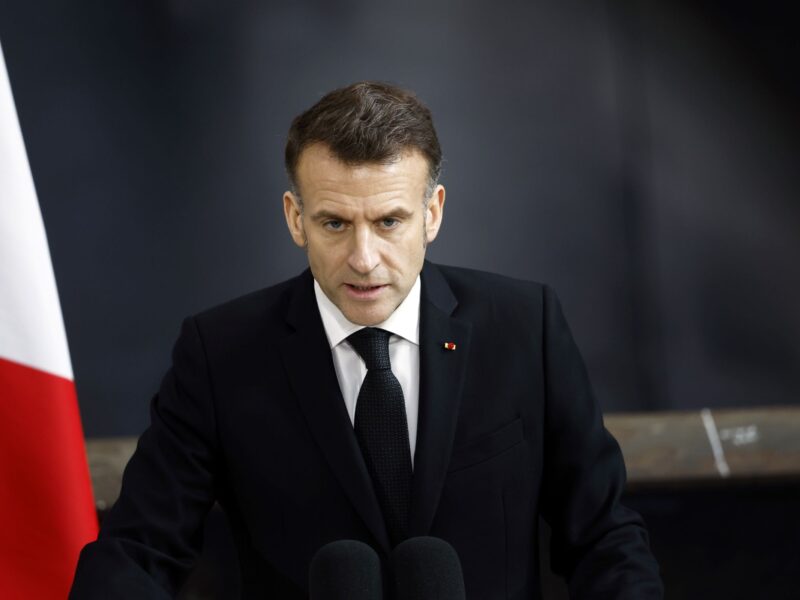
PARIS (CN) — French leaders have long prided themselves on staying out of the 2003 U.S.-led invasion of Iraq. But as President Emmanuel Macron adapts to the new full-blown regional conflict in the Middle East, it doesn’t look like history will repeat itself.
On Thursday, France said it will allow U.S. aircraft onto some of the nation’s air bases. Also Thursday, France, Italy and Greece agreed to coordinate deployments to Cyprus and the eastern Mediterranean, to ensure freedom of navigation in the Red Sea.
Macron said France would build a coalition to bring together the necessary means, “including military ones,” to restore and secure traffic through the Suez Canal and the Red Sea.
France’s flagship carrier, the Charles de Gaulle, is en route to the Mediterranean, and Rafale fighter jets are being sent to the UAE.
In the past week, Macron announced in a previously planned speech the country will increase its nuclear arsenal to an undisclosed number, because “to be free, one must be feared.” The nation will also share its nuclear assets with the U.K. and other EU nations.
The French president has maintained the country’s measures are purely defensive. But while saying the U.S. and Israel breached international law, he also said of Iranian leaders, “History never mourns the executioners of their own people,” and “no one will be missed.”

Experts argue the president’s ambiguous positioning is the result of a web of competing interests, from oil to defense treaties and a struggle to obtain strategic autonomy.
“It’s much less clear than 2003,” Laure Foucher, a research director at the Foundation for Strategic Research formerly with the French Ministry of Defense, said, speaking of Iraq. “In 2003, it was a ’no’ — there were speeches at the U.N., it was a refusal by France to participate in anything at all.”
There are differences now, she explained. France has been urging Iran to stop developing its nuclear program, and identifies its capabilities as a “real threat,” in comparison to the debunked weapons of mass destruction argument of 2003 Iraq.
There are clear economic interests in the Strait of Hormuz, the narrow waterway through which 20%-25% of the world’s oil and gas passes, now effectively closed to traffic. And, since France has been developing partnerships with countries in the Middle East, it likely wants to prove itself to them.
“How can France be useful and therefore credible to our partners there, faced with Israel’s entryism in the region and the hubris of a superpower that doesn’t necessarily take the interests of its allies in the Gulf into account, since the vast majority of them were against this intervention?” Foucher said.
Abishur Prakash, the founder of the geopolitical advisory firm The Geopolitical Business Inc., explained that France and other countries — including Germany and Italy — “don’t want their regional footprint to be rolled back.”
“Like the U.S., Europe is well aware that what is taking place in Iran will rewire the Middle East,” he said. “Those who are not playing a direct role, either militarily or economically, will play a marginal role once the fighting ends.”
Andrea Teti, an associate editor at the Middle East Critique, said when Europeans “cut themselves off” from Russian gas, they turned to Middle East producers, largely in Qatar and Saudi Arabia, for oil production.
“So there are commitments that they already have and need to uphold, that’s in their interest to uphold, and they need to be seen to uphold,” he said.
There is another factor at play — strategic autonomy from the U.S. Although this is something that Macron has promoted since his first term in 2017, the Trump administration’s distancing from Europe has increased the urgency.
Neil Quilliam, an associate fellow at the Middle East and North Africa Program at Chatham House, explained the U.S. and Israel took a unilateral position with the strikes — they didn’t consult international partners beforehand or work through the U.N.
“We’re living in this world where there is a transition taking place away from the international rules-based order,” he said. “Because the U.S. is driving a sort of ‘law of the jungle’ type policy, [Europe doesn’t] want to be left in the cold by the U.S., because the U.S. is such a vital and important partner and should be a very important partner in Russia’s war with Ukraine … So they need to sort of keep on side with the U.S.”
Teti said that Europe could be acting in a sort of “grudging compliance.”
“In public, you see statements from [European leaders] sort of backing what the U.S. is doing,” he said. “But in private, I think they know very well that this action against Iran is legally baseless, it’s extremely costly geopolitically, and it’s reputationally disastrous.”

In Paris, the words “United States” and “Iran” are constantly being overheard on café terraces, in the metro and on the streets.
On Thursday morning, Malika Bahzaz was sitting at her stand at the Marché Alimentaire Bastille food market in the 11th arrondissement. In her view, the military action is a power-play by world leaders, and no one will come out on top.
“There is no winner in war,” she said. “We hope for peace for the entire world — and we’re capable of living together.”
 Follow @lilyradz
Subscribe to our free newsletters
Our weekly newsletter Closing Arguments offers the latest about ongoing trials, major litigation and rulings in courthouses around the U.S. and the world, while the monthly Under the Lights dishes the legal dirt from Hollywood, sports, Big Tech and the arts.