
 Search Articles


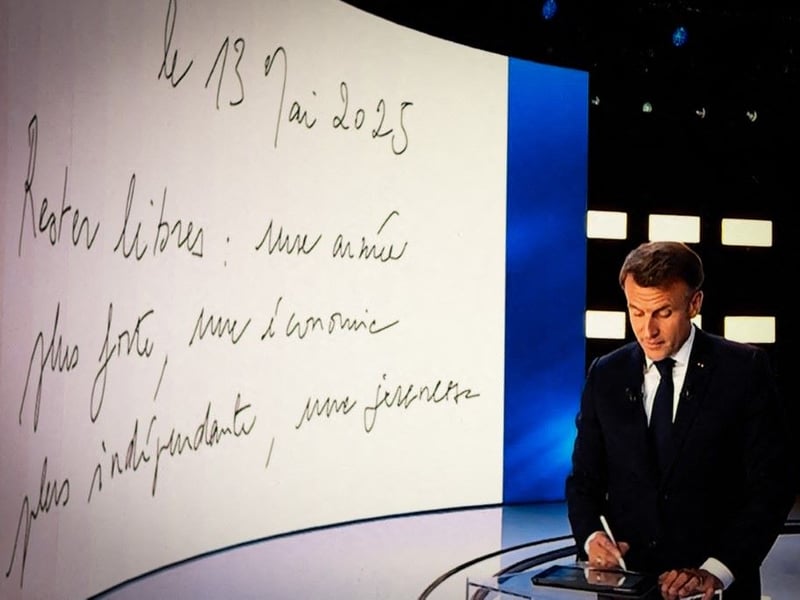
MARSEILLE, France — After months of playing Europe’s leader-in-chief in international geopolitics, French President Emmanuel Macron returned to the home stage in a three-hour live television segment on Tuesday that left experts and the public underwhelmed.
The program, called “The Challenges of France,” was marketed as a platform for Macron to recap his successes, outline the nation’s agenda for his last two years in office, and debate with representatives from across the spectrum. The president was also widely expected to give clear responses to topics such as referendums — which let voters adopt a law regardless of whether lawmakers pass it — something rumored to be on the table for various hot-button issues.
Instead, the segment largely reinforced Macron’s domestic reputation as an arrogant leader who acts as the voice of reason, and congratulates himself on issues that many in the country would deem failures. The roughly 4.9 million people who tuned in were left without clear takeaways.
“It was very long, nothing really new, very narcissistic — the symbol of a lost political authority, but of course a strategy that one can understand wanting to exist at a key moment for the end of his seven-year term, or even the rest of his political career,” Ludovic Renard, a political scientist and professor at Sciences Po Bordeaux, told Courthouse News. “Because it’s once again based on the justification of his political line, of what has been done.”
An April poll by Ipsos-Cesi École d’Ingénieurs for La Tribune Dimanche newspaper showed Macron with a 26% favorability rating. About 22% of those polled said they viewed him favorably and 4% very favorably, while 41% had a “very unfavorable” view of him.
On Wednesday morning, Rita — who preferred to withhold her last name — was working in her rum shop in central Marseille. She knew about the TV show but didn’t want to watch it, instead opting for a program about slavery on another channel.
“I think that he’s a spoiled child that we gave power to, that appropriated the freedom of people for his power,” she said. “It’s only getting worse, we see disillusions — I have the impression that we’re all petrified, and it’s impossible to defend ourselves.
Rita never voted for Macron. And for her, he evokes the biblical proverb, “Boasting to be wise, they became fools.”
It was clear that Macron would be on the hot seat within its first few minutes. The show opened with a reel of ordinary people giving their opinion on the president. The first woman said he ruined the country. Others varied from praise to anger. When the president finally took his seat, he sarcastically said, “Thanks for the warm welcome.”
In a sort of rotating debate manned by news anchor Gilles Bouleau, four prominent figures from across the political spectrum questioned Macron and responded. The president also took Internet questions from ordinary citizens.
Topics ranged from the Russia-Ukraine warto renting prison spaces abroad and social media’s effect on young people. Gaza, a controversial reform of the retirement system and referendums were also on the table. But the overall outlook was unclear.
“It seems to me that he didn’t outline any perspectives that would allow us to envision what will happen between now and the presidential election of 2027,” Jean-Yves Camus, a political scientist, researcher and author specialized in far-right movements in Europe, told Courthouse News. “He justified a certain number of reforms, notably the pension reform — but the fact that he said he didn’t implement it with a light heart doesn’t change the fact that many French people oppose it, continue to oppose it.”
In 2023, Macron raised the retirement age from 62 to 64 in a move that sparked weeks of riots across the country. It remains a sensitive topic that opposition parties continue to leverage against him.
Although the president ruled out referendums on immigration, supported by the right, and taxes — which he said were not constitutionally allowed — he allowed there could be a vote on euthanasia if the issue was blocked in parliament. Otherwise, he was noncommittal.
The segment could be seen as an attempt at a domestic comeback after a brutal political year in France. Almost a year ago, Macron abruptly dissolved the government and called for snap elections, which sent his administration into a monthslong spiral of multiple prime ministers and censures under the pressure of passing the country’s then-late budget.
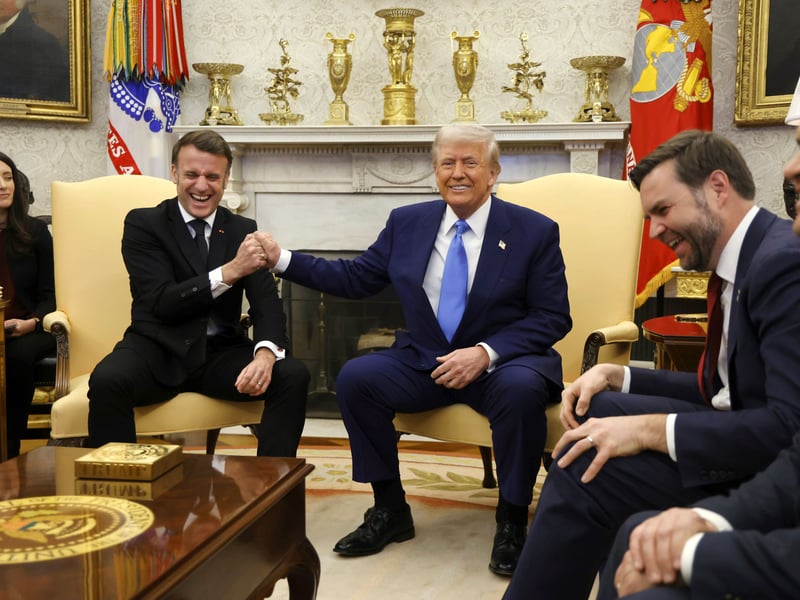
But when Macron began to embrace a bigger leadership role on the international stage, it seemed like he gained back some credibility. Experts commended the president for breaking through to U.S. President Donald Trump, who had been hostile toward other European heads of state. Numerous summits, state meetings and conferences largely held in Paris bolstered his international legitimacy.
Dominique Schnapper, a dsociologist and director of studies at the School for Advanced Studies in the Social Sciences, known as EHESS, told Courthouse News that the television appearance was probably to reset his image nationally after he dissolved the government.
“He was totally discredited on the domestic scene, and I suppose it was a way to exist again in the political vacuum that France is in at the moment,” she said, while acknowledging that his international campaign has been widely seen as a success.
The program proved that riding the wave of his international success won’t get him back on France’s good graces so easily.
 Follow @lilyradz
Subscribe to our free newsletters
Our weekly newsletter Closing Arguments offers the latest about ongoing trials, major litigation and rulings in courthouses around the U.S. and the world, while the monthly Under the Lights dishes the legal dirt from Hollywood, sports, Big Tech and the arts.