
 Search Articles


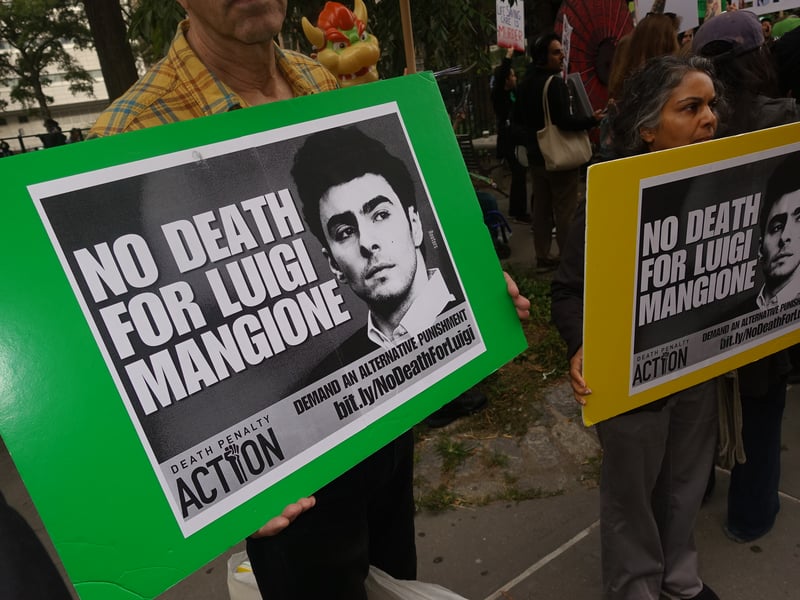
MANHATTAN (CN) — Citing his cinematic “perp walk” and a spate of high-profile cases in which the Justice Department opted against the death penalty, Luigi Mangione asked a federal judge to block the government from seeking death in his case.
Mangione, the Maryland man who’s accused of gunning down UnitedHealthcare CEO Brian Thompson, said officials violated his due process rights in the aftermath of his December 2024 arrest, as the caught-on-camera shooting gripped the nation and ignited debate about the morality of for-profit health care.
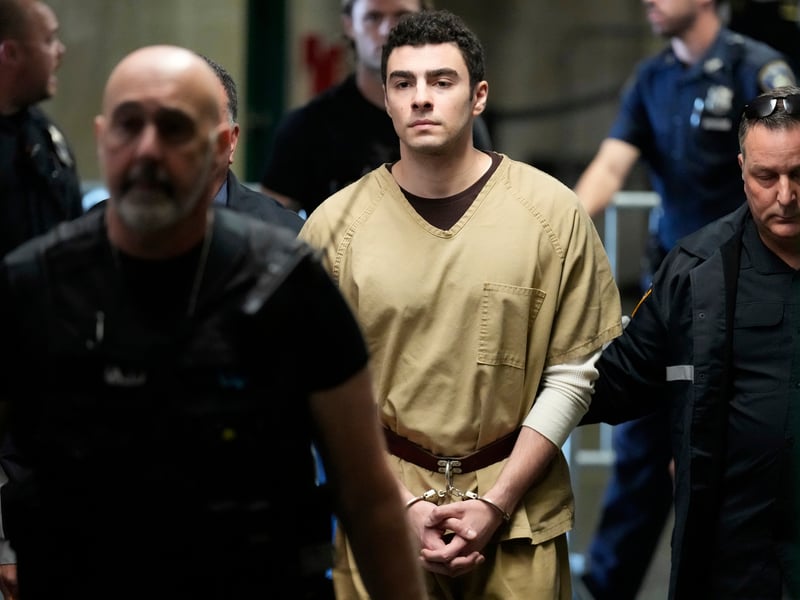
“In a show of force befitting a captured cartel chief or comic book villain, Mr. Mangione, at the time a 26-year-old who had never been in trouble with the law, was ‘perp walked’ before scores of television cameras and press reporters, surrounded by armed law enforcement officials in tactical SWAT gear and raid jackets,” he wrote in the 114-page motion filed late Friday night.
Among the group, Mangione notes, was New York City Mayor Eric Adams, who was still under an indictment that would later be scrapped in a deal with the Trump administration.
Mangione, now 27, accused federal and local officials of staging the scene for political benefit, not public safety, and said the ordeal could hinder his chances at trial.
“Potential jurors — grand and petit — were imprinted with a scene out of a Marvel movie, with dozens of agents needed to protect the public from the shackled monster Mangione,” he wrote.
Mangione also pointed to recent Justice Department decisions not to seek the death penalty against three high-profile defendants in Brooklyn federal court: Rafael Caro Quintero, the co-founder of the Sinaloa cartel; Vicente Carrillo Fuentes, a former Juárez cartel leader; and Ismael “El Mayo” Zambada García, a former Sinaloa cartel head. The latter pleaded guilty to sweeping federal crimes last month.
“Those three defendants are allegedly responsible for the distribution of massive quantities of drugs — activities that doubtless posed a greater risk of death to others than did the early-morning shooting of which Mr. Mangione is accused. They are also allegedly responsible for hundreds, if not thousands, of gruesomely violent murders in furtherance of cartel activity, but the Department of Justice is not seeking their execution,” Mangione wrote.
Mangione’s attorneys of the firm Agnifilo Intrater declined to comment on the motion, as did a representative for the Justice Department in the Southern District of New York.
In an August court filing, the department sought to justify its application of the death penalty in Mangione’s case by likening him to Shane Tamura, the gunman who killed four people — including an off-duty NYPD officer — in a Manhattan high-rise on July 28 before turning his AR-15 on himself.
Prosecutors compared the note found in Tamura’s pocket following the shooting — which claimed that he suffered from CTE caused by high school football and encouraged scientists to study his brain — to the messages they claim Mangione left on bullet casings at the scene of Thompson’s murder.
“In preparing for the crime, the defendant took the time to write the words ‘Deny,’ ‘Depose,’ and ‘Delay’ on the bullets he used — two of which were recovered at the scene of the murder as shell casings (because the bullets had been fired) and one of which was recovered as a live round,” they wrote.
In response, Mangione’s legal team called the government’s comparison “further proof of the political nature of the tragically unfortunate decision to seek to execute Mr. Mangione.”
U.S. Attorney General Pam Bondi announced in April, more than two weeks before Mangione’s federal grand jury indictment, that the Justice Department would be seeking capital punishment as part of President Donald Trump’s initiative to “make America safe again.”
Mangione faces two counts of stalking, a firearms offense and murder through the use of a firearm. He also faces charges in New York Supreme Court, including first-degree murder.
New York Supreme Court Justice Gregory Carro dismissed state terrorism charges against Mangione on Sept. 16, finding insufficient evidence to support them.
 Follow @NinaPullano
Subscribe to our free newsletters
Our weekly newsletter Closing Arguments offers the latest about ongoing trials, major litigation and rulings in courthouses around the U.S. and the world, while the monthly Under the Lights dishes the legal dirt from Hollywood, sports, Big Tech and the arts.