
 Search Articles


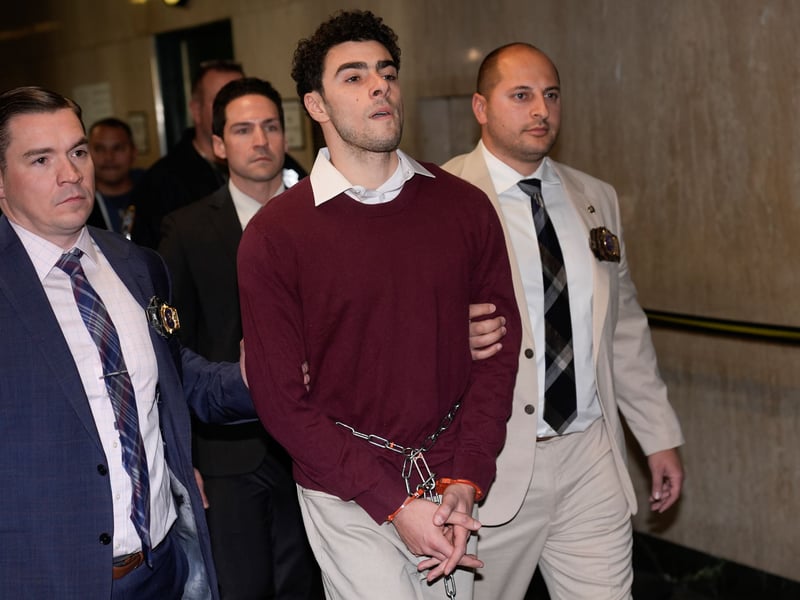
MANHATTAN (CN) — Luigi Mangione’s defense team lambasted Manhattan prosecutors on Friday for “intentionally” violating his right to a fair trial by “unnecessarily publicly releasing his alleged journal” in an effort to paint him as a terrorist.
Mangione, the 27-year-old accused of gunning down UnitedHealthcare CEO Brian Thompson last year, claims prosecutors publicized that evidence despite knowing it could be suppressed at trial.
“The prosecution has cherry-picked the most facially prejudicial information from materials that may never see the light of the courtroom,” Mangione argues in a new filing. “Why? The only rationale that makes sense is that the prosecution hopes to bias the public against Mr. Mangione and undermine his right to a fair trial.”
Earlier this month, prosecutors released journals that they say were recovered from Mangione’s backpack during his 2024 arrest.
One of the entries acknowledged that murdering Thompson could shed light on “a company that literally extracts human life force for money.” Another entry said that the UnitedHealthcare investor conference, where Thompson was headed on the morning he was shot to death, “embodies everything wrong with our health system.”
Prosecutors say these entries “clearly” show that Mangione was acting as a terrorist who hoped to spark widespread violence against the health insurance industry.
Mangione is charged with first-degree murder — a high bar to clear. To meet the threshold for the charge in New York state, prosecutors must meet certain qualifications, including showing that the victim was a judge or police officer or that the crime had terroristic intent. It’s that latter checkbox which prosecutors are marking off for Mangione.
Even so, Mangione argued Friday that terrorism accusations against him fall flat.
For one, prosecutors claim that Thompson’s killing was “not a typical street crime,” in part because the killer didn’t steal his expensive Rolex watch after shooting him. But Mangione claims there are plenty of reasons other than terrorism for why Thompson might have been killed.
“As just one example, the alleged shooter could have selected the victim because of his individual role in setting policies and priorities at UnitedHealthcare, such as manipulating denial rates to increase revenue, leading to denials in coverage for millions of Americans,” he argues. In that scenario, the shooter wouldn’t necessarily have targeted Thompson “to violently broadcast a social and political message to the public at large" but merely to stop his actions.
Prosecutors say Mangione sought “to bring about revolutionary change in the healthcare industry and to abolish health insurance companies.” Mangione claims that theory “is wholly fabricated by the prosecution and appears nowhere in any of the writings.”
“The prosecution completely ignores other journal writings that explicitly state that a terrorist ‘is the worst thing a person can be,’” Mangione adds.
Without the intense media coverage around the case — a factor Mangione says is out of his control — “the alleged homicide is indistinguishable from the hundreds of murders that occur each year in New York City,” he argues.
In fact, Mangione argues, if bad actors draw any from Thompson’s killing, that would actually be law enforcement’s fault. After all, he says, they’re the ones who inaccurately stated that bullets recovered at the scene said “deny, defend, depose,” a phrase that purportedly appeared in threats towards health care executives after the fact. Prosecutors have since clarified that the bullets actually said “delay, den[y], depose.”
“Law enforcement has only itself to blame for the situation that it has created by releasing private journal writings and other information that would not have otherwise become public,” Mangione claims.
The Friday filing was part of a broader effort by Mangione to dismiss his state case as he faces related charges in federal court, where he is eligible for the death penalty.
As it stands, both cases are proceeding simultaneously. Mangione argues that puts him in the uncomfortable position of having to defend himself in two different jurisdictions from two different theories of the crime. He wants to focus on the federal case first before defending himself in state court, arguing: “There has never been a case anywhere in this country in the modern era where a non-capital state prosecution proceeded before a concurrent federal death penalty case.”
Mangione was supposed to appear in state court next week, where the trial judge was set to rule on pretrial motions. But the court needed more time, and the parties agreed to delay the next appearance until September.
Mangione’s court appearances thus far have attracted significant fanfare. Some supporters have hailed him as a folk hero, propping him up as a symbol for health care reform. Others, unsure if he did it at all, have lambasted prosecutors and public officials for treating Mangione differently than other murder suspects.
 Follow @Uebey
 Follow @uebey.bsky.social
Subscribe to our free newsletters
Our weekly newsletter Closing Arguments offers the latest about ongoing trials, major litigation and rulings in courthouses around the U.S. and the world, while the monthly Under the Lights dishes the legal dirt from Hollywood, sports, Big Tech and the arts.