
 Search Articles


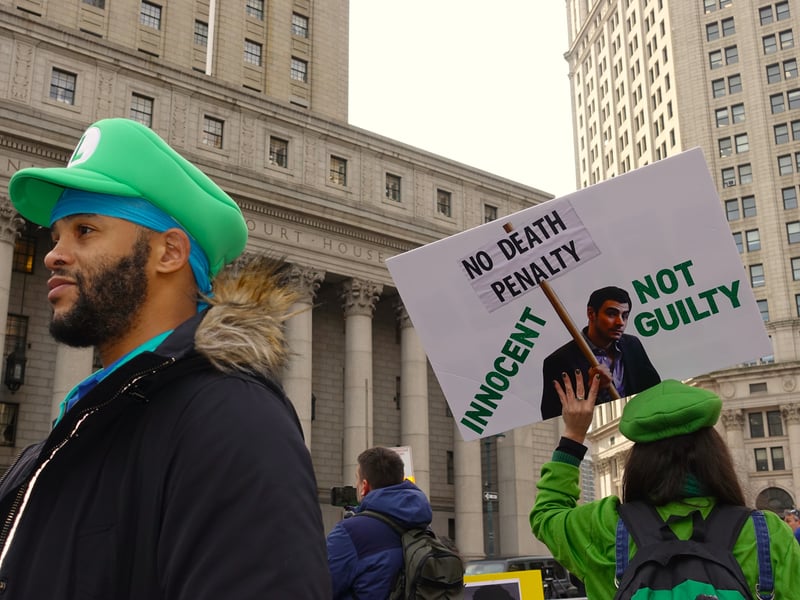
MANHATTAN (CN) — A federal jury could hear Luigi Mangione’s murder case as soon as October of this year.
Federal prosecutors said in a court hearing on Friday that they had reached a loose agreement with Mangione’s defense team on two separate trial schedules — one for if Mangione remains eligible for the death penalty and another for if it is tossed.
If capital punishment is off the table, the parties agreed on an early October trial date following jury selection in September.
Conversely, if U.S. District Judge Margaret Garnett greenlights the death penalty, next January would be a likelier start date, given the additional preparation required for those trials.
Garnett, a Joe Biden appointee in Manhattan, noted that with so many outstanding motions from the defense, these dates will likely be fluid. For instance, she explained that the schedule could change if she rules to dismiss one or more of the charges against Mangione prior to the trial and the government then appeals.
Mangione also has two paths to get the death penalty tossed, both of which could change the start date. He has argued that seeking capital punishment in his case is unconstitutional on its face, citing U.S. Attorney General Pam Bondi’s supposed conflicts of interest among other arguments. He has also argued that his murder charge, which makes him eligible for the death penalty, should be tossed since it’s unlawfully predicated on a stalking charge.
That second argument was the basis of Friday’s hearing. A specially-appointed defense attorney for Mangione argued to Garnett that stalking is not necessarily a “crime of violence” that can lawfully serve as the basis for Mangione’s murder charge.
Mangione is accused of shooting and killing United Healthcare CEO Brian Thompson in New York City on Dec. 4, 2024. In addition to the murder itself, Mangione is charged with two counts of stalking that prosecutors are using to enhance the murder count to one that is capital punishment-eligible.
Defense attorney Paresh Patel, a federal public defender from Maryland who joined Mangione’s team for this specific argument, told the judge that the stalking in this case wasn’t inherently violent.
“The only intent is the intent to harass,” Patel said.
The government argues that the stalking is obviously violent given its intent: Thompson’s murder. Garnett didn’t immediately issue a ruling from the bench on Friday but acknowledged that the broadness of the stalking statute could be an “issue for the government," noting that the law’s history applies more to domestic abuse situations.
Garnett also entertained brief arguments from Mangione’s defense attorney Jacob Kaplan on the necessity of a pretrial hearing on evidence suppression. Kaplan claimed such a hearing is imperative since the police officers who arrested Mangione read pages of a journal — in which he seemingly confessed to the crime — without a warrant, deviating from standard inventory procedure.
“The inventory procedure would allow them to mark the fact that they recovered a journal,” Kaplan argued. “It would not give them … the right to go ahead and read the journal or the contents of the journal.”
Garnett was skeptical, noting that federal investigators later obtained a lawful search warrant that didn’t rely on the contents of the journal at all.
“At present, I don’t think a hearing is necessary,” the judge said. Still, she declined to issue a formal ruling until she’s given the issue more thought.
The timing of Mangione’s federal trial could complicate his parallel state-level case for Thompson’s murder, where he is charged with second-degree murder. Following a three-week evidence suppression hearing that took place last month, it appeared that the state case was set to go to trial first — much to the dismay of Mangione’s own team, who says the higher-stakes federal case should precede it. And yet as it stands now, the state judge has not set even a tentative date for that trial, meaning the federal case could indeed go to a jury first.
 Follow @Uebey
 Follow @uebey.bsky.social
Subscribe to our free newsletters
Our weekly newsletter Closing Arguments offers the latest about ongoing trials, major litigation and rulings in courthouses around the U.S. and the world, while the monthly Under the Lights dishes the legal dirt from Hollywood, sports, Big Tech and the arts.