
 Search Articles


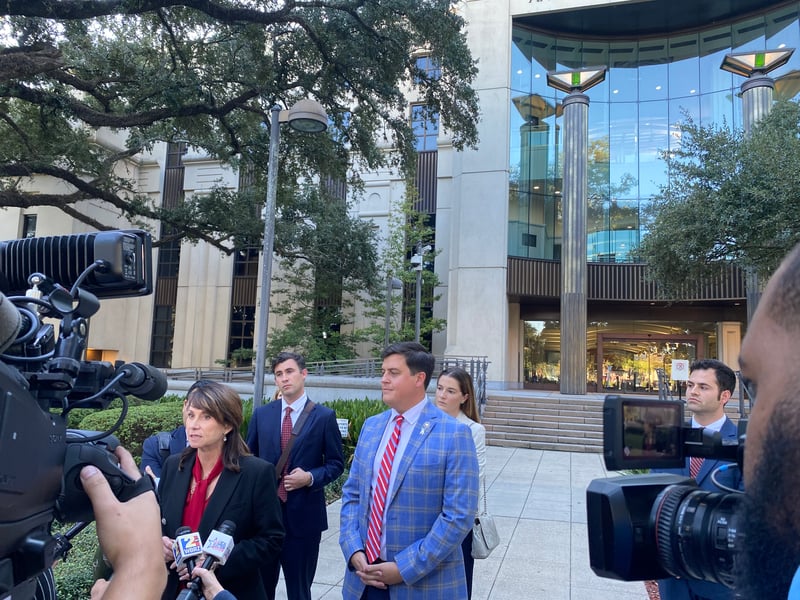
(CN) — The question of whether a Louisiana law requiring displays of the Ten Commandments in every public classroom in the state can be challenged before the law takes effect punctuated oral arguments at the Fifth Circuit on Thursday.
The ongoing effects of severe winter weather in New Orleans prevented an in-person hearing at the historic Wisdom Courthouse, so oral arguments took place via teleconference.
There, a three-judge panel heard attorney Jorge Benjamin Aguinaga argue against an injunction imposed this past November by a lower court judge who found the law violated the free exercise clause of the First Amendment. Aguinaga, on behalf of the defendant school superintendent, said the lower court lacked jurisdiction because the displays are not yet in place and “the plaintiffs seek to challenge hypothetical displays that do not exist and that they have never seen.”
Instead, Aguinaga urged the panel to find the plaintiffs filed the suit prematurely given the lack of injury and unproven theories that students would be offended by observing the displays.
U.S. Circuit Judge Catharina Haynes, a George W. Bush appointee, largely led the panel’s questioning and noted the statute’s language does not call for a maximum size or placement of the display. Haynes also asked about the legislative intent of the law and suggested schools cannot be compared to other public spaces where religious displays have been challenged like courthouses and state capitals.
Aguinaga said those were questions of merit and tried to pivot back to the issues of ripeness and standing.
“You don’t have the facts before you to actually answer the question ‘what is the context of the display?’” he said. “And in fact, because the plaintiffs jumped the gun here and filed an unripe case, no court in this litigation will ever have that important context.”
Aguinaga pointed to the 2022 Supreme Court ruling in Kennedy vs. Bremerton School District ** finding in favor of a public high school football coach who held post-game prayers on the 50-yard line.
“As Kennedy says, you no longer ask about the purpose of law,” he said. “You ask about whether the challenged action reflects one of the hallmarks of an establishment of religion.”
Aguinaga also pointed to establishment clause cases previously decided by the Fifth Circuit which “watered down ordinary standing requirements,” specifically the injury-in-fact requirement. “What requiring an actual encounter does is really the most important guardrail, because it requires a plaintiff to completely specify what has allegedly harmed the plaintiff,” he concluded, also stating his clients are entitled to sovereign immunity.
On behalf of the plaintiffs — a group of parents of public school students — attorney Jonathan K. Youngwood urged the panel to look closely at the legislative text and intent.
“What makes this so significant is the requirement that it be in every single one throughout your 13 years in public school, 177 days a year,” Youngwood said. “It can’t be avoided. It can’t be averted.”
Youngwood said the law further violates the Establishment Clause because at least three of the 10 commandments are explicitly about worshiping or revering God, and the legislative record captured proponents of law expressing their desire to introduce a “Christian, protestant God in every public school classroom every day.”
“That’s 177 days a year for Louisiana public school students anywhere from kindergarten to 12th grade in every classroom, in science, in math, in English, in health, in engineering, drones — every single classroom will have this commonality,” he said. “Of course, the Ten Commandments are worthy of great respect and are profoundly meaningful to many, many people, and they have a place in our society. But they don’t have a place in this form in public schools.”
Youngwood said the case was “remarkably straightforward” and the plaintiffs met the test for ripeness because of the legislative intent. He pointed to the 1980 Supreme Court decision in Stone vs. Graham , which banned a similar Kentucky law because it had “had no secular legislative purpose” and was “plainly religious in nature."
He also pushed back on Aguinaga’s ripeness argument, claiming the harm does not have to be suffered to know it is going to take place.
“The question under ripeness and standing is, do you know enough to make the decision?” he said. “And with great respect for the Ten Commandments, given the way the statute works … [it] will be there everywhere. It is not possible that a little boy or little girl is going to go through even kindergarten without noticing this commonality of each classroom and is not going to come home and ask their parents about it. And that is that concern our parents bring both under establishment and free exercise clauses.”
The panel also included U.S. Circuit Judges Irma Carillo Ramirez, a Joe Biden appointee, and Senior U.S. Circuit Judge James L. Dennis, an appointee of Bill Clinton.
The judges took the case under submission and recognized the need for a decision “sooner rather than later.”
 Follow @gabetynes
Subscribe to our free newsletters
Our weekly newsletter Closing Arguments offers the latest about ongoing trials, major litigation and rulings in courthouses around the U.S. and the world, while the monthly Under the Lights dishes the legal dirt from Hollywood, sports, Big Tech and the arts.