
 Search Articles


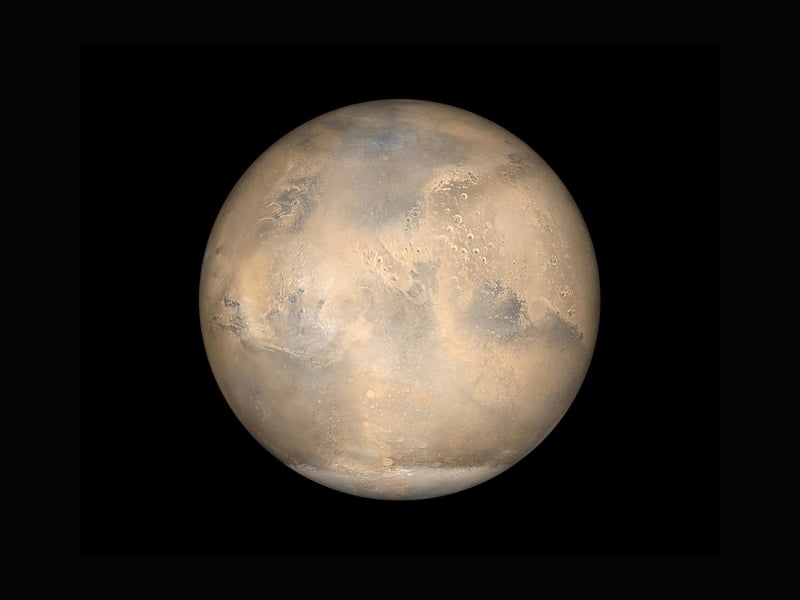
(CN) — Scientists have discovered the longest organic molecules ever found on Mars — carbon chains up to 12 atoms long — preserved in 3.7-billion-year-old rock inside an ancient lakebed.
These molecules resemble fatty acids, a basic component of life on Earth, and were detected by the Curiosity rover’s onboard lab, Sample Analysis at Mars, or SAM, which has been studying Mars’ Gale Crater since 2012.
While the exact origin of the molecules is still unclear, their structure suggests they could be degraded versions of long-chain carboxylic acids — also known as fatty acids — that form the building blocks of life on Earth. These kinds of acids can be made through both biological and chemical processes.
Caroline Freissinet, a researcher with the LATMOS Atmospheres and Space Observations Laboratory in France, said that while the molecules themselves don’t confirm past life on Mars, their presence in a former lakebed shows the planet once had the right conditions for life to exist.
“The presence of organic matter, building blocks of life, in an environment that was an ancient lake of liquid water, makes the environment ‘habitable,’” she said in an email. “It does not mean the conditions were sufficient, nor that life appeared.”
Freissinet, lead author of the study published Monday in Proceedings of the National Academy of Sciences, was joined in the discovery by an international team of researchers from France, the U.S., Mexico and Spain.
But according to scientists, what makes the finding even more remarkable is how long these complex molecules have been preserved. Mars’ lack of tectonic activity and dry, cold climate helped keep the sample intact for nearly four billion years. That opens the door for researchers to dig further into Mars’ history and possibly uncover more chemical traces of ancient life.
“This gives confidence that if life ever existed on Mars, chemical traces of this life could be preserved until today and be detected by us, humans,” Freissinet said in an email.
The discovery also helps scientists map out where to look next. The sample that contained the molecules came from clay-rich material buried for most of its history and only recently exposed to the surface. That makes similar underground deposits — protected from radiation and harsh conditions — prime targets for future missions.
With that in mind, scientists are already gearing up. European Space Agency’s ExoMars mission, set to launch in 2028, will carry a drill capable of reaching two meters below the Martian surface.
Meanwhile, NASA and ESA are teaming up to launch a Mars Sample Return mission in the 2030s, and a new instrument inspired by SAM will be aboard the Dragonfly drone heading to Saturn’s moon Titan in 2034.
Freissinet said none of this would be possible without international collaboration. The SAM lab itself is a joint French-American effort, combining a French-built gas chromatograph and a NASA-provided mass spectrometer.
“Even the instruments are working together, all as one big successful system,” she said in an email.
Freissinet added that the SAM instrument didn’t just help find the molecules, it made the discovery possible.
“SAM is a mini chemical laboratory on Mars, which can heat up a sample up to 850 °C, separate the molecules released from it, and identify them one by one,” Freissinet said in an email. “The analysis of a spectrum acquired with SAM on the Mars’ Cumberland mudstone sample led to the discovery of the long chain hydrocarbons.”
Subscribe to our free newsletters
Our weekly newsletter Closing Arguments offers the latest about ongoing trials, major litigation and rulings in courthouses around the U.S. and the world, while the monthly Under the Lights dishes the legal dirt from Hollywood, sports, Big Tech and the arts.