
 Search Articles


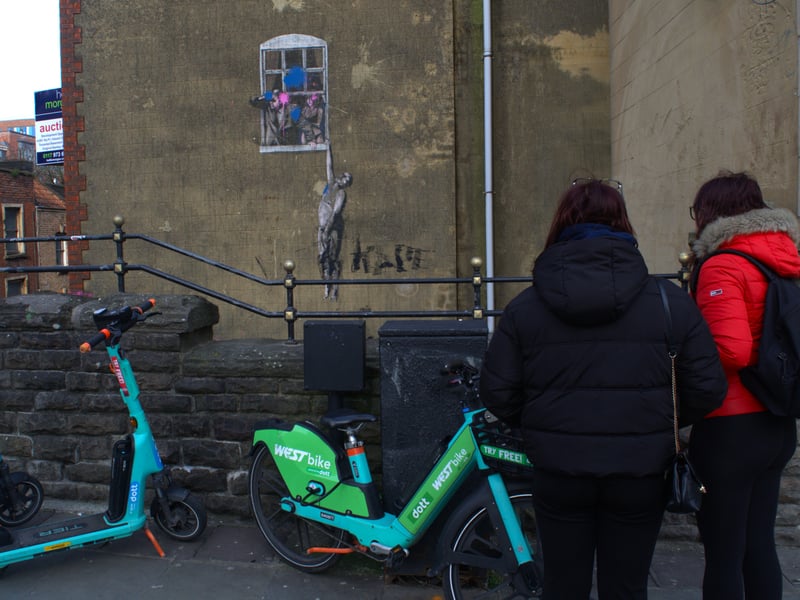
BRISTOL, England (CN) — Along busy Park Street in Bristol’s city center, a public art piece depicts a naked man hanging by his fingers from a bedroom window.
His lover stands at the window in lingerie. Another man — her husband, it would seem — leans out of it, as if looking for the first man. It’s a story about a love triangle, all told through a single, eye-catching image.
Adorning the wall of an otherwise random building, this piece — known as the “Well Hung Lover” — was painted by street artist Banksy in 2006.
It’s peak Banksy, packed with irreverence, subtext and braggadocio. It was also the first work of street art to earn official recognition in the United Kingdom and remains a testament to Banksy’s staying power in Bristol and beyond.
The enigmatic artist got his start spray-painting walls here in the 1990s. In the decades since, he’s become one of the world’s most renowned living artists.
Art magazines sing his praises. Sotheby’s, the art auction house, lists him as the 25th best-selling artist of recent years. Whenever a new Banksy appears, it draws crowds and garners headlines. A whole cottage industry has sprung up around the artist, composed of collectors, rivals, fraudsters, hucksters and even thieves.
Today, Bristol embraces Banksy — though that wasn’t always the case. On its official visitor’s website, the city touts Banksy as “just another kid on the streets of Bristol with a can of spray paint in his hand.”
After all, it was somewhere near Bristol where the shadowy artist was (probably) born. There are 15 Banksy pieces here, including one of his earliest, a work known as “Cat and Dog.”
By some accounts, Banksy is the most famous Bristolian since Blackbeard prowled the seas.
“It’s almost like having Michelangelo growing up in your town, or Picasso,” Joshua Read, a street-art expert at the Arts University Bournemouth, said in a phone interview.
“He’s made himself a massive, massive market in the world, not just in terms of selling art but in terms of being able to put a message across,” Read added. “He ties it in with that kind of British humor.” That makes him “a bit like the Monty Python of the graffiti world.”
Officials in Bristol did not respond to a request for comment on Banksy’s economic impact in the city. Nonetheless, countless fans are drawn here each year to see the artist’s public works.
“From a tourism point of view, he’s marketing gold,” said Jason Tomkins, a Banksy enthusiast who lives near Bristol and runs Banksy Locations, a Facebook group dedicated to tracking Banksy works. “So many people come to Bristol to see art.”
Many want to see “Well Hung Lover” in particular. Set up a picnic table on Park Street and one will see “pretty much a consistent stream of people taking photographs,” said Luke Sargeant, a 39-year-old who runs Banksy walking tours. And with Banksy works scattered across the city, “you could go to about four locations in Bristol and it would be the same thing.”
When Courthouse News visited earlier this year, a steady stream of sightseers were making their way to the Banksies in the center, including the “Well Hung Lover.” Among them: Kaya Kramer, a 26-year-old art teacher from Germany who was visiting the city with her friend Tyler Berry, a 30-year-old video editor.
“He’s relevant because he makes street art big,” Kramer said. “He’s the first artist to actually manage to bring that genre to another level, to make it popular for art museums.”
Berry agreed, describing Banksy’s unique works as “art for the everyman.”
“You don’t have to be super into art,” he said. “You can just wander past and say, ‘That’s cool, that’s different.’”
These days, Banksy is practically a household name. But when “Well Hung Lover” appeared in 2006, he was still making a name for himself with dark humor and headline-grabbing stunts.
Often, that involved pranks. He hung a replica of the “Mona Lisa” at the Louvre in Paris, a smiley face replacing her famous gaze. At the Tate Gallery in London, he hung a painting of the English countryside. There’s crime tape in the foreground, as if police are blocking it off. Neither venue had agreed to show Banksy’s works. Instead, he just snuck in and put them up himself.
For all the humor and mischief, Banksy’s work is often also politically charged. One of his most recognizable works, in the West Bank, shows a masked protester throwing a bouquet of flowers as if it were a Molotov cocktail.
The occupied Palestinian territory holds several notable Banksy pieces, including another known as “Flying Balloon Girl.” This artwork — stenciled on the side of an Israeli separation wall — depicts a girl rising in the air as she holds a bunch of balloons.
Who is this mysterious artist?
Maybe the clearest answer yet comes from the Daily Mail, a British tabloid.
In 2008, the newspaper claimed to reveal the artist’s identity and even included a picture of him. According to the article, Banksy was from Bristol but moved to London in his late 20s. There, he skyrocketed to fame, reportedly with the help of the wealthy British artist Damien Hirst, a fellow Bristol native. (Banksy has neither confirmed or denied the many rumors about his life and identity.)
Banksy clearly wants to remain anonymous — and those who know him have shown remarkable respect for that wish.
As a street artist, anonymity protects him from the legal liabilities that sometimes accompany his art projects. He’s gone to remarkable lengths to stay private, even starting a jokey shell company called the Pest Control Office to handle trademark disputes and public affairs. The group did not respond to a request for comment.
Tomkins, the Banksy expert, said Banksy has returned to Bristol and lives near the city. Still, like many Banksy fans, he said Banksy’s true identity wasn’t the point.
“To me, it’s about his art,” Tomkins said. “I get more out of that than I do out of knowing who he is, where he lives and what he is doing with his wife and kids.”
Even so, after decades of street-art fame, not many gaps remain in Banksy’s story.
Several books and documentaries have pieced together the arc of his life, including “Seven Years with Banksy,” a biography and memoir by fellow Bristol native Robert Clarke. Banksy himself has revealed details in the few interviews he’s given, as well as in his own works, like his own 2006 memoir “Wall and Piece.”
Here’s what’s known: In the 1980s, when Banksy was a teen, graffiti and hip-hop culture were arriving in the United Kingdom from New York City. It found fertile ground in Bristol, then a drab city facing deindustrialization and high unemployment.
Bristol’s port had closed in 1975, and many young people had little to do besides spray-paint. By 1995, a young Banksy was moving in these circles. He had plenty of local graffiti stars to look up to, including Inkie, Cheo, Nick Walker, FLX, Lokey and DJ Robert “3D” Del Naja, who led the music group Massive Attack.
Around the same time, Bristol graffiti artist John Nation started a youth club for other budding artists.
“He really encouraged them to actually get good at it,” said Sargeant, the Banksy tour guide. “That’s really the foundation of it all.”
Evidence of Banksy is scattered across Bristol.
The scent becomes strongest in Easton, a neighborhood in East Bristol where he’s known to have lived in the 1990s.
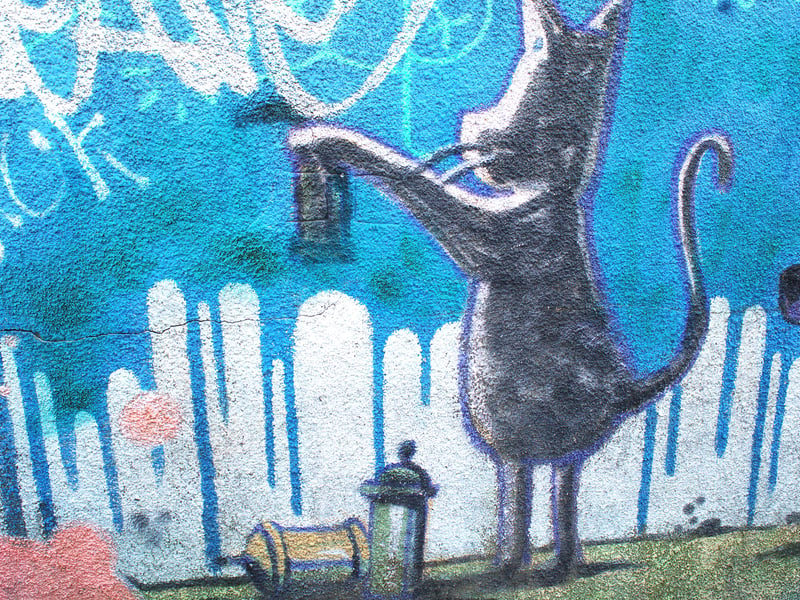
It’s here, on a wall along Robertson Road, where the early Banksy piece “Cat and Dog” can be found. The piece centers on a cat tagging — that is, spray-painting text. Unlike his later stenciled works, it was done by hand and looks cartoonish.
Hang out in Easton for a bit, and one quickly meets locals who claim ties to Banksy. One young woman who declined to give her name said her father once went for a motorcycle ride with the artist.
Ryan Berry, who lives around the corner from the “Cat and Dog,” said he knew two people who knew Banksy, including an artist in London who was friends with him. “He apparently knows who he is, but won’t spill the beans,” Berry said with a smile. “There have been so many rumors.”
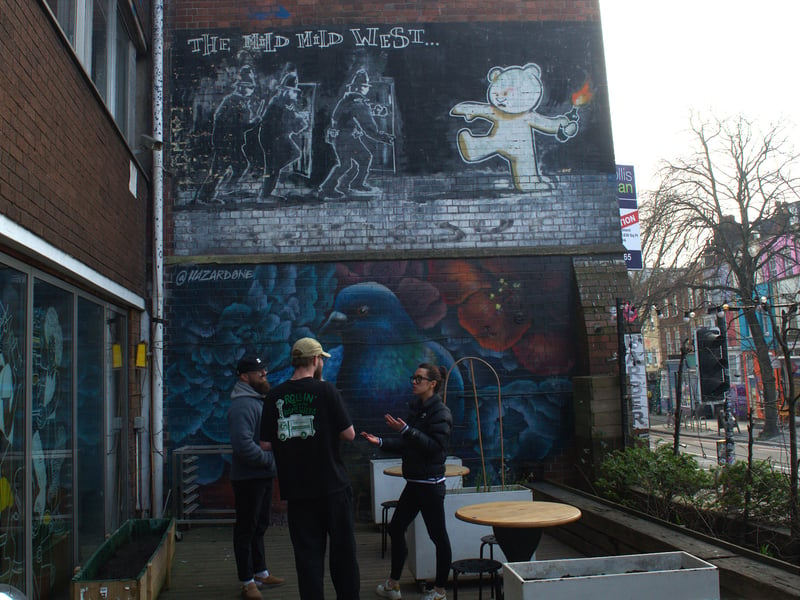
In Bristol, “Well Hung Lover” has been debated, praised, scorned and vandalized ever since it first appeared in June 2006 along Park Street.
Banksy’s works are often vandalized and defaced by rivals — and this one is no exception. In 2009, someone shot it up with a paintball gun. “There’s a lot of jealousy and a lot of hatred directed at Banksy,” Tomkins explained. “Banksy is an instant target for graffiti writers.”
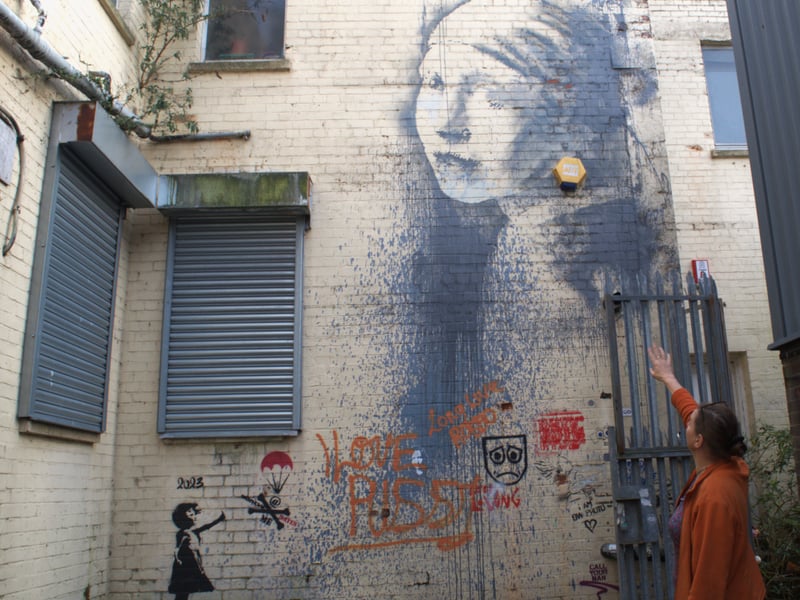
Unknown numbers of Banksy pieces here have been painted over and destroyed. At least four have even been cut out of walls and taken, including hislast known work in Bristol, a 2020 mural entitled “Aachoo” which depicts an elderly woman losing her false teeth as she sneezes.
Those who remove Banksy works are causing more damage than those who deface them, Tomkins said.
“He creates art to be on the street for people to appreciate,” he said. “It’s not meant to be cut out and put into someone’s man cave or museum.” Graffiti is ephemeral by nature, and artists often expect that others might alter or paint over their work. Physically removing it for profit and self-interest, though — that’s a whole different story.
When “Well Hung Lover” first appeared, Bristol City Council made plans to remove it. It wasn’t just vandalism — it was also sexually provocative.
After public backlash, the council conducted an online poll to determine what should happen to the work. A vast majority of voters wanted to keep it, and the council relented. That’s how “Well Hung Lover” became Britain’s first officially recognized work of street art.
These days, Bristol is a city defined by its street art. Tags seem to cover everything: Lamp posts, bus stops, traffic lights, railings, road signs. Streets, walkways and underpasses are often a tapestry of graffiti. Elaborate murals cover the sides of buildings.
Here, as nearly everywhere, it remains illegal to spray-paint in most places. Nonetheless, the city has designated at least six places where it’s legal to leave graffiti. One wall near the port stretches out for 330 feet, and artists are nearly constantly at work on it.
In short, it’s a city where street art seems to have won — and it almost feels like Banksy’s perfect city.
In his 2005 book “Wall and Piece,” the artist sketched out what such a graffitied utopia might look like.
“Imagine a city where graffiti wasn’t illegal, a city where everybody could draw whatever they liked,” he wrote. “Where every street was awash with a million colours and little phrases.”
Banksy has moved the world closer to that vision, turning street art into something serious and respected. And yet in the process he’s become the antithesis of the street-art world, his work hanging in galleries and selling for millions.
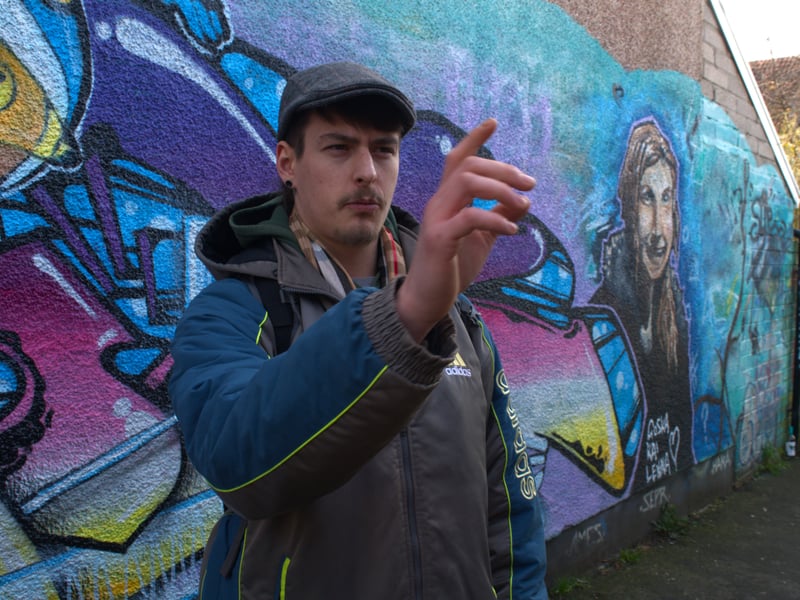
One afternoon in Banksy’s old stomping grounds of Easton, Brad Bracey, a 26-year-old street artist, happened to pass by as a Courthouse News reporter was inspecting the graffiti-covered walls of an alleyway.
Bracey used the graffiti on the walls to demonstrate the evolution of the craft. “It started from people tagging, and then obviously they wanted to put a bit more time and effort into it,” he explained, pointing to one part of the wall. “And then the chunkier letters come in, [along with] bubble letters and all these different types.”
“It’s quite hard to read,” Bracey added. “The main thing is, everyone’s got their different style.”
For Bracey, Banksy and his now almost-cliched images were boring and commercial. He also disliked Banksy’s frequent use of stencils, calling it “a quick way out.” (Stenciling is a graffiti technique in which spray paint is sprayed through cut-outs in another medium, often cardboard, allowing for quick and reproducible artworks.) His favorite local Banksy piece was “Well Hung Lover” in part because it was defaced so badly.
“People have chucked paint balls and stuff all over it,” he chuckled. “I do think that one’s pretty cool.”
“There’s a massive love and hate thing in here,” Bracey explained. “That’s the one thing with graffiti: It’s the love and hate.” Nonetheless, he acknowledged that Banksy’s contributions were undeniable. “Obviously, without some of his influence, it probably wouldn’t be the same as it is now.”
Courthouse News reporter Cain Burdeau is based in the European Union.
 Follow @cainburdeau
Subscribe to our free newsletters
Our weekly newsletter Closing Arguments offers the latest about ongoing trials, major litigation and rulings in courthouses around the U.S. and the world, while the monthly Under the Lights dishes the legal dirt from Hollywood, sports, Big Tech and the arts.