
 Search Articles


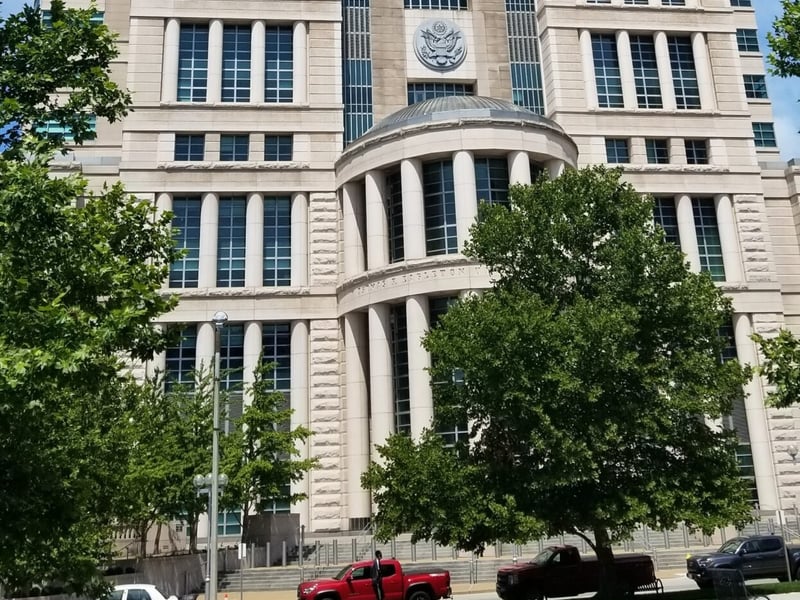
(CN) — An appeal of a lower court order denying qualified immunity to officials at a local jail Tuesday became an inquiry into the broader First Amendment question of whether an inmate’s limited access to reading materials amounted to a de facto ban on books, religious materials and newspapers.
A three-judge Eighth Circuit panel heard the arguments after officials from Washington County, Arkansas, appealed a magistrate judge’s denial of their motion for summary judgment in 2024. The officials sought qualified immunity from a lawsuit filed by an inmate who claims his constitutional rights were violated by the jail’s policy limiting access to certain reading materials to electronic tablets and kiosks.
The inmate, John William Scharnhorst, claims he was unable to easily access certain reading materials at will, including from a physical book cart that was rarely circulated and featured a scant selection. Inmate access to the electronic kiosks and tablets was also limited by time, while the devices also offered a narrow catalogue of reading material.
U.S. Magistrate Judge Christy Comstock denied the county’s request amid a dispute over the facts, concluding a reasonable officer “would have known that a de facto ban on these items violates the First Amendment.” A federal judge adopted Comstock’s findings.
On appeal, the county argued there was no violation of the First Amendment and the case raises important constitutional issues of first impression because “the law as to the method of access to information is not clearly established.” Representing the county, attorney Jason Owens told the panel Scharnhorst had appropriate access to reading materials and courts have ruled in favor of state or federal prisons where similar claims have been raised.
“His complaint was not as a ban … but that [the jail] didn’t have all the genres Barnes and Noble would supply,” Owens said, adding that even assuming all the facts in the plaintiff’s favor, the lower court should still have ruled in the county’s favor and granted immunity. Owens noted the evidence included Scharnhorst’s account history using the electronic devices, which captured him reading or requesting hundreds of articles, books or religious material while he was incarcerated at the county detention center.
The panel included three appointees of Donald Trump: U.S. Circuit Judges L. Steven Grasz, David R. Stras and Jonathan A. Kobes. All were engaged with questions about the merit, jurisdiction and facts of the case, with early concerns about seemingly “blatant contradictions” in the plaintiff’s core claim.
“How do you argue it’s a complete ban if we have uncontested time on these devices?” one asked.
“It’s absolutely not a complete ban,” Owens said, offering testimony that the jurisprudence on banned communication is well defined.
Another judge suggested Owens was “glossing over” some of the plaintiff’s other concerns, primarily the time limits on electronic device usage and his limited access to religious texts. The panel also considered whether their review should examine the plaintiff’s access to books, newspapers and religious texts separately.
Owens did not object, but emphasized that Scharnhorst had adequate access to all three.
Scharnhorst’s attorney Daniel G. Solomon said the court should affirm because it lacks jurisdiction, but also on the merits of the case. He offered to clear up the factual dispute about the plaintiff’s access to reading material.
Per the jail’s policy, inmates can only have three physical books in their cell at a time, and they cannot order or receive books from publishers or family and friends. The policy amounts to a de facto ban because the alternative — the electronic devices — are restricted. Solomon said the tablet was available only 40% of the time and the inmates were only allowed out of the cells for 15 minutes at a time to use the kiosks.
“It doesn’t amount to an available alternative because of the limitations on access,” he said.
Judge Grasz countered that the electronic records documenting Scharnhorst’s access appear to discredit Solomon’s argument.
“I agree with everything you’re saying, but I still don’t think there’s a genuine issue of material fact,” Grasz said. “The problem is those records. I don’t care if he was playing Angry Birds or whatever he was doing, he had access … so it just cannot amount to the complete ban.”
Solomon said Scharnhorst specifically sought a physical copy of the King James Bible, but there were too few copies for all the inmates while the book cart containing other religious texts was rarely accessible. Meanwhile, daily newspapers were not always always uploaded to the alternative electronic devices. At one point in the case, Solomon noted there was a preliminary injunction which mandated the jail provide a physical copy of the daily newspaper.
Judge Kobes said he was concerned about having too much influence on policy at correctional institutions.
“It’s not our job to run prisons,” he said. “What I’m worried about is federal judges coming in and saying, ‘OK, you have to provide the newspaper and a physical copy of the King James Bible, and not this kind of Bible, and you need to buy 20 more tablets’ … that’s what worries me about venturing in this area.”
Both attorneys urged the panel to examine the argument in light of the 1987 Supreme Court ruling in Turner v. Safely , which established the Turner test for whether a prison regulation violates constitutional rights.
“The Turner test should not make it impossible to find that the jail policy is unreasonable,” Solomon said. “I get the concern about not intruding, but at some point it is this court’s job to intervene and say something has to change.”
The panel did not indicate when or how it will rule.
 Follow @gabetynes
Subscribe to our free newsletters
Our weekly newsletter Closing Arguments offers the latest about ongoing trials, major litigation and rulings in courthouses around the U.S. and the world, while the monthly Under the Lights dishes the legal dirt from Hollywood, sports, Big Tech and the arts.