
 Search Articles


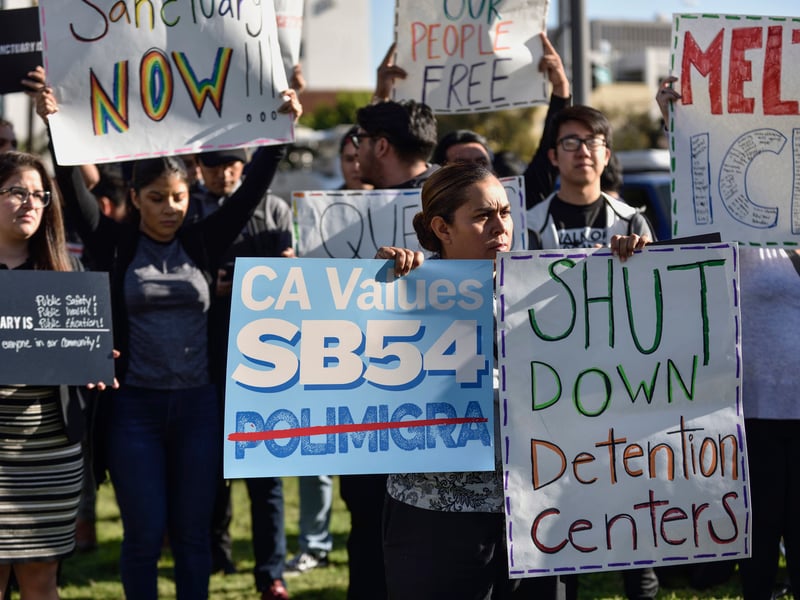
CHICAGO (CN) — After a federal judge’s recent dismissal of a Trump administration lawsuit over Chicago’s status as a sanctuary city, some legal experts are dubious as to whether the administration has an avenue through the courts to effectuate changes to sanctuary laws.
The Justice Department sued Cook County, Chicago and Illinois in February over local immigrant protection laws that it says interfere with federal immigration laws. The lawsuit specifically targeted the Illinois’ Way Forward Act and TRUST Acts and Chicago’s Welcoming City Ordinance, all of which prohibit local officials from sharing information about a person’s immigration or custody status with federal immigration authorities.
U.S. Circuit Judge Lindsey Jenkins dismissed the Department of Justice’s lawsuit citing lack of standing in a 64-page order issued on Friday. Just days before Jenkins issued her dismissal order, the Trump administration filed a similar lawsuit against New York City, Mayor Eric Adams, and top law enforcement officials, accusing them of interfering with federal immigration laws.
The crux of the Justice Department’s argument in the February suit, and the one filed in New York, is that sanctuary laws violate the U.S. Constitution’s supremacy clause, which holds that federal law is paramount over state law. Federal immigration laws were first codified in 1952 through the Immigration and Nationality Act.
Judge Jenkins wrote in her order that “because any collaboration under the INA is permissive, not mandatory, there is no hook for the United States’s preemption argument with respect to maintaining or sharing information about people in custody (including maintaining detainer requests in individuals’ criminal case files) and providing access to individuals in detention for state and local offenses to facilitate ICE interviews.”
Arthur Acevedo, a constitutional law professor at the University of Illinois-Chicago’s law school, characterized Jenkins’s order as well reasoned and noted that she laid out the framework that the federal government must follow should they pursue a supremacy clause argument.
“What the judge did was she cited back to the Arizona case, to the Printz case, to these cases that have prohibited the federal government from trying to either regulate the state or to commandeer the state,” he said.
Printz v. United States is a 1997 Supreme Court case, which held that under the Tenth Amendment, Congress could not commandeer state or local authorities to carry out federal duties. The 2012 Supreme Court case* Arizona v. United States* established that immigration law implementation falls under federal, rather than state, jurisdiction.
Jenkins focused heavily on the anti-commandeering doctrine in her order dismissing the Justice Department’s lawsuit, and noted that federal law does not explicitly prevent information sharing restrictions, like those laid out in the Chicago, Cook County and Illinois laws the Trump administration was challenging.
“It’s not really a question of the federal government’s power through federal action and through federal agents and agencies to enforce the immigration law. Obviously the state has no power to impede federal enforcement,” said James Pfander, a professor at Northwestern University’s Pritzker School of Law. “The question really is one of whether the federal government can compel state cooperation, and that’s where the anti-commandeering provisions of the Tenth Amendment or the principles of that really come into play. "
Illinois Governor JB Pritzker celebrated the judge’s order.
“Illinois just beat the Trump Administration in federal court,” Pritzker said in a Facebook post Friday. “Their case challenging the bipartisan TRUST Act was dismissed — unlike the President, we follow the law and listen to the courts.”
State’s attorney Eileen O’Neill Burke also applauded the ruling.
“The Trump administration’s continued attempts to bully local communities into adopting their preferred policies are not only unlawful, but counter to our values and ability to fight crime effectively,” O’Neill Burke said in an emailed statement.
The Justice Department did not respond to requests for comment.
Acevedo said if the DOJ were to amend their complaint, they’d have to point to some type of preemption analysis or legal precedent that gives the government the authority to regulate information sharing.
“In short, the federal government has an uphill battle,” he said.
Pfander, however, noted that the federal government can encourage states to cooperate. He added that the government can even offer financial or other inducements to convince state or local entities to enforce its policies, noting the case of New York City Mayor Eric Adams, who promised to aid Trump is his deportation efforts after the Justice Department dismissed the corruption case against him.
“But what the federal government can’t do is just simply send a dictate or an order to the states saying you should administer these federal programs for us,” Pfander added. “That is to say, you have to comply with our directives to administer these programs as we think it appropriate. That’s the violation of the anti-commandeering provision that the district court identified and I think that’s the reason the district court judge dismissed the complaint.”
 Follow @RosenCaitlyn
Subscribe to our free newsletters
Our weekly newsletter Closing Arguments offers the latest about ongoing trials, major litigation and rulings in courthouses around the U.S. and the world, while the monthly Under the Lights dishes the legal dirt from Hollywood, sports, Big Tech and the arts.