
 Search Articles


WASHINGTON (CN) — It’s a sprint to the finish this week for Congress, as lawmakers return to Washington for a lame duck session that will see the Senate’s Democratic majority attempt to cement President Joe Biden’s judicial legacy.
But the start of the year’s final legislative session also heralds a change in leadership for Senate Republicans, which could set the tone for the majority’s cooperation with the incoming Trump administration.
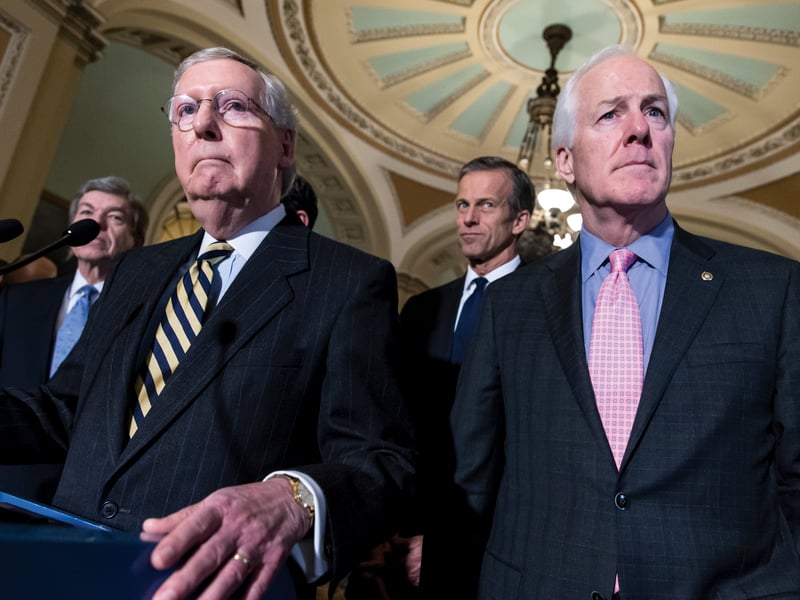
With Republican Senator Mitch McConnell stepping back from his longtime position as the party’s head honcho in January, there is a three-way battle for the majority leader’s gavel. Senate Minority Whip John Thune, Texas Senator John Cornyn and Florida Senator Rick Scott are all vying to become the Senate’s top Republican.
While Thune and Cornyn are two of the Senate’s more senior GOP lawmakers, Scott has emerged as a favorite for supporters of President-elect Trump, who see him as an ally of the incoming administration.
Billionaire Elon Musk has backed Scott’s ascent as majority leader, as has former Fox News host Tucker Carlson, who said over the weekend in a post on X that Thune and Cornyn “hate” Trump. Carlson further disparaged Cornyn, calling the Lone Star State’s senior senator an “angry liberal.”
The Texas Republican, meanwhile, appealed to his fellow Senators on Tuesday, writing in a “dear colleague” letter that his leadership would strengthen and unify the Republican conference.
“It’s no secret that the Senate has not functioned as it should for some time,” he wrote. “The experience Senate Republicans have had under the rule of Senator [Chuck] Schumer is not a reflection of what the institution can be.”
If elected majority leader, Cornyn pledged to “Make the Senate Work Again,” focusing on the chamber’s committee processes and allowing an open amendment process for legislation considered on the floor. He said the Republican Senate should also prioritize President-elect Trump’s cabinet appointments for national security positions and should focus on filling the federal judiciary with “young, conservative nominees.”
Senate Republicans are expected to vote Wednesday for their new majority leader. The process will be done via secret ballot, meaning the votes of individual senators will not be made public.
Judicial confirmation push
For Democrats, meanwhile, the remaining weeks of the year are sure to be focused on dampening the GOP agenda as they prepare to give up control of the upper chamber to a potential Republican governing trifecta.
That effort is likely to materialize in a push to confirm a slate of pending White House judicial nominees, denying President-elect Trump valuable court appointments.
Of the nearly 50 vacancies on the federal bench, which span both federal district and appellate courts, there are more than a dozen Biden nominees either awaiting a vote in the Senate Judiciary Committee or confirmation in the full chamber. The White House also announced a handful of other district court appointments during the congressional recess that will now require lawmakers’ attention.
Lawmakers were scheduled to get the judiciary blitz underway Tuesday evening with a vote on April Perry, tapped by the Biden administration to fill a vacancy on the U.S. District Court for the Northern District of Illinois.
It’s Perry’s second time before the Senate — she was previously nominated as a U.S. attorney, but her confirmation was scuttled by now-Vice President-elect JD Vance, who as a senator imposed a procedural blockade on Biden’s federal prosecutor appointments in response to legal action against Trump.
This time, however, the nominee is expected to clear the upper chamber, if on party lines.
Most of the White House’s remaining judicial appointees face a relatively simple path to confirmation, but there are a few nominees left who have caused some friction among Democrats’ slim Senate majority.
Lawmakers still must contend with Adeel Mangi, nominated to the U.S. Court of Appeals for the Third Circuit. Throughout his confirmation process, Mangi, who is Pakistani American, faced attacks from Senate Republicans who attempted to tie him to a controversial university research program and a prison reform group.
Though legal experts and Democrats have roundly decried the GOP assault on Mangi as baseless and Islamophobic, the pressure cratered support for the nominee among some Democrats. Nevada Senator Jacky Rosen, facing a tough reelection battle, said in the spring that she would not vote for Mangi on the Senate floor. Senator Catherine Cortez Masto, also from Nevada, joined her Silver State colleague in refusing to back the nominee.
Rosen last week secured an electoral victory against challenger Sam Brown. It’s unclear whether that development has changed her calculus on Mangi. A spokesperson for the senator’s office did not immediately return a request for comment.
Montana Senator Jon Tester and Pennsylvania Senator Bob Casey have also faced calls to come out against Mangi’s nomination, though neither lawmaker has said how they plan to vote. Both Tester and Casey lost reelection bids last week.
Further complicating things is the outgoing West Virginia Senator Joe Manchin, who has said that he will not vote with Democrats on nominees who do not capture at least one Republican vote.
Democrats may face another roadblock to their judicial confirmations goal in the form of Sarah Netburn, nominated to the Southern District of New York. Netburn failed to clear the Senate Judiciary Committee in July after a surprise defection from Georgia Senator Jon Ossoff.
Republicans had railed against Netburn, a magistrate judge, over a 2022 case in which she recommended that an incarcerated transgender woman serving a sentence for distributing child pornography be moved from a men’s prison to a woman’s prison. While she reasoned at the time that refusing to do so would violate the inmate’s Eighth Amendment rights, GOP lawmakers contended the transfer would endanger incarcerated women.
Ossoff, a Democrat, cast the deciding vote to keep Netburn trapped in committee. He later explained that he had “concerns” about the jurist’s recommendation, pointing out that he has been a “passionate” advocate for civil and human rights in prisons.
The lawmaker has since declined to say whether he has changed his mind about Netburn’s nomination. And the Judiciary Committee has yet to bring her up for another vote, though panel aides say they can do so at any time.
If Senate Democrats manage to approve all the Biden administration’s remaining nominees, it would restrict the number of new jurists President-elect Trump can appoint as soon as he takes office. It would also ensure that the Biden White House surpasses the 234 judges confirmed during Trump’s first term in office.
However, the incoming administration may still be able to nominate a fair few conservative figures to the federal bench. There are as many as 150 current judges eligible for senior status, a signal that they may soon retire and leave vacancies for Trump to fill.
 Follow @BenjaminSWeiss
Subscribe to our free newsletters
Our weekly newsletter Closing Arguments offers the latest about ongoing trials, major litigation and rulings in courthouses around the U.S. and the world, while the monthly Under the Lights dishes the legal dirt from Hollywood, sports, Big Tech and the arts.