Search Articles


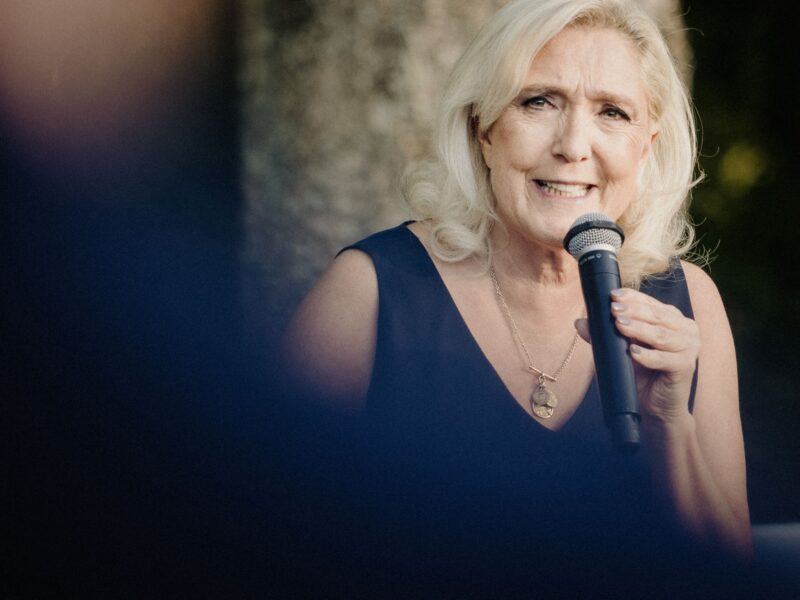
PARIS (CN) — The extreme-right National Rally leader Marine Le Pen’s presidential candidacy is hinging on a bold assumption: That embezzlement convictions won’t deter voters from electing her France’s next leader.
She wasted no time hitting the campaign trial on Wednesday, the day after a Paris appeals court upheld her conviction and she vowed to appeal, meaning she can now run while awaiting a hearing at the nation’s top court.
She arrived in the town of La Flèche, roughly 160 miles southwest of Paris, to shake hands and stroll around the local market. However, the plan was derailed by protesters, which she brushed off as sabotage by the hard-left political party.
“France Unbowed [should] try to convince voters rather than try to prevent us from meeting them,” Le Pen posted on X Wednesday. “I hope that the interior ministry will put conditions in place that will allow all candidates to campaign normally, without violence.”
But the criticism is not just a left-wing phenomenon. In Paris on Wednesday, Fathi Sahli, a clothing merchant who sympathizes with many of Le Pen’s ideas, wondered if there might be distrust growing across the spectrum.
“I’m not against Le Pen and her whole bit, there are some things I agree with socially, when she speaks she says the truth sometimes,” he said in his shop on Wednesday. “But in my opinion she’s going to lose 10-20% of the vote with this thing.”
In March 2025, Le Pen and 23 other members of her party, known as the RN, were found guilty in a multimillion- dollar embezzlement scheme that saw $24,500 monthly paychecks designated for EU aides go to party workers instead.
Le Pen was fined roughly $114,000 and sentenced to four years in prison, two suspended and two to be served with an electronic bracelet. But the most seismic consequence was political: a five-year ban on running for office, with immediate effect.
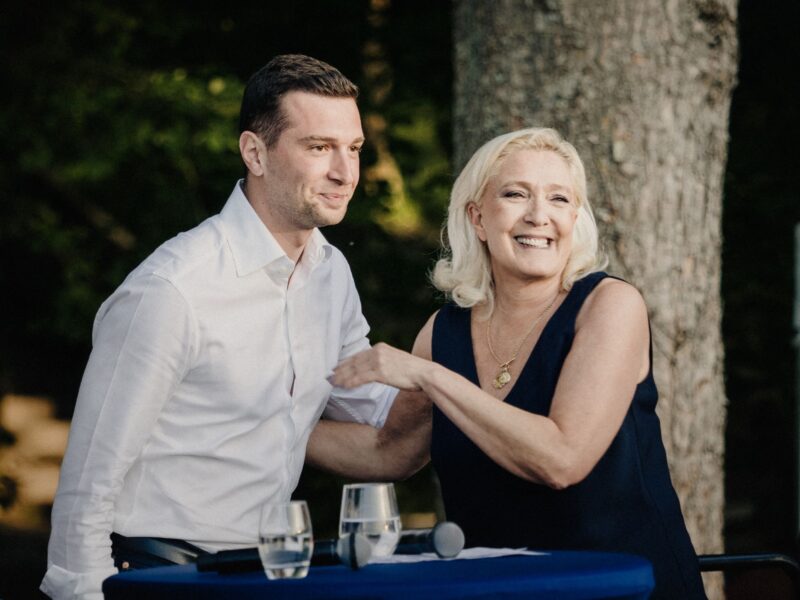
In the months that followed, the party preparedJordan Bardella, her 30-year-old protégée, to run in her place. He’s the ideal counterpoint to Le Pen, whose family name has long been associated with the antisemitism and xenophobic rhetoric propagated by her father. Jean-Marie Le Pen founded the RN as the National Front in 1972. Bardella’s political slate is clear, and his youth and social media savvy have attracted a generation the party previously struggled to win over.
It looked like Bardella would lead the party on Tuesday afternoon, when the Court of Appeal of Paris upheld Le Pen’s conviction, but loosened the ban and adjusted the prison term to three years — two suspended, and one to be served wearing an ankle monitor. The sentence meant she would have had to run a campaign with restricted movements, which she had vowed would never to do.
But on Tuesday night, Le Pen announced she would appeal the decision to the Court of Cassation, France’s highest court, which would suspend her sentence until it renders a decision. On Wednesday, the court said in a statement it would rule by April 2027 — just before the presidential elections.
“I am a candidate in the presidential election,” Le Pen declared with a big smile on the French TV channel TF1.
Down the same street in Paris on Wednesday, Hortense, who asked to go by her first name, was behind the counter of a hosiery shop. Le Pen’s announcement has opened a Pandora’s Box of philosophical questions on the intersection between the justice system, morality and democracy. Hortense immediately invoked this debate.
“Morally, is it legitimate to go from the trial to say that she’s running for president?” she asked on Wednesday. “If it was just a guy from the neighborhood, he’d be in prison, so we see that justice isn’t the same for everyone.”
Hortense believes the justice system let Le Pen run because voters would otherwise argue that judges were interfering in citizens’ freedom of choice. Le Pen herself has said repeatedly banning her would be an affront to democracy.
“She had to run because otherwise people would say that they were blocked from expressing their choices,” Hortense said. “Maybe she doesn’t have the ankle monitor, but that doesn’t mean we think, ‘Madame, you’re innocent.’”
The announcement has sparked widespread debate across the French political spectrum.
“What I see once again is that we have a political figure convicted twice for misappropriation of public funds, who is engaging in a form of judicial and legal guerrilla warfare to run, and who is also holding the entire presidential campaign hostage,” former Prime Minister Gabriel Attal said on Radio France on Wednesday morning.
Jean-Philippe Tanguy, an RN deputy, disagreed. On the same radio segment, he evoked ethical questions.
“Ethics obviously means accepting the rule of law, accepting justice, but it doesn’t mean accepting injustice,” he said. “And I’m sorry to say, Marine Le Pen is in the best position to know whether she’s innocent or not.”
But the big question is whether her convictions will impact voters. Olivier Costa, a director at the Center for Political Research at Sciences Po, believes die-hard RN supporters will be unfazed by the rulings, but Le Pen might have more trouble if she makes it to a final election round. In France, if one candidate doesn’t win 50% of the vote outright, the highest scoring candidates progress to a runoff.
“I think true RN voters don’t care at all because they demand that we be tough on criminals, but only Arabs who steal mopeds — politicians or bosses who commit fraud have never been an issue for them,” Costa said. “Where it becomes a bigger issue is for people who aren’t first-round RN voters. … Those people might be more bothered by the idea of sending a criminal to the Élysée, because the issue of integrity is important to them.”
Maxime Lefebvre, a diplomat and professor at the ESCP Business School in Paris, thinks voters could reason that Le Pen was convicted of embezzling money for her party and not for personal gain. If the Court of Cassation eventually determines she needs to wear an ankle monitor, she could spin it to her advantage.
“She’d be able to say, ‘you see, it’s a persecution,’” he said. “So she can play the role of the victim also.”
But Sahli is convinced her credibility is permanently damaged. He agrees with some of Le Pen’s hardline immigration views and other social policies, but that doesn’t outweigh his skepticism.
“She embezzled public money, so I don’t trust her,” he said. “[Like other criminals] if you don’t put her in prison she’ll do the same thing.”
 Follow @lilyradz
Subscribe to our free newsletters
Our weekly newsletter Closing Arguments offers the latest about ongoing trials, major litigation and rulings in courthouses around the U.S. and the world, while the monthly Under the Lights dishes the legal dirt from Hollywood, sports, Big Tech and the arts.