
 Search Articles


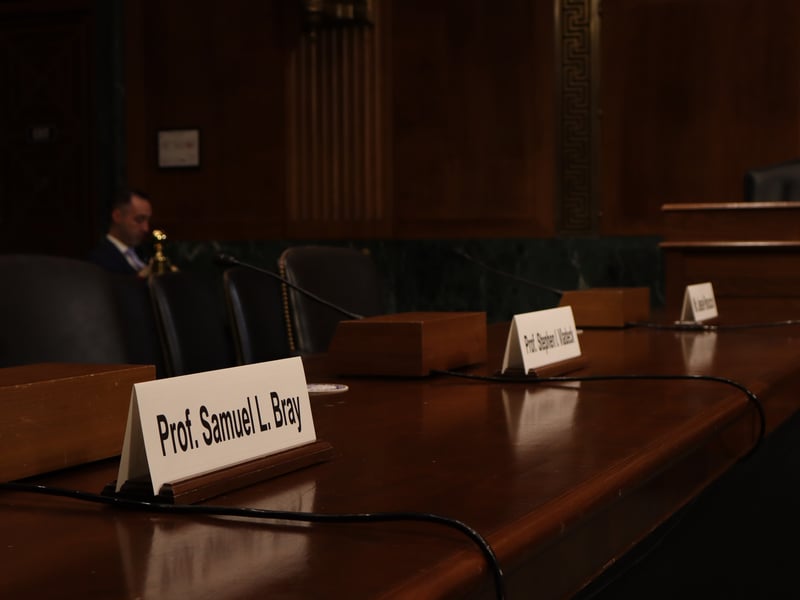
WASHINGTON (CN) — Senate Republicans on Wednesday heard from legal experts who urged Congress to clamp down on federal courts’ ability to issue nationally binding injunctions, which they said violate constitutional separation of powers and unfairly hamstring executive authority.
But Democrats, pointing to a recent spate of court orders stopping the Donald Trump administration from taking a range of unilateral actions, countered that universal injunctions are a necessary check on a runaway White House that has flagrantly violated federal law.
Congress this week began tackling the issue of nationwide injunctions, which has become a pet project for Republican lawmakers in both chambers who are furious that judges in federal district courts have stepped in to stop the administration from firing federal workers, rolling back immigration rights, and shuttering government agencies, among other things.
Roughly 46 lawsuits against Trump policies have resulted in temporary restraining orders or preliminary injunctions — emergency measures that force the White House to freeze or reverse its activities while litigation is underway.
Republicans have in recent weeks introduced legislation aimed at reducing the scope of national injunctions. In the Senate, Iowa Senator Chuck Grassley and Missouri Senator Josh Hawley have both unveiled separate bills that would make such orders applicable only to parties to the case at hand.
Criticism of the use of nationally binding judicial injunctions has not historically been limited to the GOP, however. Democrats have in the past slammed the use of these court orders to block access to abortion medication — a federal court in Texas in 2023 singlehandedly halted the sale of abortifacient mifepristone until the Supreme Court reversed the order.
Past bipartisan skepticism of national injunctions has formed the backbone of the Republican sales pitch for legislation aimed at skewering the process. Speaking during a hearing on Wednesday in the Senate Judiciary Committee, Grassley argued that both Democrats and Republicans should agree to give up universal injunctions as a “weapon” against policies they dislike.
“The damage it causes to the judicial system and our democracy is really too great,” said Grassley, who chairs the panel. He added that the use of national injunctions is a problem that has “plagued and frustrated” presidents from both parties.
Samuel Bray, a Notre Dame Law School professor invited to testify, told lawmakers that federal courts should be a “bulwark” against unconstitutional or illegal actions, but not by assuming powers he said the Constitution did not afford to the judiciary.
“A final judgment binds the parties, and a court order must be followed — no one is above the law,” Bray testified. But those judgments, he argued, only carry that weight because of the principle that courts “act as courts,” meaning that they decide cases and offer legal remedies to the parties.
“Once a federal court decides a case and gives a remedy to the parties and the people to represent, there is nothing left for it to do as a court,” said Bray. “There is no constitutional authority for the judge to go on and decide the cases of other people or give remedies to other people not before the court.”
Bray and Grassley suggested that, instead of seeking national injunctions, litigants could use class action suits to secure broad relief from courts.
Democrats on the Judiciary Committee, meanwhile, said they were open to discussing the implications and potential pitfalls of nationwide injunctions. However, they contended that such a conversation should not occur in a vacuum nor ignore what they said were blatantly illegal policy moves by the Trump administration.
“It’s impossible to separate the hearing from President Trump’s record in office,” said Illinois Senator Dick Durbin, the panel’s Democratic ranking member. “The reality is that the number of injunctions issued against the first and second Trump administrations are evidence of a president who is clearly violating the law.”
Stephen Vladeck, a professor at Georgetown University’s law school, concurred, telling the Judiciary Committee that any discussion of nationwide injunctions should be had within the context of what he said was the “unprecedented moment in which we find ourselves.”
“Substantively, we have a president running roughshod over existing, real constraints to a degree we’ve simply never seen before,” said Vladeck. “And procedurally, we have a Justice Department engaged in highly partisan and ethically dubious behavior in lower courts that we’ve never seen from lawyers working for the federal government.”
The Democrats’ witness also told lawmakers that he agreed with efforts to reform the judicial process and did not defend nationwide injunctions as a practice — but argued that such reform should aim to improve the judiciary as a whole and not merely “maximize short-term partisan political advantage.”
He suggested, among other things, that lawmakers set reforms to take effect in 2029 after Trump is set to leave office.
“Otherwise, the message this committee would be sending is that its goal is to insulate an unprecedented degree of lawless behavior by the executive branch from meaningful judicial review,” Vladeck said.
During Wednesday’s hearing, witnesses sparred with lawmakers on both sides of the dais.
Vladeck faced a sharp rebuke from Tennessee Senator Marsha Blackburn, who took issue with his comments about what he positioned as partisan behavior from the Justice Department.
“I just find it rich with irony after we sat here for four years and watched President Biden’s DOJ weaponized against the American people, we had parents that went to school boards that were called domestic terrorists, and we have seen two tiers of justice,” the lawmaker said.
Blackburn’s complaints echoed years of GOP fury at the Joe Biden administration, which they have long accused of targeting political opponents. Congressional investigations led by the Republican-controlled House turned up little solid evidence of any such campaign within the Biden Justice Department.
Vladeck did not get a chance to respond to the Tennessee senator’s charge. She instead demanded he submit an answer in writing.
Later on, Bray went head-to-head with Vermont Senator Peter Welch, who pushed back on the idea that class actions could be an alternative to injunctive relief. The Democratic lawmaker contended that securing a class action — which requires a legal determination to establish an aggrieved class — would be more expensive and take more time than seeking an injunction.
“What is the practical burden in terms of cost, in terms of what kind of legal power you have to have, as opposed to a single lawyer who has a single client who comes in and wants relief?” Welch said. “What’s it going to cost me to do a certification for class, as opposed to me just filing and paying the filing fee at the federal district court?”
Bray acknowledged there are “more requirements” for a class action suit. “But it also matches the scope of the relief sought,” he told the Vermont Democrat.
While the Senate drilled down on national injunctions, a similar push in the House hit a snag on Tuesday after an intra-party row scuttled plans to pass the lower chamber’s own bill aimed at reducing their scope.
House Republicans had planned to vote on California Representative Darrell Issa’s No Rogue Rulings Act as early as Wednesday, but leadership canceled voting for the rest of the week after a procedural vote teeing up the legislation failed Tuesday afternoon.
The lower chamber’s judiciary committee on Tuesday morning held its own hearing examining nationwide injunctions.
 Follow @BenjaminSWeiss
Subscribe to our free newsletters
Our weekly newsletter Closing Arguments offers the latest about ongoing trials, major litigation and rulings in courthouses around the U.S. and the world, while the monthly Under the Lights dishes the legal dirt from Hollywood, sports, Big Tech and the arts.