
 Search Articles


ATLANTA (CN) — A yearslong, controversial bid to mine next door to Georgia’s natural treasure, the Okefenokee Swamp, was put to an end on Friday as the Conservation Fund announced its purchase of the proposed mining site.
The nonprofit specializing in acquiring at-risk lands announced that it purchased about 8,000 acres of land near the swamp for just under $60 million from the Alabama-based company, Twin Pines Minerals. In addition to the land, the group is also acquiring the underlying mineral rights.
The acquired land includes a tract where Twin Pines had planned a roughly 600-acre demonstration mine to harvest titanium dioxide and other heavy minerals.
The purchase puts an immediate halt to the project that faced over six years of opposition from Georgians, environmentalists and scientists who warned it could irreparably damage North America’s largest blackwater swamp.
“Georgia’s Okefenokee National Wildlife Refuge is a special place and one of the most important natural treasures in Georgia. It’s the kind of place that sticks with us and sustains us — a destination for nature lovers and home to unique plants and wildlife like alligators, wood storks and bald eagles,” Stacy Funderburke, vice president of the central Southeast region at the Conservation Fund, said.
“By purchasing this land from Twin Pines, the Conservation Fund will ensure that the Okefenokee National Wildlife Refuge remains wild and unspoiled for all Americans,” she added.
Funderburke said mining along trail ridge, the eastern edge of the blackwater swamp, would have threatened the water table of the larger refuge and severely impacted the flow of water in and out of the nearly half-million-acre Okefenokee National Wildlife Refuge.
In 2019, Twin Pines sought permission to mine near the Okefenokee Swamp, but the U.S. Army Corps of Engineers required an environmental impact statement. In response, Twin Pines withdrew and resubmitted a smaller project proposal. Three years later, the Army Corps shifted permitting authority back to Georgia’s Environmental Protection Division.
Last year, Georgia regulators released draft permits for the project that required Twin Pines to set aside $2 million for future restoration of the mining site. But after 16 months, Twin Pines had yet to submit a surety bond or equivalent financial assurance to show the Georgia Environmental Protection Division that it has access to that amount of cash or credit.
“Twin Pines’ decision to sell their land to a conservation buyer instead of to a mining company is a respectable response to the hundreds of thousands of voices who have spoken out against the mining proposal,” said Megan Desrosiers, president and CEO of coastal conservation group One Hundred Miles.
“One Hundred Miles is grateful and proud to have been part of the effort to bring together funders, environmental organizations and citizens from across the country together to protect the swamp.”
The acquisition was brokered with the financial support of some of the nation’s leading private philanthropies, including the James M. Cox Foundation and the Holdfast Collective, a conservation-focused nonprofit funded by the outdoor apparel giant Patagonia.
More than 402,000 acres are protected in the Okefenokee National Wildlife Refuge, the largest refuge in the eastern United States and home to hundreds of plant and animal species, including the imperiled gopher tortoise and wood stork.
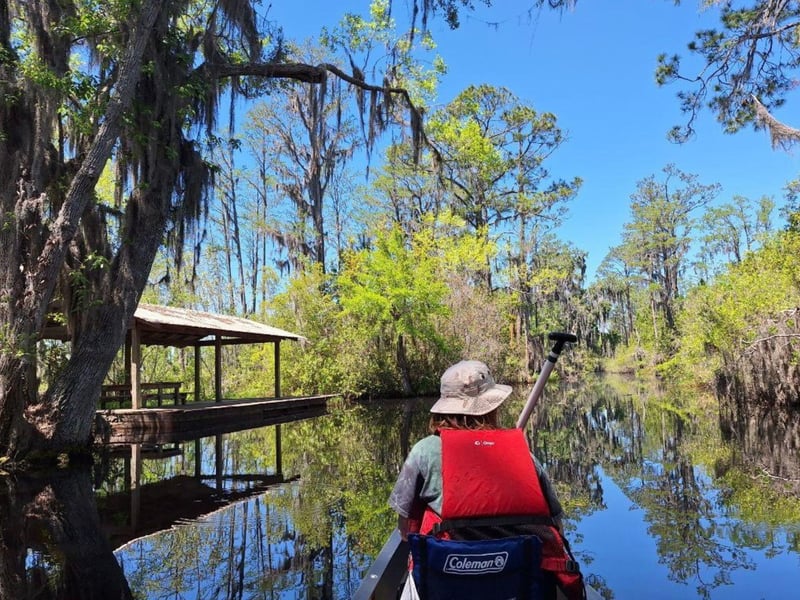
Often translated as the Creek Indian word for “land of trembling earth,” the Okefenokee’s fragile ecosystem is made of buoyant peat deposits, moss-draped cypress trees, floating flowering plants and intricate blackwater channels inhabited by an estimated 12,000 American alligators.
It’s also recognized as a certified dark sky park by the International Dark Sky Association, meaning its minimal light pollution makes it a prime stargazing destination for campers.
The captivating and seemingly untouched scenery draws in over 800,000 visitors to the Okefenokee each year, who spend $91.5 million in nearby counties, according to the Conservation Fund.
Visitation is expected to double if the refuge’s nomination as a UNESCO World Heritage Site is accepted. If designated, the swamp would join the list recognizing 1,223 cultural and natural sites of universal importance such as Arizona’s Grand Canyon, India’s Taj Mahal, China’s Great Wall, and Ecuador’s Galápagos Islands.
Conservation groups say the rare distinction would boost the Okefenokee’s profile as one of the world’s last intact blackwater swamps, as well as economic opportunities in the region.
 Follow @Megwiththenews
Subscribe to our free newsletters
Our weekly newsletter Closing Arguments offers the latest about ongoing trials, major litigation and rulings in courthouses around the U.S. and the world, while the monthly Under the Lights dishes the legal dirt from Hollywood, sports, Big Tech and the arts.