
 Search Articles


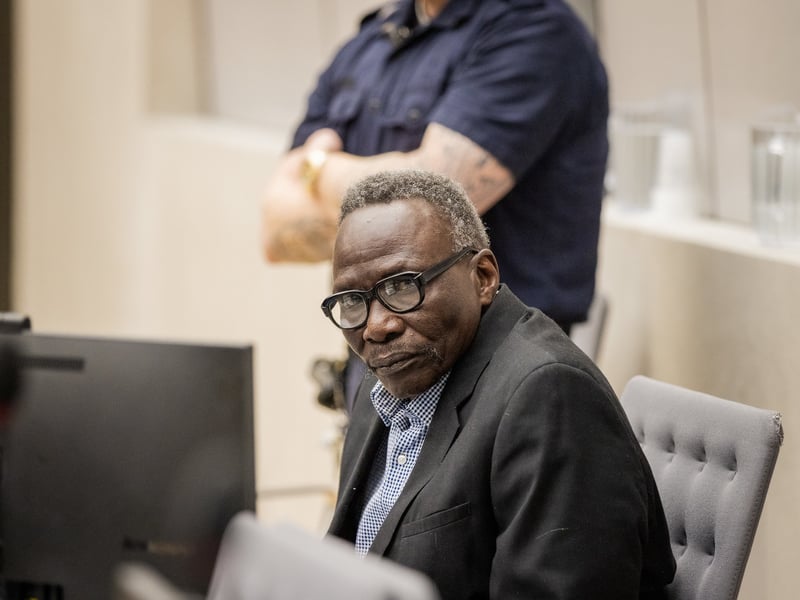
THE HAGUE, Netherlands (CN) — Across three tense days in The Hague’s International Criminal Court, lawyers sparred over the fate of Ali Kushayb, the man found guilty of some of Darfur’s darkest crimes, as judges decide how long he will spend behind bars.
The hearings ended with a debate over what justice should mean for a 76-year-old man found guilty of leading brutal attacks on non-Arab civilians two decades ago.
Prosecutors and victims’ lawyers urged the judges to impose a life sentence, saying anything less would trivialize the scale of the crimes and the trauma that still lingers in Darfur. The defense, by contrast, painted Kushayb as an old man who had already endured years of confinement and whose remorse, they said, should count for something.
Defense counsel Iain Edwards urged the judges to look beyond the atrocities and see the person behind them. “He lost two sons. He had to mourn them alone in his cell, thousands of miles from his grieving family, unable to perform funeral rites for his children,” he said, calling any long prison term “a sentence that will see him spending the rest of his life in prison.” He appealed to the chamber to consider Kushayb’s age, fragile health and the efforts he has made to stay connected to his family.
But the judges showed little patience when the defense tried to link his family losses to mitigation. One judge reminded Edwards that, for sentencing, “we have to look at what was in your client’s mind,” and said there was “no evidence at all that this had any effect on his decision or not to surrender.” The panel also challenged claims that Kushayb’s age or family hardship should significantly soften the punishment, noting that such circumstances were common among convicted war criminals.
Prosecutors pushed back hard against any plea for leniency. They argued that Kushayb’s position as a militia commander meant he bore direct responsibility for the campaign of murder, rape and forced displacement carried out under his command.
They pointed to earlier international rulings, including cases where paramilitary leaders convicted of similar massacres received life sentences, to show that the scale of devastation in Darfur left no moral or legal basis for mercy. “No personal hardship,” the prosecutors said, “can outweigh the gravity of crimes committed on this scale.”
The victims’ representative took a different tone but a similar stance, telling the court that “justice, the just and fair application of the law, is what is expected from you, Your Honors.” He urged the chamber to rise above vengeance yet uphold the ICC’s credibility as a “beacon of international criminal justice.” The real test, he said, was whether the court would remain faithful to the rule of law while recognizing the enormity of what Darfur’s victims endured.
By the end of the exchanges, the arguments had crystallized: The defense asked for humanity, the prosecution demanded accountability and the victims sought assurance that justice would not lose its meaning in the details of the sentence.
Over three days of arguments, the three judges — Joanna Korner, Reine Alapini-Gansou and Althea Violet Alexis-Windsor — pressed both sides on where justice should draw the line between punishment and compassion. Their task now is to weigh Kushayb’s age and circumstances against the sheer scale of the crimes the court said were part of a deliberate campaign of murder, rape and persecution.
Kushayb, whose real name is Ali Muhammad Ali Abd-Al-Rahman, was found guilty in October on 27 counts of war crimes and crimes against humanity for leading the Janjaweed militias during Sudan’s campaign in Darfur between 2003 and 2004.
Judges said he ordered attacks on villages, oversaw executions and drove thousands of non-Arab civilians from their homes. The verdict marked the ICC’s first conviction tied to the Darfur conflict, a war that left an estimated 300,000 people dead and millions displaced.
The judges said the violence was no accident but part of a coordinated campaign. Under Kushayb’s command, Janjaweed fighters stormed villages like Kodoom, Bindisi and Mukjar, burning homes, killing men and attacking women as families fled.
Witnesses described gunmen bursting into houses, shooting people trying to escape and hauling away captives who were never seen again. Entire communities, they said, were wiped out as Kushayb directed the assaults alongside government troops.
Born in 1949 in South Darfur, Kushayb once served in the Sudanese army before turning into a local powerbroker when war erupted. Long before he commanded militias, he was known for running a small pharmacy in the market town of Garsila.
But as the government armed local groups to crush a rebellion by non-Arab communities demanding equality, he rose quickly through the ranks and became one of the regime’s most feared enforcers.
After years on the run, he surrendered to the ICC in 2020. His trial began in 2022 and wrapped up with closing arguments last December. Although his lawyers filed an appeal on Nov. 6, the sentencing phase is moving forward before review. A separate reparations process for victims will come next.
Two decades later, Sudan is once again in turmoil. The army and the Rapid Support Forces — a powerful paramilitary group that grew out of the Janjaweed — have been fighting a new civil war since April 2023. The conflict has displaced more than a million people, killed hundreds and drawn international sanctions, including U.S. visa bans and asset freezes after failed ceasefire talks.
Sentencing is set for Dec. 9 and will be delivered in open court, streamed live from The Hague. For many people in Darfur, that moment will be another test of whether international justice can still make good on its promises.
Courthouse News reporter Eunseo Hong is based in the Netherlands.
Subscribe to our free newsletters
Our weekly newsletter Closing Arguments offers the latest about ongoing trials, major litigation and rulings in courthouses around the U.S. and the world, while the monthly Under the Lights dishes the legal dirt from Hollywood, sports, Big Tech and the arts.