
 Search Articles


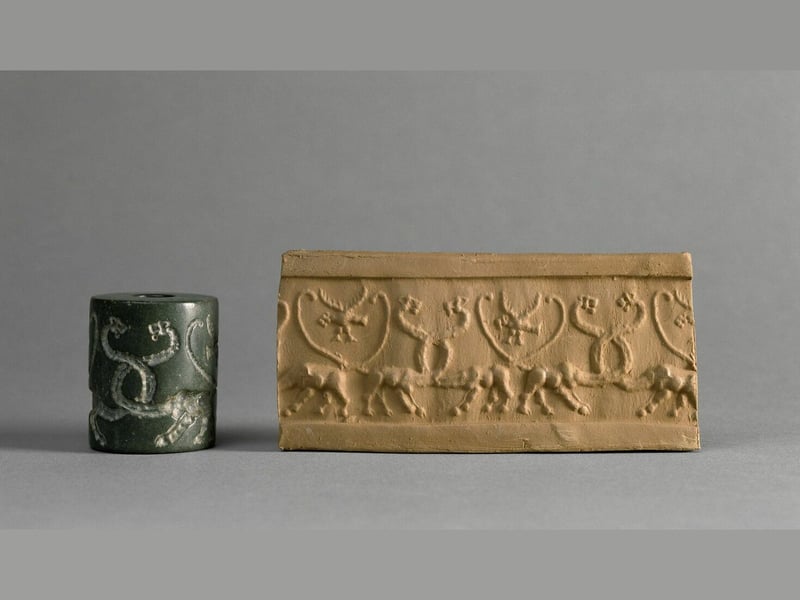
SAN DIEGO (CN) — The Rosetta Stone for deciphering and tracing the origins of one of humankind’s earliest writing systems might just be cylindrical seals used to imprint images onto a series of ancient bureaucratic accounting tablets.
“The invention of writing marks the transition between prehistory and history, and the findings of this study bridge this divide by illustrating how some late prehistoric images were incorporated into one of the earliest invented writing systems,” Silvia Ferrara, the lead researcher of the study, said in a press release.
Back in the fourth millennium, in the city of Uruk in modern day Iraq, an accounting system developed where stone cylinders engraved with designs were rolled onto clay tablets in order to stamp objects with those designs and images, the researchers write in their study published in the journal Antiquity.
The stamps were used to track the production of agricultural goods, like dry fish, and textiles. It also functioned like an early form of branding to identify institutions, the senders of goods or the destinations of the products as they made their way around ancient societies in modern day Iran, Iraq, Syria and Türkiye.
“Seals are a key consideration on the path towards writing in southwest Asia. At times, shared seal and sign shapes may reflect common referents in the real world,” like the need to track trade and the movement of goods around the ancient Middle East," the researchers write in their study.
In the same city, a form of archaic writing made up of pictographic signs called proto-cuneiform also developed.
Like the cylindrical seals, proto-cuneiform was used for accounting and bureaucratic purposes but many of the 800 identifiable proto-cuneiform pictographs aren’t yet decipherable.
“The close relationship between ancient sealing and the invention of writing in southwest Asia has long been recognized, but the relationship between specific seal images and sign shapes has hardly been explored,” said Ferrara. “This was our starting question: did seal imagery contribute significantly to the invention of signs in the first writing in the region?”
To try to better understand both images on the cylinders and the proto-cuneiform pictographs, Ferrara — a professor in the Department of Classical Philology and Italian Studies at the University of Bologna — and a team of researchers compared the two ancient accounting systems.
While late in the fourth millennium, there were times when the two systems of seals and texts had a degree of interplay, where both systems shared shapes and reflected each other; they were still distinct information systems, the researchers write.
But the researchers say that designs and images from the seals that related to the transport of goods, like textiles and pottery, may have evolved into corresponding proto-cuneiform signs and script.
“Our findings demonstrate that the designs engraved on cylinder seals are directly connected to the development of proto-cuneiform in southern Iraq,” Ferrara said. “They also show how the meaning originally associated with these designs was integrated into a writing system.”
Showing how shapes, designs and images evolved into a more cohesive writing system not only helps scientists better understand the development of human writing systems, it also “casts light on the late fourth millennium as a time of intense technological innovation, during which different modes of communication were not only exploited in new ways but were also deployed in synergy,” the researchers say in the study.
Subscribe to our free newsletters
Our weekly newsletter Closing Arguments offers the latest about ongoing trials, major litigation and rulings in courthouses around the U.S. and the world, while the monthly Under the Lights dishes the legal dirt from Hollywood, sports, Big Tech and the arts.