
 Search Articles


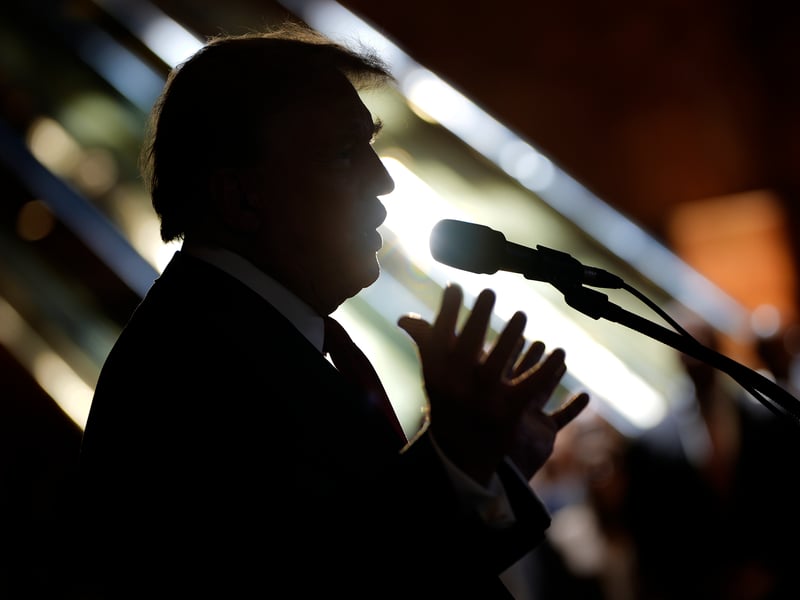
WASHINGTON (CN) — A federal judge unsealed four exhibits supporting special counsel Jack Smith’s recent immunity brief in Donald Trump’s election subversion case on Friday.
The release, which had already been delayed a week on Trump’s request, unveils a portion of the reams of evidence Smith has compiled against the former president and 2024 election candidate regarding Trump’s efforts to overturn his 2020 defeat.
Trump made a last-ditch attempt on Thursday to push the dossier’s release back to Nov. 14, over a week after the Nov. 5 election, but U.S. District Judge Tanya Chutkan rejected his request.
She disagreed with Trump’s assertion that unveiling Smith’s immunity exhibits first would amount to election interference, finding that the public has a right to consider all the available evidence and keeping it sealed would be actual interference.
Friday’s dossier was separated into four separate volumes with hundreds of pages, all totaling 1,889 pages. While large swaths of the exhibits remained sealed and partially redacted, they include evidence from interviews by the House Select Committee on Jan. 6 and Mike Pence’s book “So Help Me God.”
The first volume, with 723 pages, includes testimony by figures who had communications with Trump between the November 2020 election and Jan. 6.
One new revelation from the filing came from an interview with an unnamed White House valet, who described a conversation in which he had to tell Trump his speech from the Ellipse on Jan. 6 had been cut short “because they’re rioting down at the Capitol.” According to the valet, the conversation occurred around 1:21 p.m. that day, the earliest time stamp thus far as to when Trump learned of the violence that day.
In another discussion, an unnamed individual described meetings in which Trump was told his “Green Bay Sweep” scheme — where Pence would certify Trump’s false slate of electors on Jan. 6 — was constitutionally unviable.
The individual made clear to Trump that if the vice president has the authority to declare the winner of each state, there would likely never be a switch between parties again.
“[Trump] acknowledged that he didn’t think Kamala Harris should have that authority in 2024; he didn’t think Al Gore should have had it in 2000; and he acknowledged that no small-government conservative should think that was the case,” the individual told the House Committee.
Even if the Supreme Court was to take on the issue, they would have unanimously ruled against Trump, the individual said. Trump purportedly pushed back, saying he thought at least Justice Clarence Thomas and another conservative justice would side with him, before agreeing he would lose outright.
Other portions of the volume included testimony from figures like former Republican Speaker of the Arizona House Rusty Bowers, who described how Trump tried to pressure him to participate in his false elector scheme.
In a phone call with Trump and another adviser, Bowers was pushed to call for a special legislative session to decertify Arizona’s election result. Bowers said the adviser promised to provide evidence to back Trump’s claims of election fraud, but never turned over any such evidence.
The adviser told Bowers that someone “high up in Republican circles” had suggested that Arizona law allowed lawmakers to call for the dismissal of electors who had passed on the state’s votes for Biden and replace them with Trump-aligned electors. But when Bowers asked who that figure was, he never received an answer.
Without such proof, Bowers pushed back against Trump’s pressure campaign, emphasizing that he would not act without evidence.
“You said you had proof, and I want it,” Bowers recounted to the committee. “You bring me the proof of all these things you say are real.”
The second volume included 246 pages with screenshots from Trump’s X account after the election, where he frequently tweeted false claims of election fraud and retweets targeting swing state election officials. Smith has shown that Trump’s tweets are a key part of his argument that much of the former president’s conduct was unofficial and therefore not immune.
Smith’s third volume, at 536 pages, features public statements from state election officials — both Republicans and Democrats — in swing states like Arizona, Michigan, Georgia, Pennsylvania and Wisconsin reassuring voters that the election was in fact secure and pushing back against Trump’s claims of election fraud.
It also includes memos outlining Trump’s false elector scheme and notices that were sent to swing state governors seeking their certification.
In Smith’s final appendix, he again provides written plans to hijack the certification process on Jan. 6, using Pence’s ceremonial role to announce he had multiple slate of electors and use the dispute to justify throwing out seven swing states’ results. By dismissing those electoral votes, Trump theorized, Pence would effectively drop the total number of electors from 538 to 454, of which Trump had the majority of votes.
With wide swaths of each volume remaining under seal, it is unclear whether Chutkan will decide to release more information before the election. She scheduled Trump’s reply for Nov. 7, but has indicated he is free to file his rebuttal earlier.
 Follow @Ryan_Knappy
Subscribe to our free newsletters
Our weekly newsletter Closing Arguments offers the latest about ongoing trials, major litigation and rulings in courthouses around the U.S. and the world, while the monthly Under the Lights dishes the legal dirt from Hollywood, sports, Big Tech and the arts.