
 Search Articles


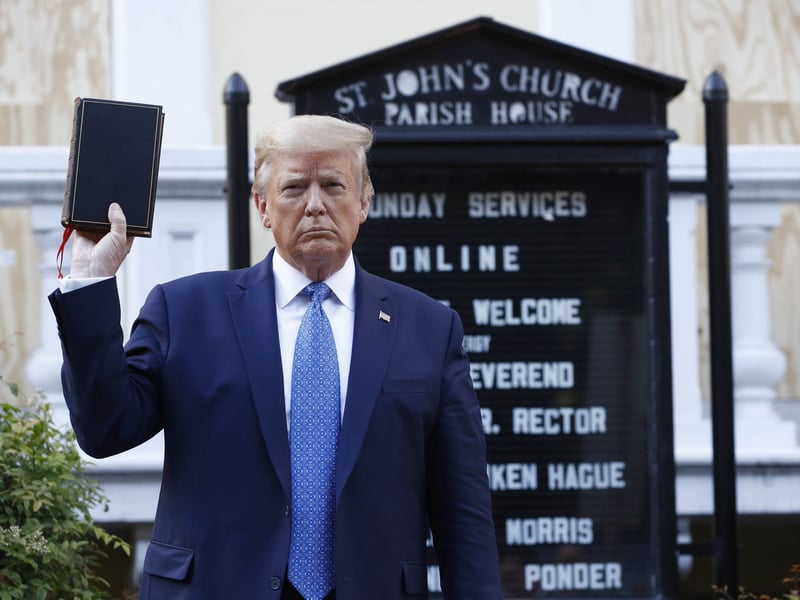
WASHINGTON (CN) — Over 1,000 nonprofits launched a national campaign on Wednesday against the White House’s effort to allow churches to engage in partisan politics, pushing President Donald Trump to uphold a decades-old provision of the tax code.
Tax-exempt organizations have been barred from participating in political campaigns for candidates for public office since 1954, when then-Senator Lyndon B. Johnson proposed what would be known as the Johnson Amendment.
However, the Trump administration freed houses of worship to endorse candidates in a court filing earlier this month. A slew of nonprofits pushed back on Wednesday, warning that the move fundamentally reshaped how political money flows through the government.
“If successful, it would open the door for political actors to use charitable nonprofits as conduits for anonymous campaign funding, benefiting from substantial tax write-offs while shifting the financial burden onto taxpayers who may disagree with the candidates or causes being supported,” the groups wrote in a letter to the president.
National Council of Nonprofits, American Humanist Association, Americans United for Separation of Church and State, Freedom From Religion Foundation, Independent Sector, Interfaith Alliance and Public Citizen were among the signatories.
The organizations urged the administration to immediately end its attempt to ignore the Johnson Amendment and reaffirm limits on partisan politicking in houses of worship.
Most Americans oppose churches endorsing political candidates, according to analysis from the Public Religion Research Institute. In a 2023 poll, three in four Americans opposed places of worship engaging in politics while retaining their tax-exempt status. Republicans are twice as likely to support politics from the pulpit than Democrats.
The Public Religion Research Institute found a link between opponents of the Johnson Amendment and adherents to Christian nationalism.
Conservative groups and evangelicals have long opposed the rule, claiming that it stifled religious speech. Trump promised to kill the amendment in 2015, and a decade later, his second administration followed through.
Earlier this month, the Internal Revenue Service announced that it would no longer enforce the Johnson Amendment, allowing houses of worship and other nonprofits to endorse political candidates.
Diane Yentel, the CEO of the National Council of Nonprofits, said that without the Johnson Amendment, candidates could use nonprofits like political tools. Yentel said this could happen from politicians pressuring organizations for an endorsement or funnel tax exempt charitable donations to their election funds.
“This effort, if successful, would radically alter campaign finance laws to benefit politicians at the expense of charities, houses of worship and foundations,” Yentel said.
Nonprofits who signed the letter to Trump said that maintaining political neutrality in churches is key to upholding religious freedom.
“It’s false and it’s inflammatory to suggest that there’s not already a robust role for religious institutions in public life,” Guthrie Graves-Fitsimmons, vice president of programs and strategy at the Interfaith Alliance, said. “The bright line preventing houses of worship from endorsing specific partisan candidates ensures that our sacred spaces won’t be radically transformed into tools of any political party.”
Reverend Leslie Copeland-Tune, advocacy director at the National Council of the Churches, said that clergy leaders are free to talk about how values, principles and important issues of the day are related to scripture. She said this is possible without endorsing a political candidate.
“We know that toxic polarization has already gained a foothold in our country, in our communities, our denominations and in our congregations,” Copeland-Tune said. “Allowing this to happen without the Johnson Amendment will only make that worse. It will make us increasingly more toxic, more polarized, and really compromise the safe space that we have when we go to church.”
Four nonprofit organizations and two churches challenged the constitutionality of the Johnson Amendment in a lawsuit filed in Texas, claiming that the law violated the First and Fifth Amendments.
The IRS initially moved to dismiss the lawsuit in 2014, but since Trump retook office, the federal government has changed course. In a court filing, the IRS claimed that when properly interpreted, the Johnson Amendment does not reach speech by a house of worship to its congregation.
An experienced First Amendment litigator, who did not want to be named on the record, rejected claims of broad changes to campaign finance laws. The litigator said that the new rule only applied to what a pastor can say about candidates, not independent expenditures like newspaper ads or political rallies.
The White House did not respond to a request for comment on the letter.
 Follow @KelseyReichmann
 Follow @kelseyreichmann.bsky.social
Subscribe to our free newsletters
Our weekly newsletter Closing Arguments offers the latest about ongoing trials, major litigation and rulings in courthouses around the U.S. and the world, while the monthly Under the Lights dishes the legal dirt from Hollywood, sports, Big Tech and the arts.