Search Articles


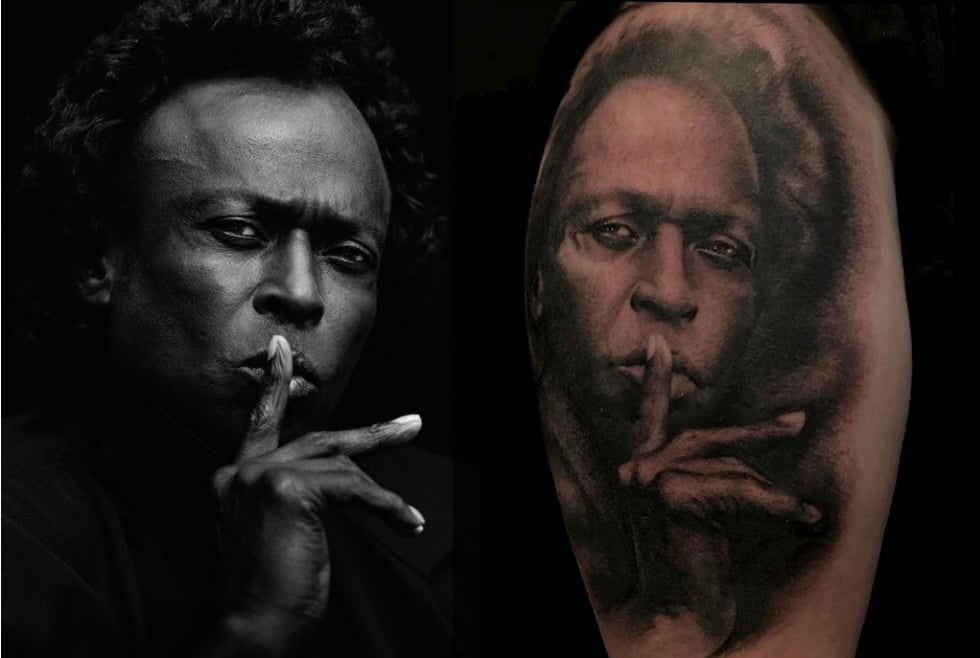
PASADENA, Calif. (CN) — The Ninth Circuit said on Tuesday that en banc panel of 11 judges will rehear the appeal by a photographer who sued celebrity tattoo artist Kat Von D for using his photograph of Miles Davis to ink an image of the jazz legend on a friend’s shoulder.
The decision to have an en banc panel rehear the case may open the door to an overhaul of the use of the so-called intrinsic test to decide copyright infringement claims in the Ninth Circuit.
Chief U.S. Circuit Judge Mary Murguia vacated the January opinion by a three-judge appellate panel that — with some profound misgivings — upheld a jury verdict that Von D’s tattoo wasn’t substantially similar to the photograph Jeff Sedlik took in 1989 of Miles Davis with his index finger raised to his lips in a “shush” gesture.
In January, despite siding with Von D, U.S. Circuit Judge Kim McLane Wardlaw and U.S. Circuit Judge Anthony Johnstone wrote concurring opinions saying the extrinsic-intrinsic analysis the Ninth Circuit has been using to decide copyright infringement disputes had outlived its use and distorts copyright law.
To prevail on a copyright infringement claim, Ninth Circuit precedent requires that a purportedly infringing work is found to be substantially similar to the original under an extrinsic test — that looks at the objective similarities between the two works — and an intrinsic test. This second, more subjective test considers “similarity of expression from the standpoint of the ordinary reasonable observer” and is left for the jury to decide.
“The Supreme Court has never said that the ordinary observer’s spontaneous impression of the ’total concept and feel of the works,’ without any expert guidance, should be a dispositive factor in copyright infringement,” Wardlaw, a Bill Clinton appointee, wrote in the January opinion. “Indeed, Supreme Court precedent suggests the opposite: that, to accord with the Copyright Act, a court should focus on carefully filtering out concepts and ideas.”
The jury’s impression that there was no substantial similarity based on the intrinsic test doesn’t necessarily mean there was no infringement, Wardlaw had added, as there can be “theft without an immediate and spontaneous detection by the ordinary observer.”
“This is particularly true where, as here, the works exist in different media: a photograph and a tattoo,” she wrote. “An ordinary observer, untrained in both media, may fail to note similarities that, if analyzed and dissected, would be only too apparent.”
Bill Patry, an attorney for Sedlik, welcomed the decision and said the Ninth Circuit should go back to a simpler and more predictable test to decide copyright infringement claims.
The panel that decided the appeal in January against his client was frustrated by their inability to review what he said was blatant copying because of the way the Ninth Circuit has uniquely construed its evaluation of copyright infringement.
“Their hands were tied,” Patry said.
Von D’s attorney, Allen Grodsky, said he was looking forward to presenting their case to the en banc panel.
Sedlik sued Von D, whose legal name is Katherine Von Drachenberg, after he discovered she had used the photo he took in 1989 of Davis.
The Miles Davis tattoo had been a gift to Von D’s friend Blake Farmer, a lighting technician who worked on some shoots for her makeup business in 2017. After talking with Farmer, who plays trumpet himself, and learning how important Miles Davis was to him, she offered to create a tattoo of the musician, Von D testified at trial.
Von D rose to fame through her appearances on the reality TV shows Miami Ink and LA Ink, the latter of which was shot at her High Voltage Tattoo studio in Hollywood. Now a stay-at-home mom, Von D told the jury in downtown Los Angeles she hasn’t charged anyone for a tattoo in over a decade and only has done work for friends for free.
Von D testified that no one in the tattoo world gets licenses to use photographs as references for their creations. She maintained her use of the Miles Davis image was “fair use” because it was her interpretation of the image and served an entirely different purpose than Sedlik’s work.
“I’m literally tattooing my friend with a portrait of his favorite trumpet player,” Von D told the jury. “I consider this fan art.”
Farmer provided Von D with the photo that became the subject of the copyright lawsuit. Sedlik, however, turned out to be a stickler when it comes to unlicensed use of his work; he regularly scans the internet to find infringers. He testified how in 2014 he tracked down another tattoo artist who had posted on social media a tattoo he had done based on the same Miles Davis photo.
That artist got away with a free retroactive license after Sedlik contacted him and agreed to waive a $5,000 licensing fee as a “professional courtesy” because, he testified, the artist apologized and showed contrition for not seeking a license beforehand.
 Follow @edpettersson
Subscribe to our free newsletters
Our weekly newsletter Closing Arguments offers the latest about ongoing trials, major litigation and rulings in courthouses around the U.S. and the world, while the monthly Under the Lights dishes the legal dirt from Hollywood, sports, Big Tech and the arts.
Additional Reads
 Scholarship for Black students must be reconsidered June 8, 2026