
 Search Articles


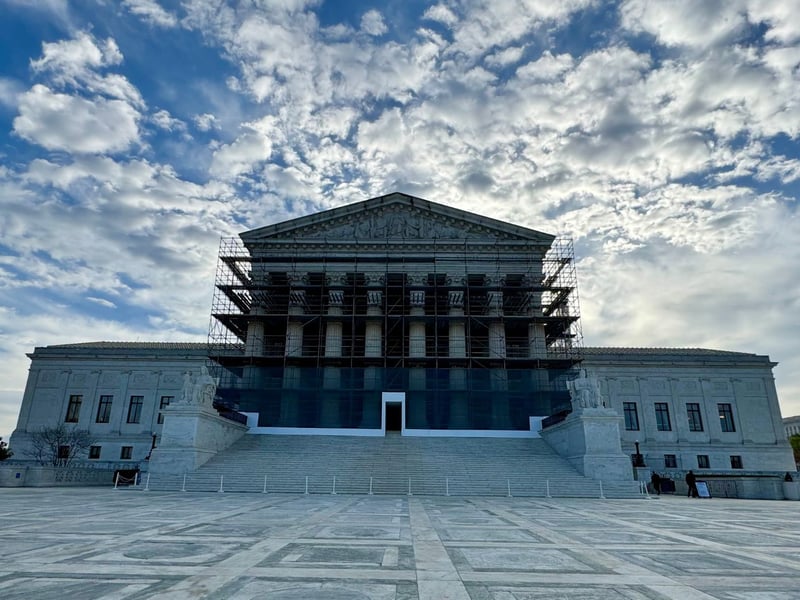
(CN) —The U.S. Supreme Court wrapped up a busy day Friday by granting four petitions for certiorari that seek to resolve splits within the circuit courts and denying several others.
The justices only explained their reasoning for turning down one of the cases, which came from the director of Ohio’s Department of Rehabilitation and Corrections. It involved Kayla Ayers, who was convicted in 2013 of aggravated arson and child endangerment after she attempted to burn down her father’s house.
In 2020, more than seven years after her conviction, Ayers filed a federal habeas application, claiming she had ineffective assistance of counsel during trial. She claimed her counsel should have consulted an independent fire expert and challenged the state’s fire inspector, who testified that the fire’s burn pattern revealed two ignition points — suggesting arson, not accident.
Ayers’ counsel did not present or even consult with an expert and instead argued that her 3-year-old son must have started the fire while playing with a lighter.
While a lower court initially shot down Ayers’ request as untimely, the Sixth Circuit reversed.
A panel reasoned that an expert fire inspection report commissioned by Ayers’ post-conviction counsel in 2019 reopened the filing window for prisoners to file a habeas petition. Under the law, a petition must be filed within a year from when “the factual predicate of the claim or claims presented could have been discovered through the exercise of due diligence.”
Although the justices declined to take on the case, they agreed that the Sixth Circuit’s decision was wrong. Ayers had everything she needed to make that argument back in 2013, Justice Samuel Alito wrote in a statement joined by Justice Clarence Thomas.
“Ordinarily, we would summarily reverse such a decision or, at the least, grant certiorari to bring the errant Circuit back into alignment. But Ayers has now served her prison sentence and is no longer subject to post-release control,” the George W. Bush appointee wrote.
“For this reason, the court’s unwillingness to summarily reverse is understandable, and it is possible to view the decision below as an aberrant decision attributable to the particular facts of this case and not as a precedent that will be followed in future cases. In any event, lower courts should not construe the denial of review as approval of the decision below, and litigants should not hesitate to seek certiorari if the Sixth Circuit repeats this error,” he added.
Two of the cases the justices chose to review pertain to questions around the “compassionate-release” statute, which permits courts to reduce a prisoner’s sentence if the court finds that “extraordinary and compelling reasons” warrant relief.
They ask for the justices’ interpretation of the First Step Act of 2018, which reduced penalties for certain drug and firearm offenses going forward, and whether it can warrant a sentence reduction.
The petitions argue that because of these changes, individuals sentenced today for these offenses often face mandatory minimum terms of imprisonment decades shorter than they would have received before the First Step Act.
One case comes from Daniel Rutherford, who committed two armed robberies in Philadelphia over five days in 2003 while he was 22 years old.
Had Rutherford been sentenced after the First Step Act, he would have received a 14-year mandatory minimum for his two convictions — 18 years fewer than the 32-year minimum he received in 2006.
The question has divided the circuit courts, with the First, Fourth, Ninth and 10th allowing courts to consider disparities created by the First Step Act’s changes, as one of several case-specific factors when determining whether to reduce a sentence.
In the other case, Johnnie Carter, who was charged along with several others for participating in bank robberies in 2007, claims that if he had been sentenced under current law, he would have 21 years of mandatory time. Although no one was physically injured and no shots were fired during the robberies, Carter was sentenced to a 70-year term of imprisonment.
The justices also agreed to decide whether and how courts may consider the cumulative effect of multiple IQ scores in assessing individuals on death row for intellectual disabilities.
Alabama argues that Joseph Smith is not intellectually disabled and can face execution because he scored above a 70 on five different IQ tests. But the 11th Circuit concluded Smith “may” qualify as mildly disabled because he had scores of “about” 75 or less.
Another petition accepted asks the justices to decide whether the Federal Rule of Civil Procedure imposes any time limit to set aside a void default judgment for lack of personal jurisdiction.
Each of the federal appeals courts, other than the Sixth Circuit, has held that the passage of time cannot rehabilitate a judgment that was void upon entry.
 Follow @Megwiththenews
Subscribe to our free newsletters
Our weekly newsletter Closing Arguments offers the latest about ongoing trials, major litigation and rulings in courthouses around the U.S. and the world, while the monthly Under the Lights dishes the legal dirt from Hollywood, sports, Big Tech and the arts.