
 Search Articles


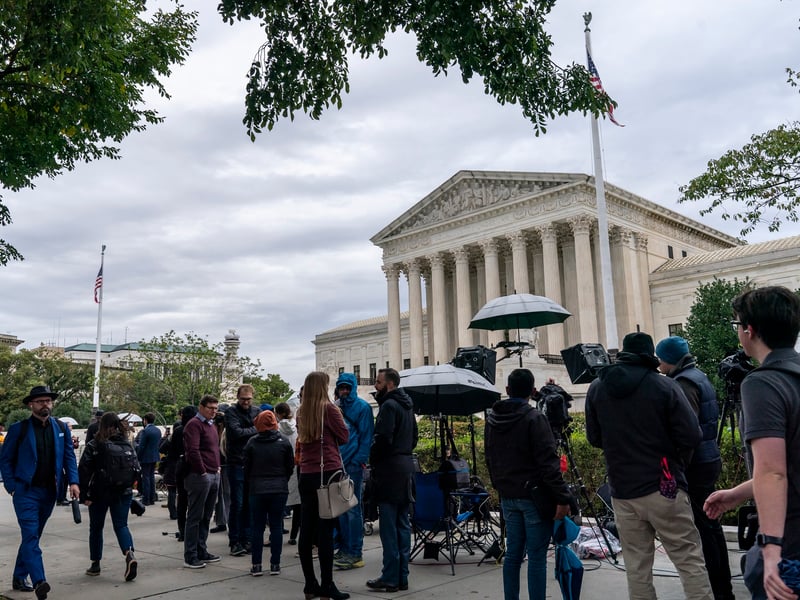
WASHINGTON (CN) — Americans hoping to glimpse next week’s high-profile oral arguments over President Donald Trump’s birthright citizenship case will likely be disappointed after the justices snubbed a request from C-SPAN to televise the proceedings.
On Wednesday, C-SPAN released a letter sent to Chief Justice John Roberts requesting permission to bring cameras into the courtroom so the millions of Americans who will be affected by the ruling can witness the oral argument session. C-SPAN said that because the case holds profound national significance, the public interest would be best served through live television coverage of the proceedings.
“The public deserves to witness — fully and directly — how such a consequential issue is argued before the highest court in the land,” Sam Feist, C-SPAN’s CEO, wrote in the letter dated April 23.
After two weeks, C-SPAN said its request has gone unanswered.
Cameras have never before been allowed in the courtroom, restricting access to oral arguments to the select few who can get a seat in person. While the courtroom seats a few hundred, according to SCOTUSblog, only 50 of those seats go to members of the public. The remaining seats are filled by attorneys, school groups and reporters.
Those 50 coveted seats are often hard to come by. In high-profile cases, members of the public camp out overnight to secure their place.
For those who can’t stake out a seat, the Supreme Court launched an online reservation system last year. The online lottery system allows members of the public to request tickets to an argument session four weeks ahead of time.
The Supreme Court made its most significant step toward the 21st century in 2020, when the justices agreed to broadcast real-time audio from the courtroom. Before this update, audio recordings of these proceedings were released a week after the argument.
Broadcasting the audio of opinion announcements is still barred, however. When the court takes the bench to hand down its rulings, the justice who wrote the majority opinion reads a statement from the bench. The recordings of those announcements are not released until the beginning of the following term.
C-SPAN commended the court’s leadership for expanding public access to audio of oral arguments, noting that networks often televise the broadcast alongside still images of the justices and attorneys.
“Allowing live video coverage of this case would build on that progress, offering Americans outside the few seated inside the court, the ability to also see how critical issues are debated and decided at the highest level,” Feist wrote.
Cameras and video recording have long been restricted in federal courtrooms, but the judiciary began loosening those limitations after the Covid-19 pandemic. Gabe Roth, executive director at Fix the Court, said the Second, Third, Seventh, Ninth and 11th Circuits have all permitted video without incident.
“The public’s right of access in the 21st century means using 21st century tools to get people engaged in court proceedings, and that obviously includes video,” Roth said in an email.
Allowing television coverage of Supreme Court proceedings is broadly popular among Americans. A 2022 poll conducted by C-SPAN and Pierrepoint found that 65% of likely voters support TV broadcasting at the court — and 70% of respondents said that such accommodations would improve public trust.
A bipartisan group of lawmakers proposed a pair of bills in March that would permit federal judges to allow cameras in their courtroom and require the Supreme Court to open certain proceedings to television crews.
Roth said it doesn’t sit well that one of the most important cases the Supreme Court will hear all year would be inaccessible to everyone except the few connected individuals who can fit inside the courtroom.
“When I went to an argument at the court last month, I noticed a softball-sized stationary camera sitting above the door of the courtroom’s main entrance, and it wouldn’t be hard to flip and reposition it in a way that would allow all Americans to see what happens in such a seminal case,” Roth said.
The Supreme Court will hear arguments on whether President Donald Trump’s executive order restricting birthright citizenship should be paused nationwide on May 15.
 Follow @KelseyReichmann
 Follow @kelseyreichmann.bsky.social
Subscribe to our free newsletters
Our weekly newsletter Closing Arguments offers the latest about ongoing trials, major litigation and rulings in courthouses around the U.S. and the world, while the monthly Under the Lights dishes the legal dirt from Hollywood, sports, Big Tech and the arts.