
 Search Articles


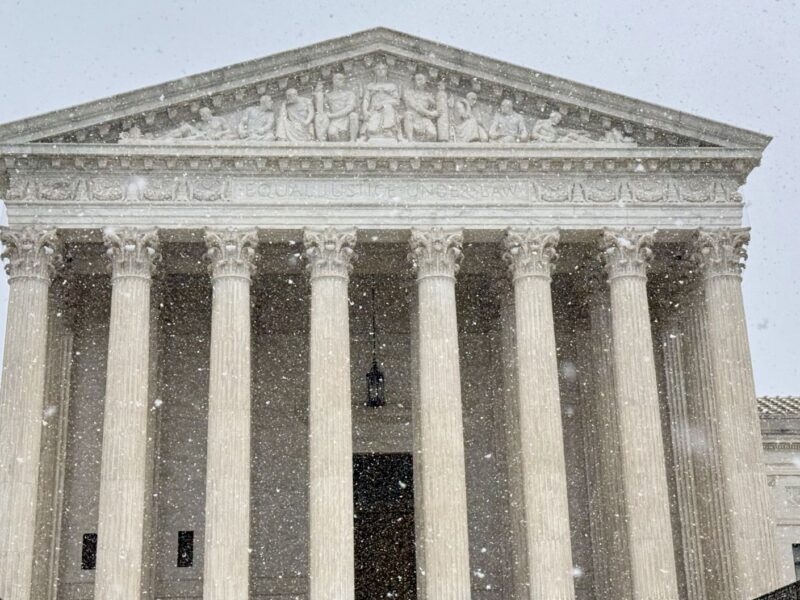
WASHINGTON (CN) — Confronted with outlandish sentencing requirements involving castration, baby daddies and antidepressants, the Supreme Court on Tuesday considered adding an escape hatch to appellate waivers that might lock criminal defendants into unlawful punishments.
Prosecutors often convince defendants to sign waivers of appellate rights as a bargaining chip to forgo certain charges and guarantee finality in a case. But the justices were concerned that barring nearly all appeals without exceptions would tarnish the judiciary’s reputation.
“A racist sentencing judge, a sexist sentencing judge, someone who is biased against religious minorities, all of that stands?” Justice Neil Gorsuch, a Donald Trump appointee, asked incredulously. “Why wouldn’t that bring disrepute to the federal judiciary?”
Baffling the justices, the government presented an unyielding opposition to any appeal exceptions, arguing the contract between prosecutors and defendants was enforceable despite a judge’s sentencing decisions.
“I would think it’s unenforceable to enter a contract that says you are going to be sentenced by a judge who does not have to follow the law,” Justice Sonia Sotomayor, a Barack Obama appointee, said.
Tuesday’s argument stemmed from a Texas judge’s requirement that Munson Hunter III be forcibly medicated for anxiety and depression disorders as a special condition to his supervised release.
The condition was intended to make the probation officer’s job easier. Lisa Blatt, an attorney with Williams & Connolly representing Hunter, told Chief Justice John Roberts, a George W. Bush appointee, “it might be easier if you were medicated, too — that’s not how you get to medicate people.”
Aside from her client’s forced medication, Blatt noted other judges compelled church attendance, prescribed medical castrations and told one defendant who was getting so many women pregnant out of wedlock “if you’re going to get someone pregnant, can you please make it your wife?”
Blatt pushed the justices to create exceptions to appellate waivers for rare circumstances where everyone can agree there was a clear error. She said a narrow exception based on contract principles would allow defendants like Hunter to have the same rights to challenge plea agreements as the government.
But several justices suggested a broader ruling. Rebutting the government’s arguments that no statute provided defendants with a right to such appeals, Justice Elena Kagan, an Obama appointee, said the Supreme Court had the power to establish rules intended to safeguard the integrity of the judiciary.
“You’re saying … we have to point to a particular constitutional provision to set some boundary lines on what judges can do in a task that is supremely a judicial one — that we can’t just say there are some things that judges can do that would be a miscarriage of justice,” Kagan told the government. “But we don’t need to point to a statute to be able to create a rule that polices the judiciary to that extent.”
The government warned that opening up exceptions would create a flood of litigation, negating the benefit of plea agreements for prosecutors. Sotomayor said such concerns were “rather exaggerated” because of the narrowness of the dispute.
Other justices noted that many lower courts already apply such exceptions without any problems.
“In the D.C. Circuit, we did have a bullet that said results in a miscarriage of justice, and I don’t remember the place falling apart,” Justice Brett Kavanaugh, a Trump appointee, said, referring to one of several exceptions to appellate waivers in the lower courts.
 Follow @KelseyReichmann
 Follow @kelseyreichmann.bsky.social
Subscribe to our free newsletters
Our weekly newsletter Closing Arguments offers the latest about ongoing trials, major litigation and rulings in courthouses around the U.S. and the world, while the monthly Under the Lights dishes the legal dirt from Hollywood, sports, Big Tech and the arts.