
 Search Articles


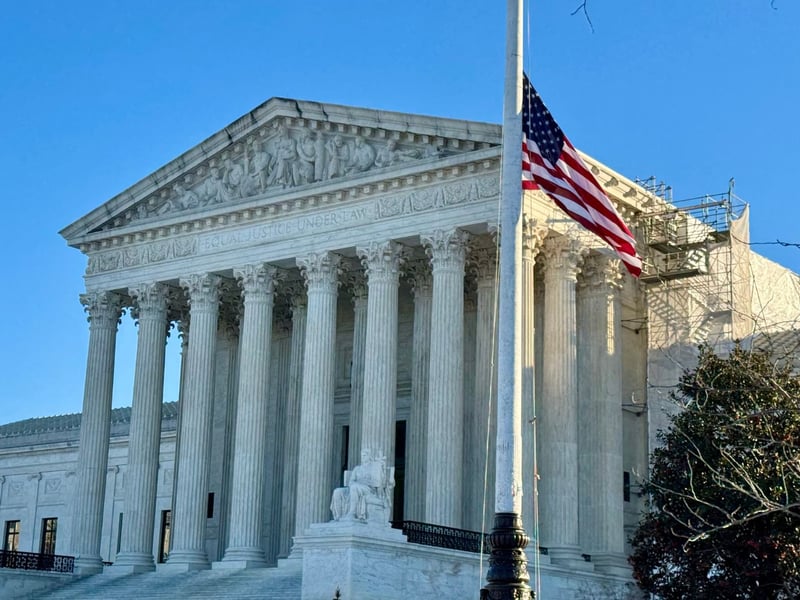
WASHINGTON (CN) — A Chicago man had the Supreme Court splitting hairs Tuesday in search of a distinction between when a claim is false and when it is misleading.
“What is falsity?” Justice Neil Gorsuch, a Donald Trump appointee, asked. “We might want to consult a few philosophers while we’re at it.”
Patrick Daley Thompson was convicted on federal charges of making false claims to a loan servicer. Between 2011 and 2014, he took out three loans from Washington Federal Bank Savings. Thompson borrowed $110,000 for an equity contribution, $20,000 to pay a tax bill and $89,000 to repay a debt to another bank.
Thompson acknowledged all three loans and their accumulating interest in communications with the bank in 2014. Washington Federal failed in 2017, however, and when a loan servicer hired by the Federal Deposit Insurance Corporation tried to recoup Thompson’s debts in 2018, he disputed his balance, only acknowledging that he borrowed $110,000.
At the Supreme Court on Tuesday, Thompson tried to convince the justices that his statement was misleading, not false.
Chris Gair, an attorney with Gair Gallo representing Thompson, gave the justices a personal example of the dichotomy between the two words.
“If I go back and change my website and ‘say 40 years of litigation experience’ and then in bold caps say ‘Supreme Court advocate,’ that would be, after today, a true statement,” Gair said. “It would be misleading to anybody who was thinking about whether to hire me or Mr. Francisco or Mr. Waxman, right? But a false statement would be if I had not ever argued in the United States Supreme Court.”
Gair was referencing two former U.S. solicitor generals, Seth Waxman and Noel Francisco.
The answer amused the court, with Justice Elena Kagan, a Barack Obama appointee, stating that it was the “humblest answer I’ve ever heard from the Supreme Court podium.” It was at least somewhat persuasive to Justice Samuel Alito, a George W. Bush appointee, who said the answer was “mildly misleading, maybe at best.”
The colloquy seemed to move some of the justices toward a middle-ground solution despite the court’s initial skepticism. Justice Neil Gorsuch, a Trump appointee, quipped that Thompson had a “tough road to hoe.”
Thompson asked for a remand to determine whether his statements were false or only misleading. To overturn his conviction, a court must find that no reasonable jury could have viewed his statements as false in context.
Some of the justices were reluctant to vacate the Seventh Circuit’s ruling, suggesting that the outcome of the case wouldn’t change on remand.
“What’s the point of remanding this to the Seventh Circuit? Alito asked. “Just as kind of a punishment for having introduced this ‘misleading’ idea into the case?”
Despite the government’s urging, the court resisted defining falsity. Gorsuch said a broad ruling in this case could impact other false statement statutes that distinguish between falsity and misleading statements.
After a little over an hour of arguments, it was unclear if the justices would give Thompson the chance to advance his uphill battle on remand, however, Kagan provided a path should her colleagues choose that option. In a hypothetical, she said a doctor could say he has completed 100 surgeries without noting that 99 of his patients have died.
Kagan said the doctor’s statement was true despite potentially misleading the patient by not disclosing his success rate.
“In some [cases] there might be overlap, but there really is a difference,” Kagan said. “Some things that are super misleading, but that are not false. Why not just say that and instruct the Seventh Circuit, and anybody else who may not have a correct understanding of this, that there is this gap?”
 Follow @KelseyReichmann
 Follow @kelseyreichmann.bsky.social
Subscribe to our free newsletters
Our weekly newsletter Closing Arguments offers the latest about ongoing trials, major litigation and rulings in courthouses around the U.S. and the world, while the monthly Under the Lights dishes the legal dirt from Hollywood, sports, Big Tech and the arts.