
 Search Articles


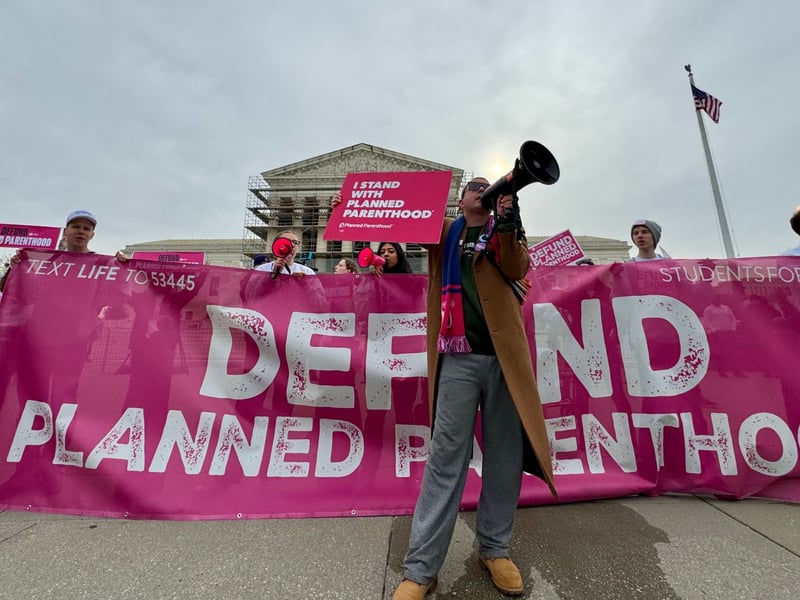
WASHINGTON (CN) — The Supreme Court undercut funding for Planned Parenthood on Thursday, allowing South Carolina to deny Medicaid assistance for health care services at clinics that also provide abortions.
In a 6-3 ruling along ideological lines, the justices held that a woman couldn’t sue South Carolina for refusing to cover medical care at her preferred provider.
Writing for the majority, Justice Neil Gorsuch, a Donald Trump appointee, said Medicaid’s any-qualified-provider provision was missing “clear and unambiguous ‘rights-creating language’" that would have allowed challenges to South Carolina’s ban on funding for Planned Parenthood.
Justice Ketanji Brown Jackson, a Joe Biden appointee, said the court’s decision would result in tangible harm to real people.
“At a minimum, it will deprive Medicaid recipients in South Carolina of their only meaningful way of enforcing a right that Congress has expressly granted to them,” Jackson wrote in a dissent joined by her liberal colleagues. “And, more concretely, it will strip those South Carolinians — and countless other Medicaid recipients around the country — of a deeply personal freedom: the ‘ability to decide who treats us at our most vulnerable.’”
South Carolina halted all funding for Planned Parenthood clinics, claiming that any support for the facilities indirectly contributed to abortions. A lower court stepped in, however, and said South Carolina’s move was barred by the Medicaid Act’s “free-choice-of-provider” provision, which lets patients choose their doctors.
Julie Edwards, a 31-year-old South Carolinian, sued the state for revoking her coverage at Planned Parenthood clinics. Edwards, who is mostly blind in one eye and has nerve damage in her feet, is a pharmacy college graduate who was sidelined from the workforce by complications from type 1 diabetes. Planned Parenthood’s South Atlantic Columbia location was one of her view options for health care after a hospital in her area shuttered.
South Carolina asked the justices to block Edward’s suit, arguing that the “free-choice-of-provider” provision was a benefit, not a right that gave her grounds to sue.
While its clinics are best known for reproductive health care, Planned Parenthood provides a variety of services including cancer screenings, STD treatment and prenatal and postpartum services.
South Carolina argued that “because money is fungible, giving Medicaid dollars to abortion facilities frees up their other funds to provide more abortions." The program uses a fee-for-service basis for reimbursements. Planned Parenthood said South Carolina’s theory was laughable since the state provides one of the lowest Medicaid reimbursement rates.
The six conservative justices disagreed.
Speaking from the bench, Gorsuch said that Congress intended for the secretary of Health and Human Services, rather than individuals, to enforce the any-qualified-provider provision. The Medicaid Act says a state only needs to “comply substantially” with the mandate.
“That focus on ‘“aggregate”’ compliance suggests that a statute addresses a state’s obligations to the federal government, not the rights ‘“of any particular person,”’" Gorsuch wrote.
The any-qualified-provider provision benefits individuals, Gorsuch explained, but it does not meet the high bar of creating an individual federal right.
Gorsuch refuted claims that the ruling would strip the provision of its teeth. He said that the federal government has many methods of enforcing the mandate, and if those solutions fall short, it’s up to Congress to create new remedies.
“Private enforcement does not always benefit the public, not least because it requires states to divert money and attention away from social services and toward litigation,” Gorsuch wrote. “And balancing those costs and benefits poses a question of public policy that, under our system of government, only Congress may answer.”
Jackson accused the majority of continuing “the project of stymying one of the country’s great civil rights laws.” Individuals’ ability to sue to enforce their rights traces back to the Civil Rights Act of 1871, allowing newly freed citizens and their allies to fight back against disenfranchisement.
The Medicaid Act easily satisfied the criteria for enforceable statutory rights under this framework, Jackson saiid, citing the unmistakable focus on the benefited class. Jackson cited the provision’s heading and its mandatory nature as key indicators of Congress’ intention.
“If Congress did not want to protect Medicaid recipients’ freedom to choose their own providers, it would have likely avoided using a combination of classically compulsory language and explicit individual-centric terminology,” Jackson wrote.
South Carolina is in the middle of a health care crisis. Almost all of the state’s residents live in primary care shortage areas. Women’s health care providers are especially hard to come by, with 14 counties lacking a practicing OB-GYN. One-fifth of South Carolinians insured by Medicaid could see further cuts to access if Planned Parenthood clinics are blocked from participating in the state’s Medicaid program.
Left-leaning advocates said the ruling opened the door for states to deny critical health care to marginalized communities. United for Democracy Senior Advisor Meagan Hatcher-Mays found it ironic that the decision came nearly three years after the court overturned Roe v. Wade .
“Today’s ruling is a further attack on health care, bodily autonomy, and our freedoms,” Hatcher-Mays said in a statement. “This ruling clearly harms communities in South Carolina, and it’s a matter of time before we see that harm expand further into the country.”
Anti-abortion advocates, however, celebrated the decision as a win. Judicial Crisis Network President Carrie Severino said the conservative supermajority declined to create a carve-out for a “left-wing heavyweight,” referring to Planned Parenthood.
“The days of the abortion distortion are over,” Severino said.
 Follow @KelseyReichmann
 Follow @kelseyreichmann.bsky.social
Subscribe to our free newsletters
Our weekly newsletter Closing Arguments offers the latest about ongoing trials, major litigation and rulings in courthouses around the U.S. and the world, while the monthly Under the Lights dishes the legal dirt from Hollywood, sports, Big Tech and the arts.