
 Search Articles


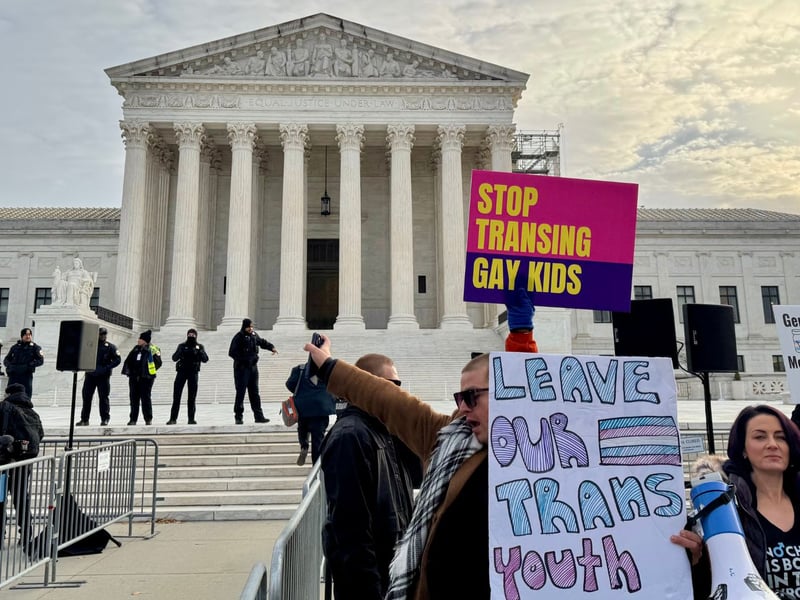
WASHINGTON (CN) — Marking another win for President Donald Trump, the Supreme Court ruled Thursday to block transgender individuals from using their preferred sex designation or “X” on passports.
Despite objections from the court’s three liberal justices, the conservative majority determined that enforcing Trump’s preferred policy was more important than any potential harm to transgender Americans under its enforcement.
“Displaying passport holders’ sex at birth no more offends equal protection principles than displaying their country of birth — in both cases, the government is merely attesting to a historical fact without subjecting anyone to differential treatment,” the majority wrote in an unsigned statement.
Justice Ketanji Brown Jackson penned a fervent dissent, claiming that her colleagues had once again failed to appropriately consider those who might be harmed by the government’s policy.
“In my view, the court’s failure to acknowledge the basic norms of equity jurisdiction is more than merely regrettable,” the Joe Biden appointee wrote. “It is an abdication of the court’s duty to ensure that equitable standards apply equally to all litigants — to transgender people and the government alike.”
Trump asked the justices to block an injunction letting transgender individuals choose M, F or X based on gender ideology, arguing that a lower court was interfering with the executive’s authority over foreign affairs.
Transgender Americans warned, however, that Trump’s policy undermined the very purpose of passports as identity documents that officials check against the bearer’s appearance.
“People across the country depend on identity documents that accurately reflect their identity — who they are in their workplaces, their schools, and their communities,” said Li Nowlin-Sohl, staff attorney for the ACLU’s LGBTQ & HIV Project. “The administration’s attempts to deny that right to transgender, nonbinary, and intersex people has no basis in law or policy, and we’ll continue to fight this policy until it is permanently defeated.”
Joined by Justices Sonia Sotomayor and Elena Kagan, both Barack Obama appointees, Jackson detailed the key principles needed to receive emergency relief from the high court. Courts shouldn’t intervene unless absolutely necessary, Jackson said, and even then, they need to carefully balance the impact on both parties.
Jackson said this inquiry should have been easy for the justices since the lower courts already evaluated evidence in the dispute, finding that Trump failed to demonstrate any harm from keeping his policy on hold.
“But the court somehow sees fit to grant the government’s stay request regardless, waving away its abject failure to show any irreparable harm and promoting a patently inequitable outcome to boot,” Jackson wrote.
The dissent questioned the administration’s need to urgently enforce its policy when passports reflecting transgender Americans’ gender identity can continue to be used until they expire.
In contrast, Jackson stated that transgender Americans faced “palpable” harms forcing them to risk harassment and bodily invasions or avoid all activities that may require a passport.
“Airport checkpoints are stressful and invasive for travelers under typical circumstances — even without the added friction of being forced to present government-issued identification documents that do not reflect one’s identity,” Jackson wrote.
Trump’s policy invited the probing and humiliation, Jackson said, to make a statement about the government’s belief that transgender identity is “false.”
In January, Trump signed an executive order requiring government-issued identification documents to list sex “at conception.” The State Department quickly updated its passport rules, blocking transgender, intersex and nonbinary people from using their preferred gender designations.
Seven individuals sued the administration, calling the policy discriminatory and preventing them from obtaining passports that matched who they are. In the lawsuit, they called Trump’s policy arbitrary and capricious, arguing it violated their rights to travel and privacy under due process and their First Amendment rights.
A Massachusetts court issued an injunction in June, preventing the administration from enforcing the policy. The court found the policy to be motivated by animus toward transgender individuals.
An appeals court refused to stay the injunction. At the Supreme Court, Trump argued that it was entirely rational for him to reject gender identity. However, he also argued that the court had no authority to challenge his policy even if it wasn’t rational.
“Private citizens cannot force the government to use inaccurate sex designations on identification documents that fail to reflect the person’s biological sex — especially not on identification documents that are government property and an exercise of the president’s constitutional and statutory power to communicate with foreign governments,” U.S. Solicitor General John Sauer wrote in the emergency appeal.
Individuals challenging Trump’s policy cast doubt on the administration’s claim that emergency action was necessary, noting the injunction had been in place since June. They argued the new policy puts transgender, nonbinary and intersex people in potential danger whenever they use a passport.
Trump pointed to the court’s recent precedent in United States v. Skrmetti , where the conservative majority upheld Tennessee’s ban on gender-affirming care for minors as it did not violate the equal protection clause. The administration argued the passport policy was likewise constitutional because it applied equally regardless of sex.
“Just as it would not be discrimination based on national origin to define a person’s national origin as the person’s birth country rather than the country with which the person self-identifies, so too it is not discrimination based on sex to define a person’s sex as the person’s immutable biological classification rather than the sex with which the person self-identifies,” Sauer wrote.
The transgender individuals rebutted Trump’s claims, arguing that the policy wouldn’t survive heightened scrutiny.
“Under any standard of review, it violates equal protection because it does not serve any legitimate governmental interest and was driven by impermissible animus,” the transgender individuals wrote.
The White House celebrated the decision, adding it to a list of nearly two dozen victories on the Supreme Court’s emergency docket.
“This decision is a victory for common sense and President Trump, who was resoundingly elected to eliminate woke gender ideology from our federal government,” White House Deputy Press Secretary Anna Kelly said. “There are only two genders, there is no such thing as gender ‘X’, and the Supreme Court is right to affirm that official identification should reflect biological truth.”
 Follow @KelseyReichmann
 Follow @kelseyreichmann.bsky.social
Subscribe to our free newsletters
Our weekly newsletter Closing Arguments offers the latest about ongoing trials, major litigation and rulings in courthouses around the U.S. and the world, while the monthly Under the Lights dishes the legal dirt from Hollywood, sports, Big Tech and the arts.