
 Search Articles


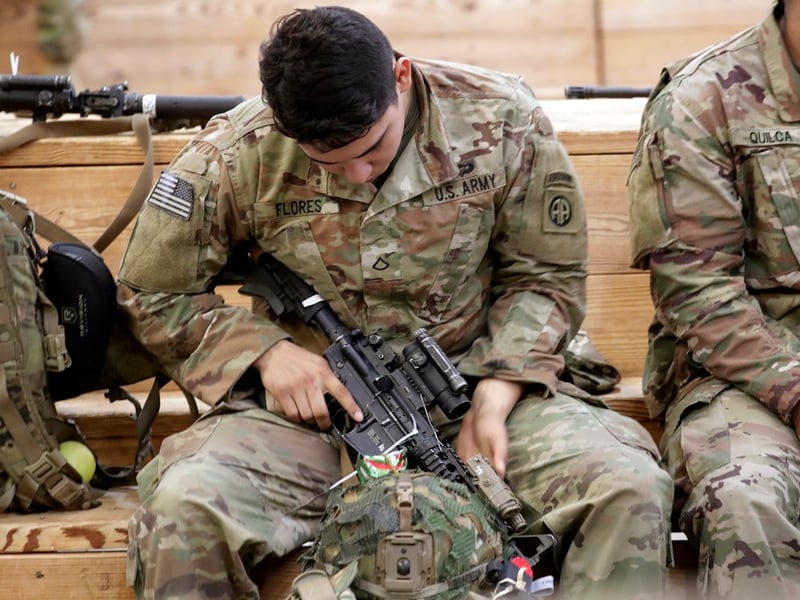
WASHINGTON (CN) — The Supreme Court on Monday declined to revisit a ruling dictating when service members can file federal tort claims against the government.
“The court has never articulated a coherent justification for this exception, and the lower courts for decades have struggled to apply it,” Justice Clarence Thomas, a George H.W. Bush appointee, said in his dissent. “The result is that courts arbitrarily deprive injured service members and their families of a remedy that Congress provided them.”
Ryan Carter, an inactive Air National Guard staff sergeant and a civilian employee of the federal government, was left paralyzed after providers at the Walter Reed National Military Medical Center struck his spine during surgery to correct a degenerative disc condition in his cervical spine.
“Mentally and emotionally, Ryan is a shell of his former self, yearning for the life he had with his wife and family,” Carter said in his brief. “Mr. Carter’s life has been unaccountably turned on its head — all due to the negligent conduct of government health care providers.”
The Fourth Circuit, relying on the Supreme Court’s 1950 decision in* Feres v. United States,* found a lower court correctly dismissed the Federal Torts Claim Act claims as barred in an unpublished opinion. In Feres , the high court found the United States is not liable under the Federal Tort Claims Act for injuries to members of the armed forces sustained while on active duty, not on furlough and resulting from the negligence of others in the armed forces.
“The Carters understand that it’s not just about them and that there’s a bigger, broader story to tell,” attorney Christopher Casciano of Brown and Barron, who represents Carter and his wife, said in a phone interview. “And you know, the injustices that continue because of how the Feres doctrine is applied, you know, warrants continued action.”
Judges and scholars alike have criticized the doctrine as unfairly excluding service members from seeking relief otherwise granted to civilians and veterans.
“Feres is indefensible as a matter of law, and senseless as a matter of policy,” Thomas said in Monday’s dissent. “Feres’s policy rationales are hardly formidable, depriving injured service members and their families of a remedy for no good reason at all.”
The Feres ruling has confused lower courts for decades about when to allow service members’ suits to continue. The doctrine has three justifications: avoiding varying state law standards, the adequacy of Veterans Benefits Administration benefits and preventing judicial interference in military affairs.
Circuit courts are split on whether and how to consider the three policy justifications. Some focus on judicial interference, framing whether the suit would question military discipline and decisionmaking. Others have ignored the three factors and focused instead on whether the injuries arose from an incident to service.
“Faced with almost four decades of silence from this court on the Feres doctrine, lower courts have developed an array of tests for determining when it is triggered, leading to inconsistent results on similar facts,” Thomas said.
Some of the areas the circuit courts have split on when determining whether an injury was an incident to service include sexual assault by another soldier, injuries arising during recreational activities with military-owned equipment, children of servicewomen suing for injuries sustained in utero from negligent prenatal care and exposure to toxic chemicals in one’s on-base home.
Thomas argued the three justifications. For the first justification, avoiding varying state-law standards, Thomas explained that federal entities such as the Census Bureau and Immigration and Customs Enforcement are already subject to a patchwork of state-law tort standards under the Federal Torts Claim Act.
“If consistently applied, the uniformity rationale would thus exempt much of the Federal Government from liability, contrary to the manifest purpose of the FTCA,” Thomas said.
Thomas disagreed with the rationale that the Veterans Benefits Administration already compensates for service-related injuries. According to Thomas, the administration shells out a fraction of what a civilian would be entitled to in an ordinary medical malpractice suit.
And concerning the third rationale, that it would cause civilian courts to disrupt military discipline and decisionmaking, Thomas pointed to service members routinely suing the government and bringing military decisionmakers to court to seek injunctive relief. Examples include a sailor who sought to bar the Navy from enforcing vaccination mandates and a Marine who sought to enjoin boot camp grooming requirements because they likely violated the Religious Freedom Restoration Act.
“Tort suits seeking compensation for noncombat, nondiscretionary acts committed domestically are far less intrusive than many of the claims courts already entertain,” Thomas said.
Thomas is far from the first justice to seek a review of Feres . Former Justice Antonin Scalia, a Ronald Reagan appointee, advocated overturning Feres in United States v. Johnson in 1987. Johnson’s widow sought compensation after her husband, a Coast Guard helicopter pilot, died colliding with a mountain in what she claimed was the fault of the Federal Aviation Administration flight controllers.
“Had Lieutenant Commander Johnson been piloting a commercial helicopter when he crashed into the side of a mountain, his widow and children could have sued and recovered for their loss,” Scalia wrote in dissent at the time. “But because Johnson devoted his life to serving in his country’s Armed Forces, the court today limits his family to a fraction of the recovery they might otherwise have received.”
Casciano described the Carters as resilient and said they would continue to seek administrative relief through the Department of Defense. Thomas and other critics continue to hope for a case they can use to undue Feres .
“I hope that this court will one day overrule Feres,” Thomas said. “Until then, I offer this advice to lower courts: Do not look for a principled explanation for our Feres case law; there is nothing to find.”
Subscribe to our free newsletters
Our weekly newsletter Closing Arguments offers the latest about ongoing trials, major litigation and rulings in courthouses around the U.S. and the world, while the monthly Under the Lights dishes the legal dirt from Hollywood, sports, Big Tech and the arts.