
 Search Articles


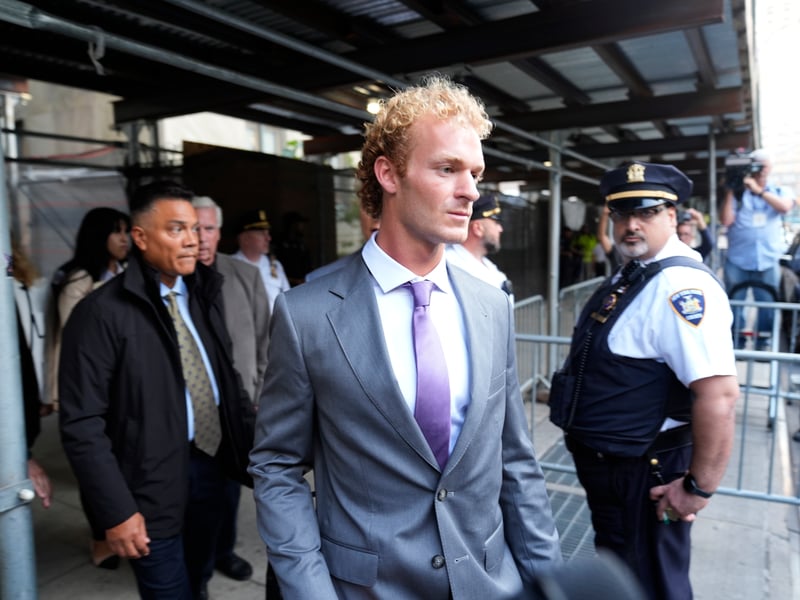
MANHATTAN (CN) — Swarms of New Yorkers on Monday filed into a packed criminal courtroom where sat Daniel Penny, the ex-Marine charged with manslaughter for putting an erratic straphanger into a fatal chokehold on a Manhattan F train last spring.
Penny, who joined the defense table draped in a navy blue suit and red tie, was flanked by the dozens of Manhattanites in the gallery — all potential jurors who could be deciding his fate. He greeted them with a “good morning” and a wave.
Monday morning marked the start of jury selection for Penny, who was 24 years old when he choked Jordan Neely to death on May 1, 2023. New York Supreme Court Justice Maxwell Wiley prepared counsel for the possibility of a lengthy jury selection process. For most of this week, potential jurors will only be screened on their availability for the roughly six-week trial; voir dire won’t begin until Friday.
As proceedings in the polarizing trial began, nearly every prospective juror in the courtroom raised their hand when Wiley asked if they had heard of the case.
“Not a surprise,” the judge remarked.
Still, Wiley reminded jurors that they are eligible to serve on the jury even if they are aware of the case and have formed some sort of opinion on it. “You have to be prepared to change it,” Wiley said.
Outside of the courthouse, a group of protesters marched and demanded justice for Neely. Neely’s father Andre Zachery described his late son to reporters as a “quiet man,” a “good kid” and “very humble.”
Neely, who was 30, was a fixture in the Times Square transit hub known best for his Michael Jackson impersonation. The day of his killing, court records and eyewitnesses say that Neely was shouting and pacing up and down the train car. Neely was experiencing homelessness and mental health issues at the time, according to numerous reports.
Penny told detectives that Neely threatened to kill other passengers as he marched through the subway, prompting him to grab Neely from behind and take him to the ground with a chokehold. He said he held the hold for several minutes until NYPD officers boarded the train at the Broadway-Lafayette station in Manhattan.
Penny didn’t think he had done anything wrong — video played during a court hearing showed him accompanying responding officers back to the precinct, doing so on his own accord without handcuffs or forceful direction from police. He told detectives at the station that he was “not a confrontational guy” and merely was trying to hold Neely down until help arrived.
“I’m not trying to kill the guy,” Penny said.
But Neely was pronounced dead at a nearby hospital. The city’s medical examiner ruled his cause of death was compression of the neck.
Trial tests boundaries of self defense
Now on trial, Penny continues to argue he acted to defend the train and didn’t intend to use lethal force against Neely. Precisely what Neely said prior to his killing is likely to be scrutinized as the centerpiece of the proceedings; some witnesses recalled him threatening to hurt passengers, while others claim he’d remarked only that he was homeless and hungry.
If Neely didn’t make explicit threats to seriously harm other passengers, then that’s not good for Penny’s case, according to veteran New York criminal defense attorney Ron Kuby.
“You can only use deadly physical force if you reasonably believe that deadly physical force is about to be used against you or somebody else,” Kuby told Courthouse News.
Penny’s statements to officers and detectives will be scrutinized, too. In police bodycam footage from the scene, which Penny’s attorneys unsuccessfully asked the court to find inadmissible, Penny can be heard telling cops that he “just put him out,” referencing Neely while making a choking motion with his hands. He also likened Neely to a “crackhead” in his interviews with detectives.
The incident has split public opinion, with Penny being hailed in certain, often right-wing circles as a good Samaritan while some progressive advocates have denounced his behavior as an act of racist vigilantism, comparing him to the likes of Kyle Rittenhouse.
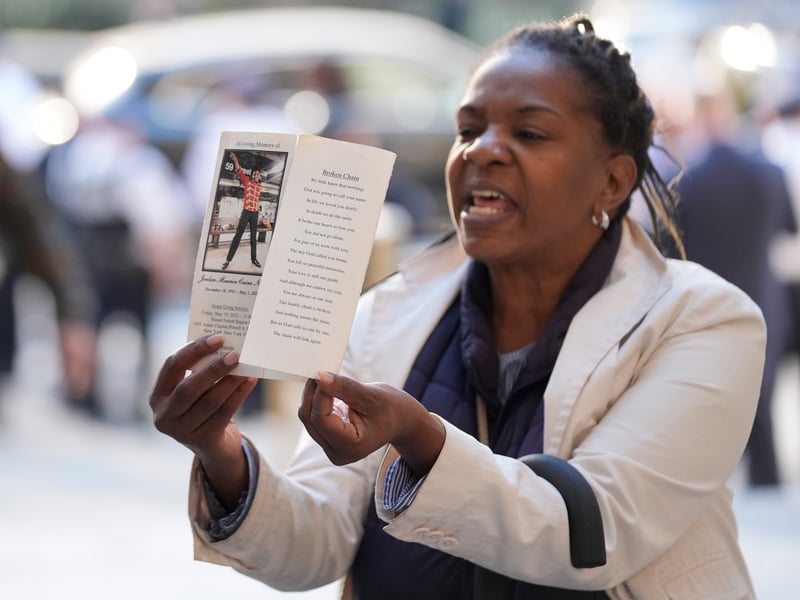
The case’s divisiveness underscores importance of the jury selection process, a process Kuby says is already the most critical part of any criminal trial.
“Sometimes it’s absolutely outcome determinative,” Kuby said. “And sometimes it’s merely just extremely important, but it is the most important part of the trial.”
In New York City, where the subway has a daily ridership of more than 3 million, the parties will be hard-pressed to find a juror that doesn’t have their own experiences and opinions about riding the train. It’s already divided eyewitnesses, according to court records.
“For me, it was like another day typically in New York. That’s what I’m used to seeing. I wasn’t really looking at it if I was going to be threatened or anything to that nature, but it was a little different because, you know, you don’t really hear anybody saying anything like that,” one witness recalled, as recited by prosecutor Joshua Steinglass at an earlier court hearing.
Other witnesses sided with Penny, according to police bodycam footage played to the court earlier this month. One said that Penny “saved” the train in subduing Neely.
“I think what the defense wants to do is to pick people who either have a history of using force against others, or people who have ridden the subway and been terrified that somebody was going to hurt them,” Kuby said.
Race will take center stage, too, Kuby said. The optics of Penny, a white man, killing Neely, a Black man, speak to an issue of racial violence that has been a cornerstone of cultural debate since the killing of George Floyd in 2020.
“Race is going to be a huge element,” Kuby said. “Let’s imagine the roles were reversed, and it was a Black man on videotape choking a white man to death … there would be a very different view of that among white New Yorkers than there would be of this.”
Penny faces charges of second-degree manslaughter and criminally negligent homicide. He pleaded not guilty in January.
 Follow @Uebey
 Follow @uebey.bsky.social
Subscribe to our free newsletters
Our weekly newsletter Closing Arguments offers the latest about ongoing trials, major litigation and rulings in courthouses around the U.S. and the world, while the monthly Under the Lights dishes the legal dirt from Hollywood, sports, Big Tech and the arts.