
 Search Articles


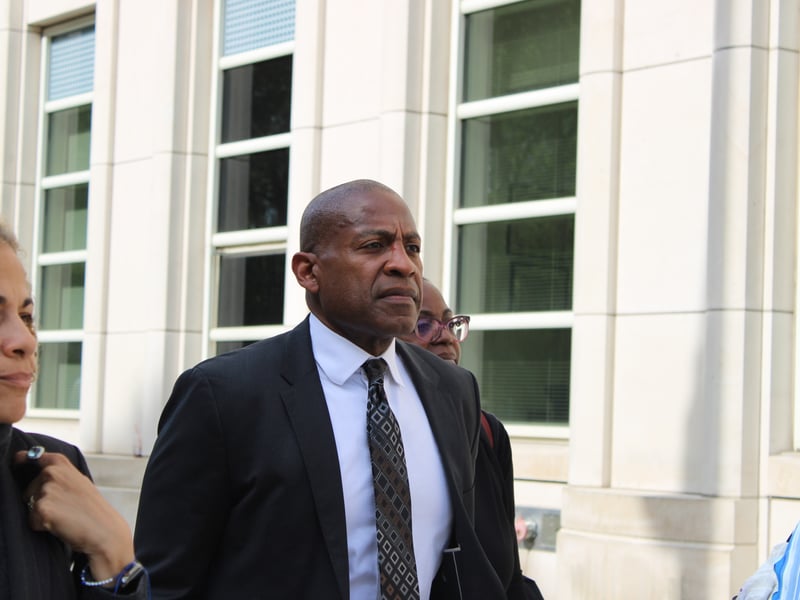
BROOKLYN (CN) — A 12-person jury found Ozy Media CEO Carlos Watson guilty on Tuesday after a nearly two-month trial over accusations he lied to investors about the now-defunct media company’s finances and conspired with another Ozy executive to impersonate a YouTube executive in furtherance of the fraud scheme.
Following the verdict, U.S. District Judge Eric Komitee revoked Watson’s bail and remanded him into custody over his attorney’s objection. The charges, which include conspiracy to commit securities and wire fraud, in addition to aggravated identity theft, carry a penalty of up to 37 years in prison.
Watson described Ozy Media, which he founded in 2012, as a “sneak peak into the future” of industries including politics, entertainment and scientific research. The digital media start-up produced TV shows, podcasts and newsletters; in its flagship program, “The Carlos Watson Show,” its founder interviewed politicians and pop culture celebrities including Joe Biden, Hillary Clinton and John Legend. Ozy also prided itself in the annual “Ozy Fest” in Central Park which featured A-list musicians, comedians and public figures — such as RuPaul, writer Malcolm Gladwell and rapper Common.
But the company shut down in 2021 after an article in The New York Times revealed Ozy’s co-founder and chief operating officer Samir Rao impersonated a YouTube executive on a call with Goldman Sachs and made flagrant misrepresentations of the media company’s finances.
During trial testimony, Rao admitted to conducting the call, but said it was a plan he and Watson came up with together — scheming to impersonate YouTube executive Alex Piper — after falsely telling Goldman Sachs that the streaming platform was interested in buying the rights to “The Carlos Watson Show.”
“We decided that I would fake the reference call and pretend to be Alex,” Rao said on the stand.
Prosecutors emphasized the importance of the Goldman Sachs call to their case throughout the trial and told the jury to pay special attention to it.
Several jurors, who declined to give their names, said the call was indeed a focal point of their deliberations.
The guilty verdict incited shouts and murmurs from Watson’s friends and family, who have consistently attended trial. “No, no, no, this is not a game,” one of Watson’s sisters said after the verdict was read.
Their opposition escalated after Judge Komitee sided against defense attorney Ronald S. Sullivan, who argued that revoking bail was unnecessary because Watson hasn’t shown any indication he would flee prior to sentencing.
Prosecutors argued that Watson repeatedly perjured himself on the stand, making him a flight risk.
“He has shown his willingness to lie under oath, which is a felony,” Assistant U.S. Attorney Jonathan Siegel said Tuesday. “How can we trust anything he says?”
Komitee agreed. “He did perjure himself on the witness stand, both in big ways and small,” he said, which left the judge with “no other choice” but to revoke his bail.
Both Komitee and federal prosecutors cited two incidents in which Watson supposedly tried to sneak phones into the courthouse, saying that he “lied” to a court officer.
“This is absolutely insane,” Watson’s sister said as she walked out of the courtroom. “Judge, why are you being racist to my brother?”
As increasing outbursts led to gallery-watchers being escorted out or reprimanded, Komitee said he wanted to “set the record straight.”
“The idea that we’re here because the government engaged in selective prosecution … that all falls into the category of things that are simply not true,” the judge said.
Both of Watson’s sisters yelled “I love you” he was escorted away by U.S. Marshals. The family declined to comment.
“We are disappointed in the jury’s verdict and plan to appeal immediately,” Watson’s attorneys said in a statement.
Breon Peace, United States Attorney for the Eastern District of New York, called Watson a “con man” in a statement announcing the verdict.
“The jury found that Watson was a con man who told lie upon lie to deceive investors into buying stock in his company,” Peace said. “Watson invented phony financial figures and caused others to forge fake contracts and impersonate a media executive.”
Sentencing is scheduled for Nov. 18.
Prosecutors brought the criminal indictment against Watson and Ozy last year.
Rao and Suzee Han, the company’s onetime chief of staff, each pleaded guilty to charges last year and are cooperating with the government. The pair were also named alongside Watson in a separate lawsuit filed by the U.S. Securities and Exchange Commission.
At trial, prosecutors referred to them as Watson’s “secret inner circle” and repeatedly claimed that Rao and Han both acted with Watson’s direction and consent. “They both testified in no uncertain terms that they didn’t commit those crimes alone,” Assistant U.S. Attorney Gillian Kasner said during closing arguments. “They committed those crimes with Carlos Watson.”
Prosecutors also sought to demonstrate a series of schemes to oversell the company’s finances to investors. Tripti Thakur, who served as Ozy’s chief financial officer for three months in 2019, testified that Rao sent a fake contract with the Oprah Winfrey Network to a potential bank lender.
Thakur resigned immediately after the incident, according to an email shown in court, writing, “This is fraud. This is forging someone’s signature with the intent of getting an advance from a publicly traded bank.”
Prosecutors said Watson misrepresented Ozy’s earnings to investors by as much as four times the actual revenue numbers, citing internal income statements that dramatically contradicted emails and pitch decks sent to investors.
For instance Ozy representatives told Google the company had $42 million in revenue in 2020 — and told Goldman Sachs the it had $46 million in revenue the same year — but reported on its 2020 income statement that it earned just $11 million.
Watson has repeatedly denied accusations he lied to investors about the company’s revenue, saying Ozy’s internal income statements did not account for “barter” revenue.
“My belief is that we consistently undercounted our revenue,” Watson added during his testimony.
 Follow @NikaSchoonover
Subscribe to our free newsletters
Our weekly newsletter Closing Arguments offers the latest about ongoing trials, major litigation and rulings in courthouses around the U.S. and the world, while the monthly Under the Lights dishes the legal dirt from Hollywood, sports, Big Tech and the arts.