
 Search Articles


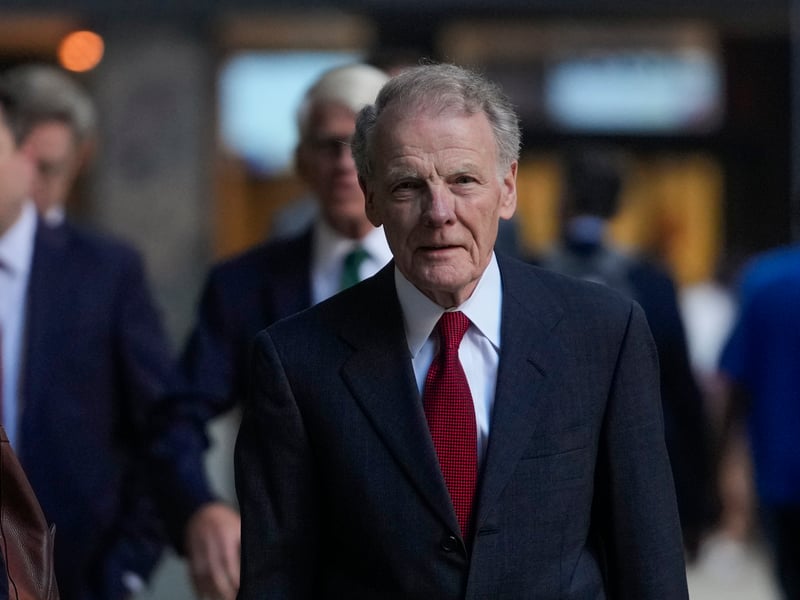
CHICAGO (CN) — Jurors on Wednesday returned a split verdict in the monthslong federal corruption trial of ex-Illinois House Speaker Mike Madigan.
Jurors found Madigan guilty on 10 of the 23 corruption charges he faced and not guilty on seven counts. They did not return a verdict on his co-defendant and longtime ally Mike McClain.
The jury deadlocked on the six charges McClain shared with Madigan: an overarching racketeering conspiracy charge that ran throughout case’s multiple “episodes,” and additional fraud, bribery and racketeering counts.
Acting U.S. Attorney Morris Pasqual said “no decision has been made” on whether prosecutors would try to retry Madigan or McClain over the jury’s deadlock.
Presiding U.S. District Judge John Robert Blakey, a Barack Obama appointee, in his own comments to attorneys prior to the verdict, said prosecutors could “let the dust settle” on the deadlocked counts before deciding if it’s worth it to retry them.
“Maybe it isn’t,” the judge quipped.
It took over four months of trial proceedings to reach Wednesday’s split verdict, with jury selection beginning early last October.
The jury received the case on the afternoon of Jan. 29, and deliberated about 64 hours before telling the court they had come to an impasse. Over the course of the trial, they heard from more than 60 witnesses — including Madigan himself — and were shown dozens of secretly recorded phone call and video clips.
The jury announced it had reached an impasse on 12 counts — six each for Madigan and McClain — on Wednesday morning. After discussion among the attorneys and Blakey, the court agreed the jurors could return a partial verdict despite not reaching consensus on those charges.
Pasqual nevertheless declared Madigan’s conviction a victory.
“Michael Madigan, who stood at the very top of Illinois state government, stands convicted of ten counts of bribery and corruption. Corruption far reaching in scope, spanning a period of over eight years,” Pasqual told press in the lobby of Chicago’s Dirksen Federal Courthouse. “This is a historic conviction which ranks high in the annals of criminal cases tried in this courtroom.”
The U.S. Attorney’s Office of Northern Illinois has spent years prosecuting the former speaker, individuals in his orbit and others involved with Chicago’s legacy of political patronage.
Madigan served as a representative in the Illinois House for 50 years before stepping down in 2021, and led it as speaker for 36 years. He also spent over two decades as chairman of the Illinois Democratic Party. Pasqual said Madigan abused the power and public trust afforded by his offices.
“Madigan exploited his public position, seeking and accepting bribes from ComEd in a scheme involving $1.3 million in no-show work, in order to put money in the pockets of Madigan’s political allies, thereby strengthening Madigan’s own personal political might,” Pasqual said.
Federal prosecutors indicted him in March 2022 over conduct ranging between 2011 and 2019. A major portion of his indictment and subsequent trial dealt with energy company ComEd’s admitted yearslong bribery scheme in the Illinois legislature.
Prosecutors said Madigan was at the heart of that scheme, supporting the company’s legislative agenda between 2011 and 2019 in exchange for arranging jobs and contracts for his political allies, who received a collective $1.3 million from no-work ComEd subcontracts.
Among the ten counts on which jurors convicted Madigan, four related to the former speaker’s involvement with ComEd — including the arrangement of the no-work subcontract gigs.
The jury acquitted Madigan on two counts related to ComEd, including the accusation that he pressured the company to take on politically-connected Illinois businessman Juan Ochoa for a board seat.
McClain, a former Democratic state representative and ComEd contract lobbyist, was heavily involved in the ComEd scandal — federal prosecutor Amarjeet Bhachu went so far as to call him Madigan’s “bag man.” He was one of the “ComEd Four,” a quartet of former ComEd executives and lobbyists whom jurors convicted on separate corruption charges in May 2023.
In a similar episode, prosecutors said Madigan supported the legislative agenda of AT&T Illinois in 2017. The company at the time was backing a bill to make it easier for it to discontinue landline services in the state.
In exchange for Madigan’s support, the government claimed, the company arranged another $22,500 do-nothing subcontract for ex-Democratic state representative Eddie Acevedo. McClain was implicated in this episode as well, with jurors seeing that in February 2017 he sent an AT&T lobbyist an email asking if a contract was available for Acevedo.
The jury returned no verdict for Madigan or McClain on the count related to this episode.
McClain’s attorneys maintained he only ever conducted legal lobbying.
“Mike never intended to break the law,” McClain’s attorney Patrick Cotter told press after the verdict was announced. “And somebody or somebodies on that jury got it.”
The remaining episodes of the trial involve ex-Chicago alderman-turned FBI informant Danny Solis. Amid his own corruption accusations, Solis helped record multiple calls and videos of Madigan, McClain and others involved in the trial between 2017 and 2018, and signed a deferred prosecution agreement with the government on a single bribery charge in December 2018.
Prosecutors claimed that with Solis’ help, Madigan sought to funnel legal work to his private law firm Madigan & Getzendanner. Tied to that accusation, the government also claimed Madigan backed an ultimately-unsuccessful legislative effort to transfer a state-owned parking lot in Chicago’s Chinatown neighborhood to city ownership. Once owned by the city, Madigan hoped to benefit from legal work provided by the developers who built on the site, the government claimed.
The jury returned no verdict for Madigan or McClain on the counts related to the Chinatown episode.
Madigan’s own defense attorney Dan Collins spent much of his closing arguments attacking Solis’ credibility, calling him a “malignant tumor at the heart of this case.”
The jury nevertheless convicted Madigan on six counts involving Solis. They related to his efforts to secure a state board job for the then-alderman, as well as Solis’ attempts to connect Madigan with potential clients for his law firm.
The jury did acquit Madigan on one count involving Solis’ admittedly feigned interest in a state board job, and on four counts related to Madigan’s 2017 efforts to secure business from the developers of the “Union West” apartment project in what was then Solis’ ward.
Collins more broadly presented Madigan as a working class politician with an eagerness to help those he could. He denied the former speaker knew his allies weren’t doing any work for ComEd or AT&T in exchange for their subcontractor paychecks, and argued Madigan actually fought the companies to ensure their legislation benefitted Illinois consumers.
Madigan himself, while testifying, also sought to distance himself from McClain’s purported actions on his behalf. He claimed he never authorized several of McClain’s communications to ComEd officials, and denied he ever leveraged action by his office on ComEd or AT&T offering jobs and contracts to individuals he or McClain referred.
Madigan testified that his decadeslong friendship with McClain had survived “until recently.”
McClain separately expressed Wednesday that he was still grappling with the jury’s decision.
“My head is spinning,” McClain said.
Courthouse News was unable to reach Madigan or his attorneys for comment before they left the courthouse for the day.
Snow fell outside the courthouse as the former speaker exited the building, with Chicago bracing for a winter storm.
 Follow @djbyrnes1
Subscribe to our free newsletters
Our weekly newsletter Closing Arguments offers the latest about ongoing trials, major litigation and rulings in courthouses around the U.S. and the world, while the monthly Under the Lights dishes the legal dirt from Hollywood, sports, Big Tech and the arts.