
 Search Articles


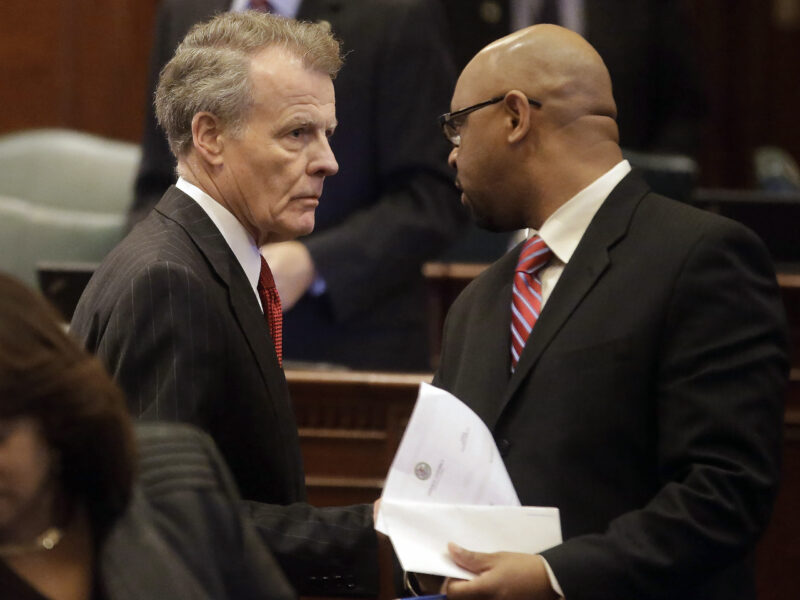
CHICAGO (CN) — The legacy of the Me Too movement continued to haunt former Illinois House Speaker Mike Madigan on Monday, with much of the morning testimony in Madigan’s ongoing federal corruption trial focused on his ex-aide Kevin Quinn.
The speaker’s office fired Quinn in February 2018 amid sexual misconduct accusations brought by former campaign worker Alaina Hampton, but Quinn’s association with Madigan’s circle didn’t end there. Madigan’s co-defendant, ex-state representative-turned-energy lobbyist Mike McClain, reached out to several Madigan associates later that year in order to secure an income for Quinn while he got back on his feet. Jurors heard Monday, as they did last week, clips from several secretly recorded 2018 calls where McClain discussed getting Quinn $1,000 each from those associates for about six months.
On one August 2018 call with ex-Illinois Democratic state Representative John Bradley, McClain floated the idea of Quinn investigating who public officials’ “sugar daddies” were. McClain suggested the work would be part of a consulting gig, in case the IRS asked any questions.
“I think you can hire him as a consultant. Because I think at the end of the day, you’re gonna write it off,” McClain told Bradley on the call.
McClain made the same suggestion on another 2018 call to former Madigan political staffer Will Cousineau, who was on the stand from last Tuesday afternoon through this Monday morning. Jurors heard that call last week.
On yet another August 2018 call jurors heard Monday, McClain asked Quinn’s brother Marty Quinn — alderman of Chicago’s 13th Ward, Madigan’s home turf — if he wanted to know what was going on with his brother.
“I’d rather stay in the dark,” Marty Quinn answered.
The same day, McClain also spoke with Madigan about the plan to help Quinn, and asked if the then-speaker wanted to speak to Marty Quinn about the issue. Like the alderman, the speaker wanted to steer clear.
“Yeah, I think I thought to stay out of it,” Madigan told McClain on the call.
Prosecutors showed the jury Monday that Quinn did receive checks from McClain, Bradley, Cousineau and two other Madigan associates — either directly or via the associates’ consulting firms — in late 2018. None of the checks jurors saw was worth less than $1,000.
Cousineau testified last week that his lobbying firm Cornerstone Government Affairs paid Quinn.
Federal prosecutors produced further evidence of the effort to pay Quinn during the testimony of FBI Agent Prince Prempeh, who took the stand Monday after Cousineau. Prempeh led a raid on Quinn’s Chicago home in May 2019, during which investigators secured consulting contracts for Quinn dating to September 2018.
The Quinn evidence was the source of major controversy between the attorneys last week, with prosecutors saying it fit within the scope of the conspiracy and racketeering claims Madigan and McClain both face. A major element of the prosecution’s case is to present Madigan as a political kingpin — head of the so-called “Madigan Enterprise” — in Springfield and Chicago, with McClain acting as his consigliere.
But the defense argued the evidence involving Quinn went beyond the scope of the government’s 2022 indictment, and would prejudice the jury over the issue of sexual misconduct in the speaker’s office. Madigan’s chief of staff Tim Mapes also resigned his post in June 2018 amid separate sexual misconduct accusations.
The defense attorneys had more success on that front during the related “ComEd Four” trial in spring 2023. Though jurors did convict McClain and three other former insiders with energy company ComEd on separate corruption charges — for their roles facilitating ComEd’s admitted attempt to sway Madigan and other state lawmakers between 2011 and 2019 — now-deceased U.S. District Judge Harry Leinenweber ruled to exclude the evidence relating to Quinn.
U.S. District Judge John Robert Blakey, who is overseeing Madigan’s trial, did not arrive at the same conclusion. He instead barred U.S. attorneys from specifying to jurors why Quinn was fired, and allowed the evidence to be presented under the stipulation that his departure from Madigan’s office was the result of “allegations of misconduct.”
On Monday afternoon, jurors heard more about the ComEd Four, which besides McClain include ex-ComEd CEO Anne Pramaggiore, ex-ComEd internal lobbyist and executive John Hooker and ex-ComEd consultant Jay Doherty, via the testimony of ComEd vice president for external affairs Keisha Parker.
Parker testified that she learned ComEd’s legislative strategy while working under Hooker, and that McClain and Hooker often worked closely together. The jury also heard more wiretapped call recordings involving the ComEd Four and how they related to Madigan.
On a May 18, 2018, call that jurors heard Monday — which the jury in the ComEd Four trial also heard — Pramaggiore broke the news to McClain that she was moving on to become CEO of Exelon Utilities, a division of ComEd’s parent company Exelon.
“It never would have happened without you and John and the speaker,” Pramaggiore said on the call, adding, “You guys have been my spirit guides.”
Madigan and McClain face multiple charges surrounding ComEd’s involvement in the Illinois legislature. Prosecutors say the former speaker, with McClain’s help, helped the energy company pass legislation it favored in exchange for jobs and contracts for members of his political circle. The trial on that and other “episodes” is expected to last several more weeks.
 Follow @djbyrnes1
Subscribe to our free newsletters
Our weekly newsletter Closing Arguments offers the latest about ongoing trials, major litigation and rulings in courthouses around the U.S. and the world, while the monthly Under the Lights dishes the legal dirt from Hollywood, sports, Big Tech and the arts.