
 Search Articles


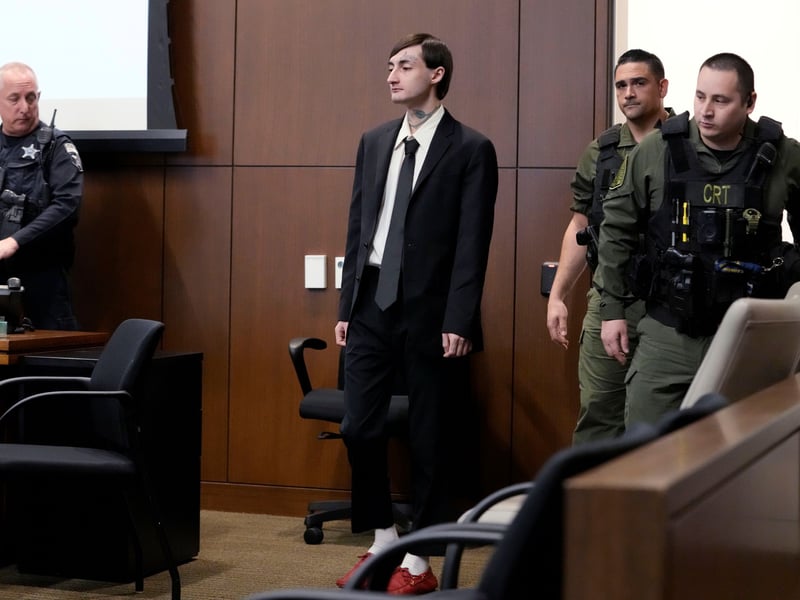
WAUKEGAN, Ill. (CN) — A Highland Park man convicted of a mass shooting at a suburban Fourth of July parade was sentenced to life in prison without parole on Thursday.
Robert Crimo III entered a guilty plea on March 3 in connection to the 2022 parade massacre that left seven people dead and dozens more injured. The 24-year-old pleaded guilty to 69 felonies, including 21 counts of murder — three counts for each person killed — and 48 counts of attempted murder. He did not appear in court alongside his attorneys on either Wednesday or Thursday.
He was initially charged with 117 felonies, which covered the aforementioned charges and 48 counts of aggravated battery, but Lake County Judge Victoria Rossetti dismissed the battery charges during jury selection.
Rossetti described Crimo as irretrievably depraved and permanently incorrigible before she announced his official sentence of seven consecutive life sentences — one for each person killed — which will be served consecutively.
In addition to the seven consecutive life sentences, Rossetti sentenced Crimo to 50 years for each of the 48 counts of attempted murder. The attempted murder charges are to be served concurrently immediately after the murder charges.
Rossetti paused in the middle of reading Crimo’s sentence and ordered a short recess, during which Crimo was seemingly going to join his attorneys in the courtroom. Rather there was a miscommunication between the jail and the attorneys, and Crimo only planned to appear before the judge to complain about not being able to access a book in the jail.
Police say Crimo dressed as a woman and put makeup over his facial tattoos to disguise himself before he started firing an assault rifle from the roof of a Central Avenue cosmetics store while overlooking the crowded parade.
Prosecutors played video footage from Crimo’s initial police interview where he described his mindset ahead of the shooting. Crimo told officers that he sat in his car and debated if he wanted to go through with the shooting. “You know, should I stay or should I go,” he said.
In the interview, Crimo appeared at ease as he described his meticulous planning ahead of the parade. Crimo said he scouted the alleyway of the Central Avenue cosmetics store almost every day, and one day during a political rally he found stairwell access to the store’s roof.
When police asked Crimo why he wanted to kill people, he didn’t have a concrete answer; he said it was like he was a zombie or sleepwalker. He also told police that he cares a lot about other people, to which the officer asked “what about the people you shot today?”
“Sometimes you’ve gotta crack a couple eggs to make an omelette," Crimo replied.
Rossetti repeatedly admonished Crimo for his callous remarks and cavalier attitude regarding the shooting.
In the initial aftermath of the shooting, authorities weren’t certain of Crimo’s motives, but noted that he shared racist and antisemitic social media posts in the days leading up to it.
“This court has absolutely no idea what the motive may have been,” Rossetti said. “But his actions tell the court that he is just a coward, hiding behind a skirt, makeup and an assault rifle.”
Bryan Bodden, a Highland Park police officer who interviewed Crimo on July 4, 2022, testified on Wednesday that Crimo repeatedly listed the names of friends of his who’d been killed by police when he was walking to the parade from his father’s Highwood home.
Bodden said Crimo spoke very matter-of-factly about the shooting. He added that Crimo told him he started enacting plans for the shooting back in 2017, and initially planned for it to happen on July 4, 2020. Prosecutors said during their closing remarks on Thursday that Crimo purchased the Smith & Wesson semiautomatic rifle he used during the July 4 shooting in February 2020.
Several other law enforcement officials and witnesses took the stand Wednesday afternoon and described the confusion and panic in the crowd of paradegoers when the gunfire started.
Gerald Cameron Jr., a retired commander with the Highland Park police department who was doing traffic and crowd control the day of the parade, said he initially thought the gunshots were fireworks or the exhaust from a vehicle.
Highland Park native Dana Ruder Ring said she and her family had been attending the Fourth of July parade for years. She recalled running into her neighbors — Erica Weeder and John Kezdy — before she heard the first gun shots ring out, which she initially assumed were fireworks.
Ruder Ring, her husband and three kids took cover in an underground parking garage. She said the garage was eerily silent, and such a stark contrast to the turmoil of the parade.
While they were in the garage, a visibly shaken woman carrying a toddler approached them. Both the boy and the woman were covered in blood, and Ruder Ring said the woman told them, “The blood’s not ours; he’s not mine,” before handing them the toddler and walking away.
Ruder Ring would later learn that boy was 2-year-old Aiden McCarthy, who lost both his parents in the shooting. She said she repeatedly asked McCarthy for his name and the only thing he could say was, “Mama dada will come get me soon.”
Weeder recounted running into Ruder Ring and her family at the parade before she heard gunshots, which she also assumed were fireworks.
Weeder said the next thing she remembers is a piercing pain and ping in her ear and the feeling of a hot rake down her back — she realized that she had been shot.
She described how she and her husband, Kezdy, who was also shot, hit the ground in opposite directions. Weeder said they lay parallel to two women and watched them bleed out.
“On that day when I shed blood in the town square, my brain was rewired,” Weeder told the courtroom Thursday morning.
She said some of her ability to bounce back from stressful events is forever gone.
“Listening to the news, I am re-traumatized listening to the next mass shooting and the next,” she said.
Karina Mendez, whose father Eduardo Uvaldo was among those killed in the 2022 parade shooting, said her dad had just retired and her family was robbed of the opportunity to give back even a fraction of what he gave them.
“My father was living the American dream and died the American nightmare,” Mendez said.
Survivors of the shooting, prosecutors and local officials vowed to pressure federal officials to make changes on the accessibility of automatic weapons.
Ashbey Beasley, a survivor of the parade shooting who became a gun violence activist, said she wants to push officials to have a uniform approach to charging offenders of mass shootings.
“This is domestic terrorism,” Beasley said. “We have to start charging shooters for what this is, which is terrorism.”
 Follow @RosenCaitlyn
Subscribe to our free newsletters
Our weekly newsletter Closing Arguments offers the latest about ongoing trials, major litigation and rulings in courthouses around the U.S. and the world, while the monthly Under the Lights dishes the legal dirt from Hollywood, sports, Big Tech and the arts.