
 Search Articles


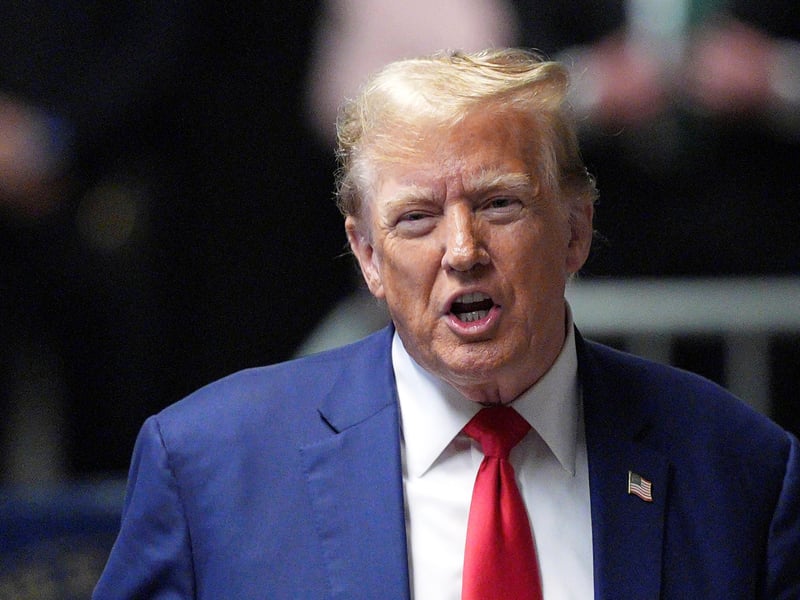
MANHATTAN (CN) — A New York judge on Monday declined to toss President-elect Donald Trump’s hush money conviction after Trump claimed he should be immune from prosecution due to the U.S. Supreme Court’s recent ruling for broad presidential immunity.
New York Supreme Court Justice Juan Merchan found that the evidence presented by Manhattan prosecutors in this case was not related to Trump’s official actions as president.
“This court further finds that the evidence related to the preserved claims relate entirely to unofficial conduct and thus, receive no immunity protections,” Merchan wrote in a 41-page ruling released Monday.
Earlier this year, a Manhattan jury found Trump guilty of 34 felony counts of falsifying business records. Prosecutors argued that the crimes were part of a broader scheme to bury bad press related to his 2016 presidential campaign.
A month later, the Supreme Court ruled that former presidents have absolute immunity for official acts. Trump then argued that certain evidence should have been withheld from his case since it concerned, what he said, were official acts he took during his first presidential term.
Trump pointed to testimony from Hope Hicks, one of his top White House aides, and several social media posts he made during his presidency.
But Merchan was unpersuaded, finding that prosecutors’ use of that evidence “poses no danger of intrusion on the authority and function of the executive branch.”
The judge added that, even if including that evidence was proven erroneous, “such error was harmless in light of the overwhelming evidence of guilt.”
“Today’s decision by deeply conflicted, acting Justice Merchan in the Manhattan DA Witch Hunt is a direct violation of the Supreme Court’s decision on immunity, and other longstanding jurisprudence,” Trump’s Communications Director Steven Cheung said in a statement.
Trump defense attorney Todd Blanche, whom Trump tapped to be the U.S. Deputy Attorney General, didn’t immediately respond to a request for comment; neither did the Manhattan District Attorney’s office.
Merchan also sent a letter to both parties on Monday, in which he alluded to new sealed allegations from Trump’s lawyers reagarding juror misconduct. He didn’t delve into details, but more information may become available in the near future, as Merchan directed the attorneys to file submissions on the issue in the public docket — albeit with redactions.
The judge’s ruling Monday puts to bed one of several strategies Trump has tested to have his guilty verdict vacated and the entire case tossed.
After he won the presidential election in November, Trump’s lawyers scrambled to file an additional motion to dismiss the case, once more citing presidential immunity, as well as the supremacy clause. This time, they claimed that Trump cannot continue to be prosecuted in this case as it would interfere with his impending return to the White House.
“The sitting president may not be subject to any phase of a criminal proceeding as a defendant,” Trump argued in the Dec. 3 motion.
Merchan has yet to rule on that motion. But prosecutors have noted that Trump is not yet the sitting president and that “president-elect immunity does not exist.”
Despite his guilty verdict at the end of May, Trump thus far has managed to avoid sentencing by repeatedly making presidential immunity arguments and delaying hearings.
He faces potential jail time. But as it stands, Trump’s sentencing is indefinitely delayed. It is becoming increasingly unlikely that he will be sentenced before his inauguration on Jan. 20, 2025.
Manhattan District Attorney Alvin Bragg has floated the possibility of staying Trump’s sentencing for the entirety of his incoming four-year presidential term. He has also proposed terminating the sentencing altogether without dismissing the case, as to keep the jury’s historic verdict intact.
Trump is the first president, current or former, in U.S. history to be charged with or found guilty of a crime.
 Follow @Uebey
 Follow @uebey.bsky.social
Subscribe to our free newsletters
Our weekly newsletter Closing Arguments offers the latest about ongoing trials, major litigation and rulings in courthouses around the U.S. and the world, while the monthly Under the Lights dishes the legal dirt from Hollywood, sports, Big Tech and the arts.