
 Search Articles


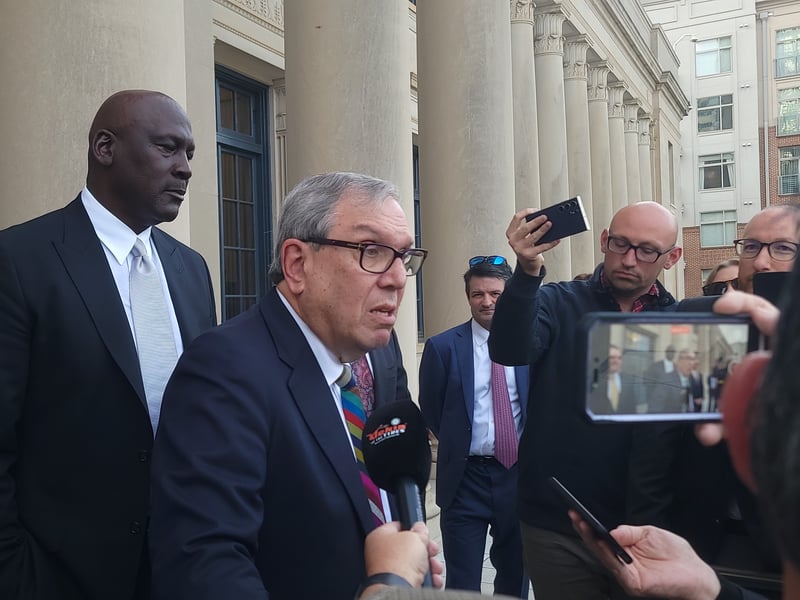
CHARLOTTE, N.C. (CN) — For now at least, NASCAR will not be forced to allow two teams suing the company to participate in NASCAR races, a judge ruled on Friday afternoon.
Front Row Motorsports and 23XI Racing — the latter team partially owned by basketball legend Michael Jordan — sued the sports racing giant in October, claiming that it was violating antitrust laws by requiring participating teams to sign anticompetitive contracts to race and that it had a monopoly on the stock car racing industry.
Both parties argued before U.S. District Judge Frank Whitney on Monday. The teams had requested a preliminary injunction, which would have required NASCAR to allow them to sign temporary agreements to compete during the next season. They also wanted NASCAR to release them from a provision in those agreements that would kill their antitrust claims.
Jeffrey Kessler, who is representing both plaintiffs, argued that not being able to compete during pending litigation may kill the racing companies. But Whitney nonetheless dismissed their request for the court to interfere, saying the teams didn’t require extraordinary remedy.
“Although Plaintiffs allege they are on the brink of irreparable harm, the 2025 racing season is months away — the stock cars remain in the garage,” Whitney, a George W. Bush appointee, wrote in his order.
The 2025 Cup Series is expected to start in February. Whitney said that despite his denial, the case would be fast-tracked on the court’s calendar.
23XI Racing and Front Row Motorsports wanted the courts to force NASCAR’s hand because they said NASCAR could choose to not allow them to compete. They said that not having a new charter agreement (that is, a racing contract) would allow their drivers and sponsors to leave.
While the teams argued they may not survive without intervention, they didn’t argue it would be impossible, Whitney noted. The potential possibility of losing sponsors is too speculative for the court to issue an injunction, he wrote.
“At this stage, the teams are no closer to irreparable harm than they are to the command, ‘Drivers, start your engines,’ at the first race of the 2025 season,” he said. “Accordingly, ’the proper conclusion to draw is that [Plaintiffs have] failed to make the clear showing required.’”
Kessler said Monday that the key date for the teams is January 1, when new charter agreements between participating teams and NASCAR will begin. The teams have a charter agreement with NASCAR that expires at the end of the year, and they’ve sought to resolve the dispute so the teams can compete next season.
In order for the teams to compete they need to sign one of two agreements: either an open agreement in which they’re excluded from merchandising and broadcasting profits, or a new charter agreement where they get a cut of the profits and guaranteed entry into races.
Both 2025 agreements include a provision that would exclude the teams from suing NASCAR for future actions. That has thus far prevented the teams from signing.
In court Monday, Christopher Yates, representing NASCAR and its CEO James France, argued that the court shouldn’t force NASCAR to sign an agreement with the teams.
“NASCAR only wants to enter into charter contracts with teams who want to further the sport,” he said. He argued the teams’ decision not to sign new agreements was entirely on them.
The possibility that NASCAR may decide to exclude open teams is speculative, Whitney wrote, because plaintiffs could sign open agreements today if they didn’t take issue with the provision preventing them from suing NASCAR.
In their suit, the plaintiffs claim that NASCAR has monopolized the stock car racing industry and restrained competition, violating the Sherman Act.
In order to participate in stock car racing, they have to sign NASCAR’s contracts or leave the industry altogether, they say. Transitioning to other types of racing, such as Formula One, isn’t an option because it would require new cars and drivers.
“We literally cannot practice our profession without this release,” Kessler said Monday — arguing that since the introduction of charter agreements, no team has been able to operate under an open agreement for an entire season.
Representatives for NASCAR and Front Row Motorsports did not respond to a request for comment, nor did attorneys for either party.
 Follow @SKHaulenbeek
 Follow @shaulenbeek.bsky.social
Subscribe to our free newsletters
Our weekly newsletter Closing Arguments offers the latest about ongoing trials, major litigation and rulings in courthouses around the U.S. and the world, while the monthly Under the Lights dishes the legal dirt from Hollywood, sports, Big Tech and the arts.