
 Search Articles


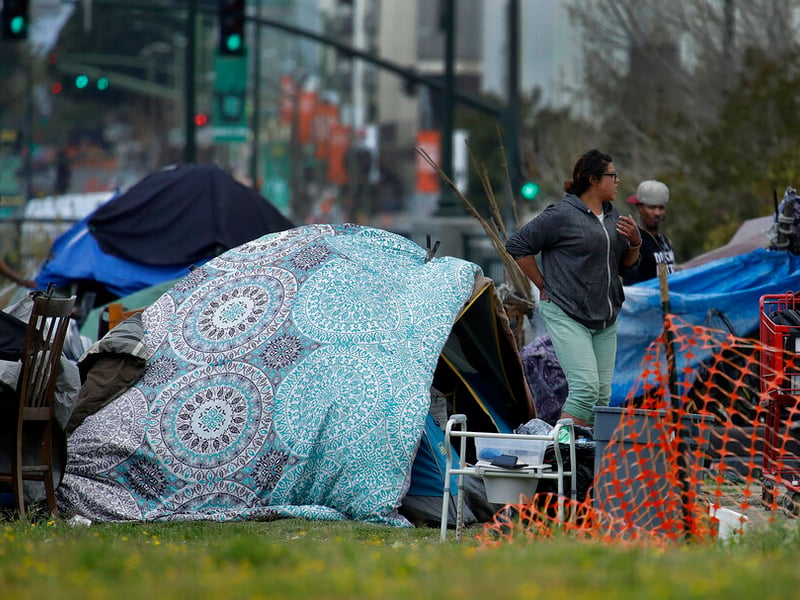
SAN FRANCISCO (CN) — A federal judge allowed several claims against Berkeley to move forward in a case filed by a class of disabled homeless people who say the city violated the Americans with Disabilities Act and the Constitution when it cleared a large homeless encampment and destroyed their property.
The plaintiffs — several homeless individuals and the homeless advocacy organization Where Do We Go Berkeley — claim that throughout the city’s abatements, evictions and treatment of disabled homeless persons, the city has violated the Fourth Amendment’s prohibition against unreasonable search and seizure, the Fair Housing Amendments Act, and the plaintiffs’ due process rights by placing them in a state-created danger.
U.S. Senior District Judge Edward Chen denied the city’s request to dismiss the plaintiff’s second amended complaint over organizational standing, finding that the city’s policies and enforcement practices caused “concrete, operational impairments to WDWG’s core service.”
“The city’s abatements and sweeps disrupt WDWG’s client-tracking and service delivery systems, forcing diversion of staff time to locate displaced clients and re-establish care, ultimately expending time and resources that would otherwise have been used to ‘assist additional unhoused people that it had not previously assisted,’” the Barack Obama appointee wrote.
He added: “Because the city’s abatement activities directly interfere with WDWG’s core activities, forcing it to expend greater time and material resources in response, WDWG has asserted an adequate injury to support standing.”
Chen also partially denied the city’s request to dismiss three disability discrimination claims: failure to assist in moving personal property, shelters’ no-visitor policy and enforcement of the 72-hour parking rule.
In the case of Erin Spencer, a disabled plaintiff who suffers from injuries that limit his ability to lift, carry and move objects, Chen noted that Spencer requested accommodations on several occasions related to planned abatements, including “requests for additional time and assistance with moving items due to his physical disabilities.”
“Plaintiff Erin Spencer alleges a concrete disability, explicit requests for accommodation or constructive notice of the need for accommodations, the city’s knowledge and refusal to accommodate, and resulting exclusion from or unequal treatment in city programs. At this stage, those allegations suffice to proceed,” he said.
As for the city’s no-visitor policy for shelters, Chen advanced claims in respect to Monique Williams, a plaintiff who has mental health disabilities and physical injuries that affect her hip and arm. Williams claims she relies on her daughter for caregiving, and requested an accommodation to the city’s no-visitor rule so her daughter could visit. She says that the city did not grant her request or “engage in any interactive process” to identify a reasonable accommodation.
“Even if the city ultimately could have offered alternative arrangements, for instance, off-site support, its failure to even consider or discuss any reasonable accommodations after receiving a request could plausibly constitute a violation of the ADA,” Chen said.
However, Chen dismissed claims brought by plaintiff Yessica Prado, who lives in an RV and has been diagnosed with PTSD and ADHD, ruling that Prado did not explain why her mental health required in-person visits at the shelter.
“The SAC’s generalized assertions that community interactions are therapeutic for her PTSD do not, by themselves, establish that the city’s no-visitor rule denied her equal access to shelter by reason of her disability,” he said.
Chen also dismissed Prado and other plaintiff Amber Whitson’s claims contesting the city’s 72-hour parking rule, which prohibits drivers from parking vehicles for more than 72 consecutive hours.
Whitson, who has mental and physical disabilities, some of which cause extreme back and leg pain, lives in an RV and says she has been ticketed due to her inability to move her vehicle every 72 hours.
“The SAC does not allege specific facts showing that Ms. Whitson requested an accommodation related to the 72-hour parking rule, and Ms. Prado’s claim falls short because her challenge does not convincingly connect her disability with a need for an accommodation to the 72-hour parking rule,” Chen said.
While Chen granted Whitson leave to amend her claim, he did not do not same for Prado.
Finally, Chen dismissed the plaintiff’s state-created danger claim under state law and denied the plaintiffs’ request to amend or substitute new plaintiffs.
“Here, plaintiffs have already filed three complaints, and the court has provided clear and detailed instructions expressly laying out how plaintiffs can avoid dismissal with their SAC,” he said.
He continued: “Dismissal here does not threaten to moot the entire class action. Plaintiffs’ vague, contingent request to add unnamed class members is unnecessary and procedurally improper.”
Representatives for either party did not immediately respond to a request for comment.
 Follow @mhattridge_
Subscribe to our free newsletters
Our weekly newsletter Closing Arguments offers the latest about ongoing trials, major litigation and rulings in courthouses around the U.S. and the world, while the monthly Under the Lights dishes the legal dirt from Hollywood, sports, Big Tech and the arts.